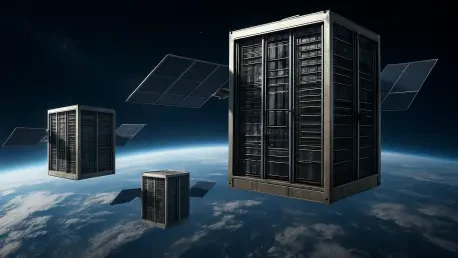

The seemingly limitless growth of artificial intelligence is colliding with a very terrestrial problem: an insatiable and fundamentally unsustainable demand for energy that threatens to throttle innovation. As the computational needs of advanced AI models continue their exponential rise, the world’s data centers are straining power grids and depleting water resources, creating a critical bottleneck. In response to this impending crisis, some of the world’s most influential technology corporations and innovative startups are turning their gaze upward, pioneering a radical solution that moves the very heart of digital infrastructure from the ground into the vast, resource-rich expanse of space. This strategic pivot marks the beginning of a new technological frontier, one where the future of computing will be forged in orbit.
The Terrestrial Dilemma and the Orbital Solution
The central catalyst for this cosmic migration is the escalating resource crisis fueled by AI on Earth. Terrestrial data centers have become colossal consumers of electricity and water, with their energy footprint expanding at an alarming rate. Projections indicate that data center electricity consumption in the United States, which accounted for over 4% of the nation’s total in 2024, could triple to a staggering 12% by 2028. On a global scale, the demand is forecast to nearly double by 2030, reaching up to 980 terawatt-hours annually. This voracious appetite for power, coupled with the immense volumes of water required for conventional cooling systems, is creating an environmental and logistical impasse that directly threatens the continued development and deployment of next-generation artificial intelligence, making alternative infrastructure models not just an option, but a necessity.
In stark contrast to Earth’s finite resources, space presents a uniquely elegant and scalable solution to these fundamental limitations. Orbit offers two critical advantages that are impossible to replicate on the ground: a source of near-constant, abundant solar energy and an ideal environment for natural, passive cooling. Solar panels operating in space, free from atmospheric interference, day-night cycles, or inclement weather, can achieve an energy-generating efficiency up to eight times greater than their terrestrial counterparts. This allows for the continuous generation of clean power for compute-intensive tasks. Simultaneously, the vacuum of space, with temperatures approaching absolute zero, serves as a perfect heat sink. The immense thermal energy produced by powerful processors can be radiated directly into the void, completely eliminating the dependency on the water-guzzling cooling systems that are a major operational and environmental cost for data centers on Earth.
A New Space Race Begins
The transition toward orbital computing is no longer a theoretical exercise; it has entered a dynamic phase of active development, led by both established technology behemoths and agile newcomers. Google has publicly embarked on “Project Suncatcher,” an ambitious research initiative focused on creating the blueprints for orbital data centers. The company is charting a course to launch two prototype satellites by early 2027, which will be equipped with its proprietary Tensor Processing Units (TPUs) specifically optimized for AI workloads. A cornerstone of Google’s design is the innovative use of laser links for inter-satellite communication, which will establish a high-speed, wireless data network in space, demonstrating a serious commitment from industry leaders to validate and pioneer this transformative infrastructure.
While the tech giants are investing in long-term research, nimble startups are already achieving significant milestones and proving the concept’s viability. Starcloud, a venture backed by industry heavyweight Nvidia, made history in late 2025 with the successful launch of its Starcloud-1 satellite. This groundbreaking prototype, carrying an Nvidia #00 GPU, became the first-ever platform to train and operate an AI model while in orbit. Beyond this initial success, Starcloud’s long-term vision is far more expansive, proposing the construction of a massive orbital data center powered by a 5-gigawatt solar array spanning several kilometers. This emerging field has also captured the attention of the new titans of the space industry. SpaceX is actively exploring methods to integrate high-performance compute hardware into future satellite designs, leveraging its Starlink constellation and its reusable rocket technology, which is critical for reducing launch costs and enabling large-scale deployment.
A Global Contest for Cosmic Supremacy
This burgeoning technological revolution is not confined to the United States but has ignited a global race for supremacy in space-based computing, now widely viewed as a matter of strategic national infrastructure. China has entered the field with its highly ambitious “Three-Body Computing Constellation” project. This initiative aims to deploy a network of thousands of satellites equipped with high-performance GPUs, targeting a combined computing capacity of 1,000 peta-operations per second (POPS). Such a performance level would rival, and in some cases exceed, the capabilities of many of the world’s most powerful terrestrial supercomputers, underscoring the geopolitical significance attached to leadership in this domain. This international competition signals that orbital data infrastructure is becoming a critical component in the future balance of technological power.
The competitive landscape is further enriched by a diverse ecosystem of private enterprises and specialized startups, each contributing to the development of this new market. Companies like PowerBank Corporation and Orbit AI are actively developing their own proprietary orbital cloud services, aiming to offer space-based computing solutions to a global clientele. In a significant convergence of space industry sectors, the private space station company Axiom Space has announced plans to incorporate dedicated data center modules into its commercial station, with a target deployment date of 2027. This integration of computing infrastructure into human-rated space habitats illustrates the broadening scope and perceived long-term viability of maintaining and operating critical digital assets in orbit, moving beyond standalone satellites toward a more integrated cosmic ecosystem.
Overcoming Orbital Obstacles
Despite the immense promise of orbital data centers, the path toward their full realization is fraught with significant engineering and logistical hurdles that must be overcome. The harsh, unforgiving environment of space presents unique and formidable challenges. Cosmic radiation poses a constant threat, capable of corrupting stored data and causing physical damage to sensitive electronic components like GPUs. This necessitates the development of robust radiation shielding and the implementation of complex, redundant hardware systems to ensure reliability and data integrity. Furthermore, while the vacuum of space offers an ideal medium for cooling, efficiently dissipating highly concentrated heat from powerful processors requires sophisticated radiative systems, a non-trivial engineering problem that is critical to the long-term operational stability of these orbital facilities.
Beyond the immediate technical challenges, broader logistical and environmental risks loom large. The growing problem of space debris poses a constant and serious collision risk, a threat that is particularly acute for the proposed large-scale, multi-kilometer structures like massive solar arrays. A significant collision could not only disable a critical asset but also exacerbate the Kessler syndrome, a cascading chain reaction of debris creation that could render certain orbits unusable. Ultimately, the primary barrier remains the prohibitive cost of launching mass into orbit. However, optimistic industry projections suggest that the continued development of reusable rocket technology could drive launch costs down to approximately $200 per kilogram by the mid-2030s, a crucial economic tipping point that would finally make the large-scale deployment of orbital data centers not just technologically possible, but commercially feasible.
A New Digital Foundation
The convergence of advanced artificial intelligence with innovative space technology has clearly marked a strategic pivot for the entire computing industry. Driven by the urgent need to overcome the terrestrial limitations of energy and cooling, the concept of orbital data centers rapidly transitioned from science fiction into a tangible, albeit challenging, reality. The successful prototype launches and the ambitious roadmaps laid out by a growing roster of international competitors signaled a powerful and accelerating trend. These early efforts established the foundational work necessary to prove that the final frontier was indeed the next logical step for humanity’s digital infrastructure, setting the stage for a future where the boundless energy of space would power the next evolution of intelligence.