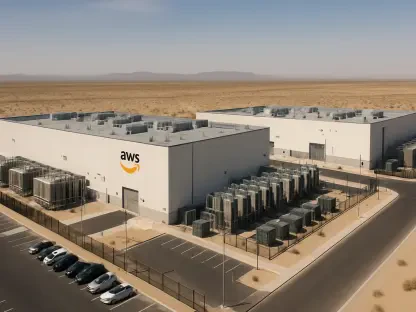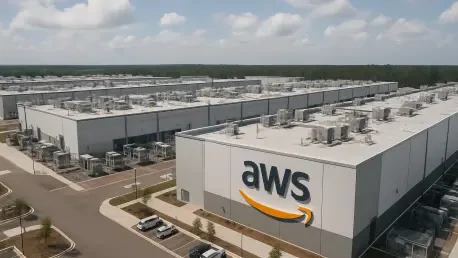

In a move signaling a profound transformation in the digital economy, Amazon is strategically allocating approximately $200 billion in capital expenditure, with a significant portion earmarked to fortify and expand its cloud computing division, Amazon Web Services. This monumental investment serves as a direct and aggressive response to the unprecedented demand for cloud capacity, a surge fueled by the rapid and widespread adoption of artificial intelligence by enterprises across the globe. The spending initiative, articulated by company leadership, not only addresses the immediate capacity crunch but also positions AWS to capture what is seen as a generational growth opportunity. This plan underscores a critical market reality: the ability to provide immense, readily available computational power has become the new benchmark for leadership in the cloud industry, fundamentally reshaping the competitive landscape and the strategic priorities of its largest players.
A Paradigm Shift in Cloud Infrastructure
The foundational driver for this massive capital outlay is the fundamental shift in cloud computing requirements precipitated by the AI revolution. Unlike the predictable, transactional workloads of traditional cloud applications, modern AI systems—particularly those involving the training of large machine learning models and the deployment of generative AI—are exceptionally resource-intensive. These workloads consume computational power and networking resources at a scale that strains existing cloud infrastructure, creating a bottleneck for innovation. The demand is not isolated to tech giants developing foundational models; it extends to a vast ecosystem of businesses leveraging cloud platforms for sophisticated AI-driven analytics, advanced automation software, and intelligent customer-facing systems. For many organizations, the primary constraint preventing them from moving AI projects from experimental stages to full-scale operational use is no longer a lack of algorithms or data, but a scarcity of available, high-performance computing capacity.
This new reality necessitates a holistic and far-reaching expansion of the entire data center ecosystem, moving well beyond simply adding more servers to racks. To keep pace with the voracious appetite of AI, cloud providers are now engaged in a complex build-out that includes acquiring vast tracts of land for new data center campuses, securing enormous and reliable power supplies to fuel energy-hungry AI processors, and engineering advanced cooling systems to manage the intense heat generated by these high-density compute environments. Furthermore, this expansion involves a critical pivot toward specialized hardware. Amazon is doubling down on its proprietary custom silicon, such as its Trainium chips for model training and Inferentia chips for inference. These specialized processors are designed to handle machine learning tasks more efficiently and cost-effectively than general-purpose CPUs, representing a strategic effort to optimize both performance and the underlying economics of providing AI as a service at an unprecedented scale.
The Accelerating Hyperscaler Capacity Race
Amazon’s strategic spending is not occurring in a vacuum but is a definitive move in a new, high-stakes “capacity race” among the major cloud providers, often referred to as hyperscalers. Key competitors, including Microsoft and Google, are similarly injecting billions of dollars into their own global data center footprints and proprietary AI hardware initiatives. This parallel investment pattern reflects a powerful industry consensus that the enterprise appetite for AI is not a fleeting trend but a permanent and exponentially growing driver of demand. The defining characteristic of this new era of competition is the sheer velocity and scale required to stay relevant. AI workloads can scale unpredictably and explosively once deployed, compelling providers to engage in sophisticated, long-term capacity planning—often years in advance—to preemptively address potential chokepoints and ensure they can meet customer needs without delay or disruption.
This intense competition is reshaping the value proposition of cloud services, moving the focus from a wide array of software features to the fundamental, non-negotiable ability to provide sufficient and readily available computational power. While the quality of AI services and development tools remains important, the primary differentiator is increasingly becoming access to the raw infrastructure needed to run them. In this environment, the ability to guarantee customers access to thousands of specialized AI accelerators on demand is a more potent competitive advantage than a marginal improvement in a software-as-a-service offering. This dynamic elevates infrastructure from a background utility to the main event, where long-term investments in physical assets—data centers, power grids, and custom silicon—will determine market leadership for the next decade and beyond, shaping which platforms can credibly support the future of enterprise AI.
Redefining the Future of Enterprise Technology
The profound implications of this investment wave extended far beyond the balance sheets of cloud providers, signaling a new chapter for their enterprise customers. This large-scale capital commitment confirmed that cloud-based AI was no longer a niche capability but a critical and permanent fixture of digital transformation strategies across every industry. This realization influenced how companies approached their own technology roadmaps, encouraging them to design new systems around the powerful, scalable AI services offered by hyperscalers rather than attempting to build and maintain prohibitively expensive in-house compute facilities. The sheer scale of the infrastructure being built by providers like Amazon made it clear that achieving competitive AI performance would increasingly depend on leveraging the economies of scale that only the largest cloud platforms could offer.
Consequently, the reliability and availability of cloud infrastructure escalated from a technical consideration to a board-level operational concern. As more core business processes—from supply chain optimization and financial modeling to customer service and product development—became dependent on AI systems running in the cloud, uptime and consistent performance were paramount. Amazon’s strategic plan was a clear effort to get ahead of this curve, aiming to ensure that sufficient capacity would exist as enterprise AI adoption matured from early experiments to mission-critical deployments. The success of this massive investment cycle determined whether companies experienced accelerated AI deployment timelines or if infrastructure constraints continued to be a primary limiting factor in their pursuit of innovation and competitive advantage in an increasingly automated world.