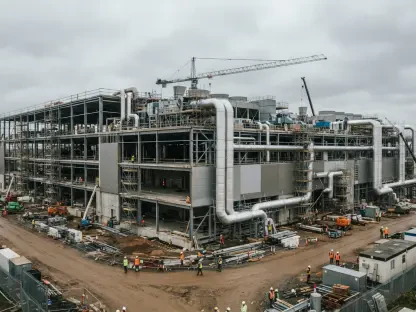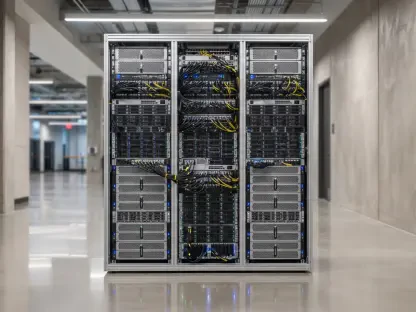

Amazon anticipates spending approximately $220 billion on capital expenditures by 2026 to secure its position in the increasingly competitive artificial intelligence market. This staggering financial commitment follows a pivotal period where the tech giant’s financial architecture underwent a profound transformation, shifting from a retail-centric model to an infrastructure-heavy powerhouse. Recent performance data reveals a striking divergence between operational excellence in the cloud and the fiscal gravity of modern computing. While Amazon Web Services has historically been the primary profit engine, the current trajectory requires a level of investment that challenges traditional valuation metrics. Investors are now witnessing a high-stakes gamble where billions of dollars in liquidity are being converted into physical silicon and concrete. This strategic pivot aims to ensure that the company remains at the forefront of the generative AI boom, even as the immediate cost of entry pressures the balance sheet and dictates new fiscal realities across the entire sector.
Cloud Sector Dynamics and Market Share
Comparing Growth Against Major Industry Rivals
The dominance of Amazon Web Services within the internal ecosystem has never been more apparent, with the segment producing an astounding $17.8 billion in operating income during the recent reporting cycle. Despite accounting for less than a quarter of total revenue, AWS effectively bankrolled the entire corporation’s innovation pipeline by contributing over 60 percent of its total operating income. This efficiency is highlighted by a record-setting operating margin of 38.7 percent, demonstrating that the cloud division can maintain extreme profitability even as it expands its global footprint. However, the broader market landscape reveals a competitive environment where being successful is no longer sufficient to satisfy expectations. While a 39 percent revenue increase for AWS is a landmark achievement, it is being measured against the hyper-growth of rivals like Microsoft Azure and Google Cloud, which reported 48 percent and 100 percent growth respectively, suggesting a shift in momentum.
Analyzing Backlog and Revenue Resilience
The demand for cloud services shows no signs of waning, as evidenced by a massive backlog of future contracted revenue that has climbed to $578 billion. This figure represents a significant commitment from global enterprises that are locking in long-term partnerships to leverage Amazon’s vast computing resources, suggesting that the fundamental appetite for cloud capacity is outpacing the current supply. Management argues that the speed at which customers are adopting these new capabilities justifies the expense, noting that capacity is being utilized almost as quickly as it can be brought online. By establishing this massive physical foundation now, Amazon aims to lock in a tier of service that smaller competitors cannot match due to the immense barriers to entry. The strategy is built on the belief that once the foundational AI models are integrated into the AWS ecosystem, the resulting stickiness of the customer base will allow for significant margin expansion and long-term dominance for the next several years.
The Financial Impact of AI Infrastructure
Rising Capital Expenditures and Debt Management
The most significant shift in the financial narrative centers on the dramatic movement in free cash flow, which has swung toward a substantial $42.4 billion outflow. This pivot marks a departure from the cash-generating machine investors had grown accustomed to, reflecting the brutal capital requirements of the generative AI era. To support the relentless demand for training and inference, Amazon has ramped up its purchases of property and equipment, spending nearly $95 billion over the trailing twelve months. This aggressive investment strategy is not a temporary spike but rather a calculated baseline for future operations. The expansion of global data center footprints requires not only specialized hardware but also massive investments in power infrastructure and cooling technologies. This transition into a more capital-intensive business model signifies that the company is prioritizing long-term infrastructure dominance over short-term liquidity, betting that the technological advantage will yield returns.
How Did These Investments Impact Liquidity?
To navigate this period of intense capital deployment without depleting operational reserves, the company has turned toward a sophisticated strategy in the global debt markets. By issuing over $92 billion in bonds recently, the corporation is leveraging its strong credit rating to secure the necessary funding for its ambitious AI projects. This shift toward long-term borrowing allows for a more stable approach to infrastructure development, insulating day-to-day operations from the massive cash requirements of data center construction. The strategic use of international debt markets also provides a hedge against currency fluctuations and diversifies the investor base, ensuring that the company has access to capital regardless of regional economic shifts. While this increases the overall leverage on the balance sheet, the low interest rates secured on much of this debt make it a cost-effective way to fuel growth that is expected to far outpace the cost of the borrowed capital through the current market cycle.
Strategic Implications for Long-Term Market Positioning
The path forward for major stakeholders required a careful reassessment of how modern technology giants managed the transition into the age of artificial intelligence. It was clear that the traditional metrics of free cash flow were temporarily superseded by the necessity of building out a global physical infrastructure that could handle unprecedented computational loads. For analysts and investors, the key takeaway from this period was the importance of evaluating the revenue backlog alongside the capital burn, as the former provided a more accurate picture of future demand than the current cash balance. Successful navigation of this landscape involved a focus on how well the company integrated AI capabilities into its existing high-margin advertising and cloud segments to offset the costs of debt. Ultimately, the decision to prioritize long-term dominance over short-term fiscal metrics set a new standard for how companies in the sector approached large-scale technological shifts, emphasizing that infrastructure was the ultimate moat.