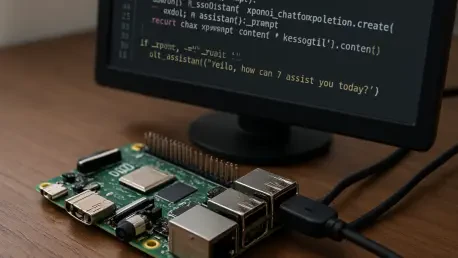

A recent breakthrough by software engineer Mario Zechner has demonstrated that a fully functional AI coding assistant can operate entirely on a Raspberry Pi 5, a compact single-board computer, signaling a significant departure from the industry’s reliance on massive, cloud-based infrastructure. This accomplishment directly challenges the prevailing narrative that powerful artificial intelligence tools are the exclusive domain of large corporations with vast computational resources, offering instead a compelling vision for a future where software development is enhanced by private, affordable, and decentralized AI. By running offline without any need for an internet connection, this project not only prioritizes data sovereignty but also opens the door for high-quality development tools in environments where connectivity is unreliable or nonexistent. It stands as a powerful proof of concept that practical, effective AI can be deployed on consumer-grade hardware, fundamentally shifting the conversation around the accessibility and ownership of sophisticated coding assistants.
The Self-Contained AI Stack
The system functions as a direct, locally hosted alternative to prominent cloud-based solutions like GitHub Copilot and Amazon CodeWhisperer, providing developers with real-time code suggestions, bug detection, and refactoring capabilities from within their existing development environment. Its defining characteristic is its complete operational independence; since all processing occurs on the device itself, no proprietary code is ever transmitted to external servers. This architecture guarantees absolute data privacy, a critical requirement for many enterprise workflows. While the response times, averaging between two and eight seconds, are slower than the near-instantaneous feedback from cloud counterparts, they are well within an acceptable range for many development tasks. This slight delay is often considered a worthwhile trade-off for the immense benefits of zero ongoing subscription fees, immunity to network outages, and the assurance of complete data control.
The technical foundation of this innovative project is a carefully curated stack of open-source technologies, each selected for its efficiency and ability to perform within the significant constraints of the Raspberry Pi 5’s 8GB of RAM. At its heart is the DeepSeek Coder V2 Lite, a sophisticated 16-billion-parameter language model specifically engineered for code generation and analysis. To execute this model, the system relies on llama.cpp, a highly optimized C++ inference engine renowned for its ability to run large language models on consumer-level CPUs without a dedicated GPU. For seamless integration into a developer’s daily routine, a custom extension was created for the popular Visual Studio Code editor. This allows the AI assistant to provide its insights directly within the coding window, creating a self-contained ecosystem that is both powerful and unobtrusive, enabling developers to leverage AI assistance without altering their preferred workflow or compromising on security.
Overcoming Hardware Hurdles
The most formidable technical obstacle was fitting a capable AI model and its entire operational framework within the Raspberry Pi 5’s limited 8GB of memory. This feat of engineering required a multi-pronged approach involving aggressive optimization techniques designed to manage scarce resources effectively. With the operating system, the VS Code editor, and the inference engine all competing for the same pool of RAM, every megabyte had to be meticulously accounted for to prevent system instability and ensure a smooth user experience. The challenge was not merely to make the model run but to make it run reliably during prolonged coding sessions, where memory demands can fluctuate significantly. This necessitated a departure from standard deployment practices and the development of custom solutions tailored specifically to the hardware’s limitations, turning a seemingly impossible task into a practical reality.
To navigate these memory constraints, several key strategies were implemented. First and foremost, 4-bit quantization was applied to the DeepSeek Coder V2 Lite model, a process that reduces the numerical precision of the model’s weights. This single step decreased its memory footprint by approximately 75% with only a negligible impact on its coding performance, retaining about 95% of the original model’s accuracy. Second, aggressive context window management was employed to limit the amount of surrounding code the AI model analyzes when generating a suggestion, thereby reducing the memory required for each request. Finally, a custom caching system was developed to intelligently keep the most frequently used parts of the AI model in fast RAM while swapping less-utilized components to the Raspberry Pi’s slower microSD card storage. This dynamic memory handling was crucial for maintaining system stability and proving that high-performance AI can operate on low-cost hardware.
The Case for Local AI
This project carries profound implications for enterprise development, particularly in industries where data privacy and security are paramount concerns. By ensuring that all code analysis and generation happen locally, the system completely eliminates the risks associated with transmitting proprietary or sensitive intellectual property to third-party servers. This directly addresses major corporate anxieties, such as the potential for inadvertent data leaks that have been documented with cloud-based AI tools. For organizations in highly regulated sectors like finance, healthcare, and defense, which must comply with stringent data protection laws such as GDPR and HIPAA, a fully offline solution is not merely preferable but often an essential requirement for maintaining legal and regulatory compliance. It provides a secure, auditable environment where innovation can proceed without compromising on security protocols.
Beyond the security advantages, the financial argument for a local AI assistant is equally compelling. The economic model starkly contrasts the recurring subscription fees of services like GitHub Copilot, which can become a significant operational expense, with the one-time hardware cost of this solution. For a hypothetical development team of 50, the annual cost for a business-tier cloud AI service would amount to over eleven thousand dollars. In comparison, outfitting the same team with a Raspberry Pi 5 setup would represent a one-time capital expenditure of approximately $7,500, achieving a full return on investment in under eight months. This dramatic cost-effectiveness makes local AI assistants a highly attractive and sustainable option for startups, educational institutions, and large organizations seeking to reduce operational expenditures without sacrificing access to modern development tools.
Acknowledging the Trade-Offs
Despite its innovative design, this system is not a universal replacement for its more powerful, cloud-based competitors. Its limitations are inherently tied to the constraints of the underlying hardware. The 16-billion-parameter DeepSeek model, while remarkably capable for its size, is significantly smaller than the state-of-the-art models powering services like GitHub Copilot, which are believed to leverage architectures with hundreds of billions of parameters. This size disparity is reflected in the quality and complexity of the AI’s suggestions. The local system excels at routine, well-defined tasks such as autocompleting code, generating boilerplate templates, and performing simple refactoring. However, it struggles with more abstract and complex reasoning, such as proposing high-level architectural designs or optimizing intricate algorithms, which remain the strength of larger, cloud-hosted models.
Furthermore, the memory constraints of the Raspberry Pi necessitate a smaller context window, meaning the AI can only analyze a few hundred lines of surrounding code at any given moment. Cloud-based systems, with access to virtually limitless computational resources, can analyze thousands of lines or even entire codebases, allowing them to provide more contextually aware and relevant suggestions, especially within large, complex projects. The 3-5 second inference delay can also disrupt the seamless, instantaneous “flow state” that many developers have come to expect from modern AI assistants. The system requires a more deliberate coding style, where a developer might pause and explicitly wait for a suggestion rather than having it appear fluidly as they type, making it better suited for those who approach AI assistance as a discrete, intentional step in their creative process.
The Future of Decentralized Development
Mario Zechner’s project served as a landmark technical demonstration that has already begun to influence the broader AI landscape. By building the entire system on open-source components—from the freely available DeepSeek model to the llama.cpp engine—it has provided a powerful blueprint for a more democratized AI future, effectively breaking the dependency on a few large technology corporations. This open foundation has catalyzed community engagement, with other developers launching derivative projects that explore different hardware platforms, test alternative models, and adapt the system for a wider range of programming languages. This collaborative innovation underscored a key trend: the rapid advancement of smaller, more efficient language models designed specifically for resource-constrained environments, a capability that was almost unimaginable just a few years prior. The project proved that useful, private, and affordable AI coding assistance could be liberated from the data center and run on a device that fits in one’s pocket. While it was best suited for use cases where privacy, cost, or connectivity were primary concerns, it expanded the imaginative boundaries of software development. It offered a refreshing counter-narrative to the trend of ever-escalating cloud dependency and provided a compelling glimpse into a more decentralized, AI-powered future.