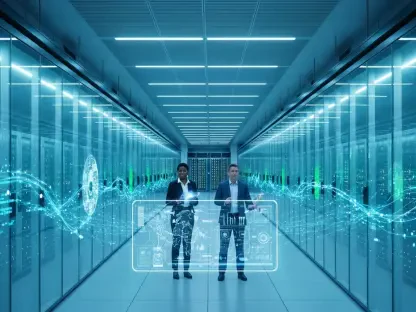

Nigeria’s ascent in the global technology landscape is confronting a formidable barrier, as the explosive growth of artificial intelligence threatens to outpace the nation’s digital infrastructure. On a vast 42-hectare site in Lekki, Lagos, a monumental project is taking shape that aims to shatter this limitation. Kasi Cloud is constructing the country’s first hyperscale data center campus specifically engineered for AI, a venture poised not just to bridge an infrastructure gap but to redefine Nigeria’s role in the dawning era of intelligent computing. With a projected capacity of 100 megawatts, this facility represents a long-term, high-stakes investment designed to provide the raw power necessary for the nation to participate meaningfully in the global AI revolution. The success or failure of this endeavor could very well determine the trajectory of Nigeria’s technological future for decades to come.
A Direct Answer to Nigeria’s Infrastructure Deficit
The strategic imperative driving the Kasi Cloud project is a direct response to a critical shortfall in Nigeria’s current digital capabilities. The nation’s existing data centers, numbering around 17 operational facilities, collectively offer a maximum capacity of approximately 20 megawatts. This figure is profoundly insufficient to meet the voracious power demands of modern artificial intelligence. Global hyperscale AI campuses routinely target capacities of 50 to 100 megawatts or more, a scale necessitated by the immense energy consumption of dense Graphics Processing Unit (GPU) racks, which can individually draw between 50 and 150 kilowatts. Without access to such dedicated, high-power infrastructure, Nigeria risks being relegated to the role of a consumer rather than a creator of advanced AI, unable to support the compute-intensive workloads essential for training sophisticated models and deploying cutting-edge applications. This infrastructure deficit represents a significant bottleneck to innovation and economic growth in the AI sector.
This is precisely the challenge that Kasi Cloud’s $250 million venture was designed to overcome. Founder and CEO Johnson Agogbua emphasizes that this facility is not a retrofitted enterprise data center but has been conceived “for AI from day one.” This forward-looking philosophy is embedded in every aspect of its design, providing the high-density power and advanced cooling solutions that AI workloads demand. Unlike facilities adapted from older specifications, this purpose-built campus directly confronts the risk of Nigeria being left behind in a rapidly advancing technological landscape. By establishing a domestic platform capable of hosting complex AI systems, Kasi Cloud is creating an environment where local innovation can flourish, reducing reliance on foreign infrastructure and positioning Nigeria as a potential hub for AI development in West Africa.
Engineered for the Future a Phased and Disciplined Approach
The development of the Kasi Cloud campus reflects a long-term, methodical vision rather than a rush to meet immediate demand. Construction, which commenced in the second quarter of 2023 following a groundbreaking in April 2022, is structured in deliberate phases. The initial milestone involves bringing 5.5 megawatts of capacity online by April 2026, with commercial operations slated to begin in the second quarter of the same year. This initial capacity will be situated within the campus’s anchor facility, a six-story building that serves as the blueprint for all subsequent development. This first structure is meticulously engineered, with four of its floors dedicated to data halls, each designed to support an 8-megawatt load, giving the building a potential capacity of 32 megawatts. The campus master plan, fully permitted by the government, allows for the construction of up to four such buildings, yet the engineering is focused on delivering a total of 100 megawatts of sellable power, which may ultimately require only three high-density facilities. This scalable architecture ensures that the campus can grow in lockstep with the evolving demands of its clients over many years.
This meticulous planning is underpinned by an unwavering commitment to a “world-class” standard, a principle that Johnson Agogbua defines not as a mere slogan but as a “discipline.” This philosophy is physically manifested in the building’s design, which features unusually high ceilings, wide corridors, and robust, closely spaced concrete columns, all intended to accommodate future technological advancements and heavy equipment without the need for costly retrofits. The guiding principle is to avoid the pitfalls of incremental thinking that so often lead to long-term limitations. This disciplined approach extends to every facet of the infrastructure, with a clear hierarchy of priorities: “Power first, everything else second.” This ensures that the foundational systems are not only capable of meeting today’s demanding requirements but are also robust enough to support decades of technological evolution, providing a stable and future-proof platform for Nigeria’s digital ambitions.
The Technical Backbone for High-Density AI
To deliver on its “power first” mandate, Kasi Cloud has implemented engineering solutions that represent a significant leap forward for the region’s data center industry. Instead of conventional cable bundles, the facility employs solid busbars—rigid copper or aluminum conductors—to distribute electricity. This choice allows for more efficient, flexible, and high-capacity power delivery directly to server racks, which is essential for managing high-density loads. To guarantee maximum operational uptime, the design incorporates four independent high-voltage feeds, creating fully redundant A and B power paths with N+2 resiliency. This means the facility can continue to operate without any interruption even if two of the four main power lines experience an outage. This level of redundancy is critical for AI workloads, where a brief power interruption can corrupt a training run that may have been in progress for weeks, wasting immense time and computational resources. The sheer scale of the power infrastructure, including massive dry-type transformers, directly influenced the building’s architectural design, dictating the size of doorways and wall openings, and demonstrating a deep, integrated approach to engineering and planning from the project’s inception.
The facility is explicitly engineered to support rack densities ranging from a robust 10 kilowatts to an extraordinary 100 kilowatts, a capacity that stands in stark contrast to the 5-to-10-kilowatt standard common in other Lagos data centers. To accommodate these demanding workloads, specific sections of the facility are designated as high-density data halls. These zones feature reinforced structures to support heavier equipment and integrated infrastructure for direct-to-chip liquid cooling, proactively addressing the need to dissipate the immense heat generated by AI hardware. The design philosophy also embraces the inevitability of system failures; for instance, drainage channels are built directly into the floor. As Agogbua pragmatically states, “eventually, a pipe will burst.” The goal is not to prevent all failures but to engineer a system where failures are contained and never become catastrophic. The cooling systems utilize magnetic-drive technologies to minimize noise and enable rapid ramp-ups to handle sudden spikes in processing loads, while towering air-handling units and triple HEPA filtration systems protect sensitive equipment from the coastal environment.
Beyond the Building Forging a Digital Ecosystem
Recognizing the inherent risks associated with high-density power systems, Kasi Cloud has implemented a multi-layered fire suppression system to safeguard its critical infrastructure. The uninterruptible power supply (UPS) systems are powered by modern lithium-ion batteries housed in reinforced underground bunkers. While these batteries offer superior energy density and a longer lifespan, they also present a unique fire risk. To mitigate this, the facility is equipped with a comprehensive safety protocol that includes gas-based suppression at the module level, specialized chemical agents designed to halt thermal runaway, and a final-resort system capable of sacrificing an entire room to protect the rest of the facility. This comprehensive, no-corners-cut approach to safety is matched by an equally robust connectivity strategy. The primary meet-me room, the central hub for telecommunication interconnections, is described as being larger than some entire data centers in Lagos. The campus plans for two such rooms, ensuring ample space for network operators, while fiber ducts are buried deep underground at a standard depth of 1.8 meters to prevent future construction from disrupting critical network links.
The Kasi Cloud project was positioned as far more than just the construction of a data center; it was a foundational investment aimed at securing Nigeria’s digital sovereignty and altering Africa’s standing in the global AI landscape. By enabling the local hosting of cloud and AI infrastructure, the campus was designed to help Nigerian businesses reduce their reliance on foreign bandwidth, empower a new generation of local developers, and provide the government with the tangible tools needed to enforce data localization policies. The long-term vision extended beyond the data halls to the cultivation of a complete digital ecosystem across the 42-hectare campus. This strategy sought to attract complementary businesses, such as tower companies, network operators, and service providers, to create a thriving technological hub. Through this holistic approach, Kasi Cloud laid not just the physical and digital foundation for Nigeria’s future in the age of artificial intelligence but also a blueprint for the nation to become a digital anchor market for the entire West African region.