
With deep experience evaluating the architectural evolution of cloud providers and their specific tech stacks, Maryanne Baines has become a leading voice in the infrastructure space. She has spent years dissecting how major players adapt to shifting industry demands, particularly as the focus moves from pure software services to the massive physical requirements of the AI era. In this discussion, we explore the monumental capital shifts, the technical complexities of photonics, and the strategic decisions facing modern enterprises as they navigate a landscape defined by hardware constraints and multi-billion-dollar infrastructure projects.
Major technology firms are expected to increase infrastructure spending from $410 billion in 2025 to $650 billion in 2026. How does this massive capital shift redefine competition between cloud providers, and what specific physical constraints are currently the most difficult for these companies to overcome?
This extraordinary leap in spending signals that the competition has shifted from a battle of software features to a race for physical supremacy. When we talk about $650 billion, we aren’t just discussing server racks; we are talking about the sheer industrial capacity to host massive AI models. The primary constraints are no longer just about who has the best code, but who can secure massive amounts of electricity and reliable supply chains for specialized chips. We are seeing a “land grab” for power-dense data center locations, where the ability to cool these high-performance environments is becoming a severe bottleneck. The providers that win will be those who can stabilize their access to the grid and physical hardware faster than their rivals.
Industry leaders are investing billions into photonics to replace electrical signals with light for faster data transfer between processors. Can you explain the technical hurdles of integrating this technology at scale and how it specifically improves the speed and energy efficiency of large AI clusters?
The shift to photonics is a response to the “thermal wall” that traditional copper wiring and electrical signaling have hit. By using light to transmit data, companies like Nvidia are looking to bypass the resistance and heat generated by electricity, which allows data to travel much faster across the fabric of a data center. The technical hurdle lies in the precision required for these optical connections, as they must be flawlessly integrated into the silicon at a massive scale. If successful, this reduces the energy overhead of moving data, which is crucial when you have thousands of GPUs communicating simultaneously. It effectively turns a sprawling cluster of separate chips into one giant, cohesive brain that processes information with far less latency.
Large organizations are increasingly entering multi-year, multi-billion-dollar agreements to secure GPU capacity rather than managing their own hardware. What strategic risks do these long-term commitments carry for an enterprise, and how should IT leaders evaluate a provider’s physical data center capabilities before signing?
The most significant risk is “hardware lock-in” during a period of rapid technological flux. When an enterprise signs a multi-year deal worth billions, they are essentially betting that the provider’s current hardware trajectory will remain relevant, even as new chips and networking standards emerge. IT leaders must look beyond the marketing and evaluate the provider’s actual physical resiliency, such as their cooling capacity and the age of their power infrastructure. It is vital to ensure that the data centers can handle the specific thermal demands of the next generation of AI hardware. You don’t want to be locked into a five-year contract for a facility that cannot support the power-hungry chips of year three.
Massive initiatives like the $500 billion Stargate project represent a historic level of investment in domestic computing power. How do these mega-projects alter the geographical landscape of data centers, and what are the primary challenges regarding local energy grid stability and advanced cooling requirements?
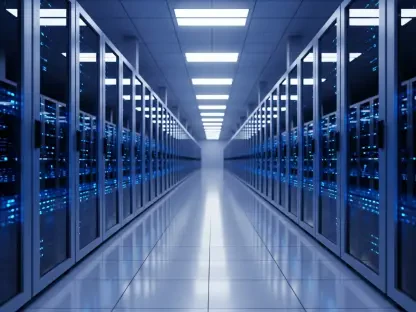
Mega-projects like Stargate are fundamentally redrawing the map, moving data centers away from traditional tech hubs and into areas where land and power are more abundant. These projects are so massive that they can strain local energy grids, often requiring the construction of dedicated power substations or renewable energy farms just to keep the lights on. The cooling requirements are equally daunting, as traditional air cooling is often insufficient for the heat density these clusters generate. We are seeing a shift toward liquid cooling and more industrial-scale HVAC solutions that require proximity to stable water sources or specialized cooling infrastructure. These sites are becoming more like heavy industrial plants than the office-park data centers of the past decade.
The primary constraint in AI development is shifting from software innovation to the physical availability of chips, networking, and power. How should engineering teams adapt their model-building strategies to account for these hardware limits, and what metrics best track the ROI of infrastructure-heavy projects?
Engineering teams can no longer afford to build models in a vacuum; they must now design with “hardware awareness,” optimizing their architectures to fit the specific constraints of the clusters they can actually access. This means writing code that is more efficient in how it utilizes GPU memory and reduces the need for heavy data transfers across the network. To track ROI, leaders should look at “tokens per watt” or the total cost of training per model iteration rather than just looking at the upfront cost of the lease. Tracking how much of the allocated GPU time is spent waiting on networking versus actual computation provides a clear picture of whether the infrastructure is actually delivering value. Efficiency is the new currency in an era where you can’t simply buy your way out of physical scarcity.
What is your forecast for AI infrastructure?
My forecast is that we are entering an era of “sovereign and specialized” infrastructure. Over the next few years, I expect to see a move away from general-purpose cloud regions toward highly specialized, purpose-built AI campuses that operate almost like independent utility grids. We will see $33.9 billion in private generative AI investment continue to grow, but it will be dwarfed by the massive physical expansion of the core providers. The geographical concentration of computing power will become a matter of national economic policy, as projects like Stargate prove that domestic computing capacity is the new oil. Ultimately, the winners in the AI space will be determined not by who has the best algorithm, but by who has the most reliable access to the massive amounts of electricity and cooling required to run them.