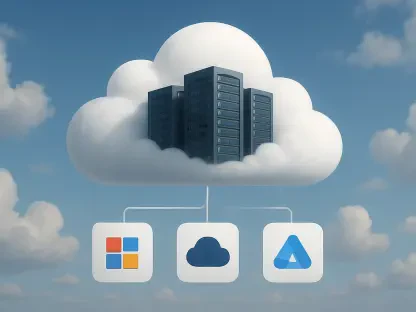

For years, the cloud was the enterprise equivalent of a vast, off-site storage unit—a utility as predictable and unglamorous as electricity or water, but a profound shift is underway transforming it from a passive repository into a dynamic, real-time decision engine. Today, leading organizations are embedding this enhanced capability at the very core of their operations. This analysis explores that evolution, using the high-stakes, data-drenched world of Formula 1 racing as a blueprint for the modern enterprise. It examines how the cloud has moved from the background to the foreground, becoming an indispensable partner in making critical, time-sensitive decisions that define competitive advantage.
The Foundational Era of IT Optimization
The initial migration to the cloud was driven by a straightforward value proposition: efficiency. On-premise data centers were expensive to build, maintain, and scale. The cloud offered a pay-as-you-go model that turned capital expenditures into operational ones, providing seemingly infinite storage and compute power on demand. During this era, the primary goal was IT optimization. Businesses moved their email servers, customer relationship management (CRM) systems, and data archives to the cloud to reduce hardware footprints and free up IT teams from routine maintenance. The cloud was a destination, a place where non-critical workloads lived. This utility model was foundational and necessary, but its focus remained squarely on cost savings and infrastructure management, far removed from the front lines of business strategy and real-time operational execution.
Redefining the Cloud’s Role in a High-Performance World
From Back-Office Support to the Racetrack’s Edge
Nowhere is the evolution from utility to decision engine more apparent than in the pit lane of a Formula 1 team. The Mercedes-AMG Petronas F1 team, for instance, leverages its cloud infrastructure not just for post-race analysis but as an active participant in race-day strategy. During a race weekend, their car generates a torrent of real-time data from hundreds of sensors, covering everything from tire degradation to aerodynamic performance. This data is no longer solely processed by trackside servers; it is streamed to the cloud, where it fuels complex simulations that inform split-second decisions. This move demonstrates the cloud’s capacity to function in an environment where latency is intolerable and performance is everything. For the modern enterprise, this serves as a powerful model for embedding cloud capabilities directly into mission-critical workflows, whether on a factory floor, a trading desk, or a global supply chain.
Beyond Raw Speed to Achieve Computational Scale
While speed is critical, the true competitive advantage unlocked by the cloud is computational scale. In Formula 1, a race strategy is a complex web of variables—weather patterns, competitor actions, fuel loads, and potential safety cars. Using on-site systems alone, a team can only run a limited number of “what-if” scenarios. By pushing data to a platform like Microsoft Azure, the Mercedes F1 team can run a vast array of simulations in parallel, exploring far more potential outcomes than would otherwise be possible. This transforms decision-making from an educated guess into a data-backed probability assessment. This mirrors a growing trend in other sectors, where manufacturing firms simulate production line changes to predict bottlenecks, and financial institutions run continuous risk models to anticipate market shifts, moving from reactive analysis to proactive, scenario-based planning.
The Hybrid Imperative for Performance-Critical Operations
This advanced capability does not come from a simple “lift and shift” to a public cloud. In environments where an insight delayed is an insight denied, a purely centralized cloud model is often inadequate. The laws of physics—specifically, the speed of light—dictate that latency is unavoidable over long distances. An F1 team cannot wait for data to travel to a data center and back to make a call on a pit stop. This reality has given rise to a hybrid architecture that combines the best of both worlds: local, on-premise, or “edge” systems for immediate processing, coupled with the immense computational power of a central cloud for deeper analysis. Industry analysis shows that over 75% of enterprise data is now created and processed outside traditional data centers. The F1 model, using trackside systems in concert with cloud resources, exemplifies this hybrid approach as the default architecture for any performance-critical operation.
The Emerging Blueprint for Market Leadership
The strategic use of cloud in high-performance settings highlights several overarching trends shaping the future of enterprise IT. The first is the convergence of cloud and advanced analytics. Research shows that the most successful organizations are those that embed data-driven insights directly into daily workflows, a feat made possible by the cloud’s ability to democratize access to powerful analytical tools. Furthermore, the drivers for cloud adoption have matured. According to industry data, business resilience and operational flexibility have overtaken pure cost savings as primary motivators for more than half of large enterprises. This reflects a strategic shift toward using the cloud to gain a competitive edge and better control over business outcomes, rather than simply trimming the IT budget.
From Theory to Practice in a Performance-First Strategy
For business leaders, the lesson from the racetrack was not to simply copy a technology stack, but to adopt a new mindset. The first step involved re-evaluating the cloud’s purpose within the organization. Was it viewed as a cost center for storing data, or as a strategic asset for accelerating decision-making? The answer dictated investment and architecture. Secondly, enterprises had to embrace a flexible, hybrid model that placed workloads where they performed best, whether at the edge, on-premise, or in a public cloud. A one-size-fits-all approach was no longer viable. Finally, and most critically, technological transformation was matched by organizational redesign. A high-performance cloud model required breaking down silos between data scientists, engineers, and business strategists, fostering a culture of collaboration and trust in shared, real-time data.
Your Cloud Became What You Made It
The journey of cloud computing from a simple utility to a sophisticated decision engine marked a pivotal moment in the digital transformation of business. The high-pressure environment of Formula 1 offered a glimpse into a reality where the cloud was not just a place where systems ran, but an active participant in how an organization thought, adapted, and performed. This evolution demanded more than new technology; it required a new strategy. For leaders who successfully navigated the landscape, the central question was no longer if they should use the cloud, but how. Their answer determined whether their cloud remained a background utility or became the engine that drove their competitive future.