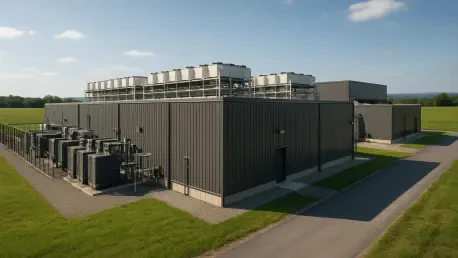

The rapid expansion of the digital economy has ignited a contentious debate across the American heartland, where proposals for massive new data centers are often met with significant public resistance. While communities near urban hubs like Sioux Falls have seen packed city council meetings filled with concerned citizens, the journey of Sully County, South Dakota, presents a powerful counter-narrative. Once a community steeped in apprehension about a major data center development, it has transformed into a vocal advocate, showcasing a model where industrial growth can become a catalyst for profound and positive local change, revitalizing a rural landscape in ways few thought possible.
The Sully County Story a Case Study in Rural Renewal
From Widespread Skepticism to Wholehearted Support
Just three years ago, the prospect of a 30-megawatt cryptocurrency mining data center near the Oahe Dam stirred considerable unease among the residents of Sully County. According to Austin Gross, the County Planning and Zoning Board Chair, the public meetings held to discuss the proposal were some of the most highly attended in the board’s recent history, a clear signal of widespread community skepticism. Concerns mirrored those voiced in other parts of the state, focusing on energy consumption, environmental impact, and the potential disruption to their rural way of life. The community was at a crossroads, weighing the promises of economic development against the potential costs of hosting such a large-scale industrial operation. This initial period of uncertainty and debate was a critical test of the relationship between developers and the local populace, setting the stage for what would become a surprisingly symbiotic partnership.
That initial apprehension has since evolved into robust and unwavering support from local leaders and the community. The data center, owned by the Pierre-based company Big Watt Digital, has not only become the largest in South Dakota but has also laid out ambitious plans for a tenfold expansion to 300 megawatts. This projected growth would increase its energy consumption to a level equivalent to that of nearly 209,000 average South Dakota homes, a staggering figure that continues to be a point of concern for state-level officials. However, on the ground in Sully County, the perspective is starkly different. County Commissioner Caleb Shepherd has gone on record to declare that any additional data facilities would be welcomed with “open arms,” a sentiment that reflects a dramatic shift from doubt to advocacy. This change was not instantaneous but was earned through demonstrated benefits that directly addressed the county’s most pressing challenges, turning a potential liability into a celebrated local asset.
The Ripple Effect on the Local Economy
For Sully County, the state’s fifth least-populated county, the arrival of the data center represented a rare and vital opportunity to counteract the persistent trends of population decline and economic stagnation. While the facility currently employs a modest team of fewer than 20 people, its planned expansion is set to be a game-changer, creating approximately 100 new full-time positions and an additional 300 jobs during the construction phase. Austin Gross highlighted that for small, rural communities, the chance to secure such a significant economic anchor is “ever-fleeting.” These new jobs are more than just numbers on a spreadsheet; they represent families moving into the area, children enrolling in local schools, and a much-needed injection of “Main Street spending” that supports local businesses, from diners and hardware stores to service providers. The project has provided a tangible pathway toward a more stable and prosperous future, offering hope in a region where economic opportunities have historically been scarce.
The strategic location of the data center, with its access to vast rural land and significant hydroelectric and wind power resources, has also fostered a uniquely beneficial relationship with the Oahe Electric Cooperative. According to CEO Jordan Lamb, the facility’s massive and consistent demand for energy creates a stable load that allows the cooperative to retire its older energy generation assets and pay off existing infrastructure investments at an accelerated pace. This financial efficiency ultimately benefits all of the cooperative’s customers, including residential, small business, and agricultural users, by stabilizing rates and improving service reliability. In a direct contribution to local infrastructure, Big Watt Digital also financed the complete rebuilding of an adjacent electrical substation, a critical upgrade that enhances the resilience of the local power grid. This synergistic partnership demonstrates how large-scale industrial consumers can become crucial allies in modernizing rural infrastructure.
Turning Industrial Revenue into Community Investment
A Financial Lifeline for Public Education
Perhaps the most transformative and widely celebrated impact of the data center has been its profound effect on the Agar-Blunt-Onida School District. The facility has become a pivotal source of revenue, contributing approximately $850,000 annually through gross receipts taxes. Superintendent Jeremy Chicoine described this new income stream as a monumental source of property tax relief for local residents, fundamentally altering the district’s financial landscape. This influx of capital has allowed the district to shift from merely sustaining its operations to actively investing in its students and the broader community. Last year alone, the district was able to reduce its capital outlay request, a property tax fund designated for building and equipment upgrades, by a remarkable $600,000. This single reduction accounted for nearly 13% of the total education property taxes paid by residents within the district, providing direct and substantial financial relief to local families and farmers.
This new revenue has been strategically reinvested to create educational opportunities that are often out of reach for small, rural schools. The district has successfully launched comprehensive career and technical education programs, giving students hands-on skills and pathways to viable careers. Furthermore, it has been able to guarantee dedicated music, physical education, and art classes for all grade levels, enriching the educational experience and fostering well-rounded development. In a direct response to a community need, the district is also using the funds to establish a new public preschool program, filling a critical gap left by the closure of a private facility. This financial independence has propelled the Agar-Blunt-Onida School District into an elite group; it is now one of only six districts in South Dakota that is entirely self-funded through local tax collections, operating without any reliance on state aid.
A Replicable Blueprint for Rural Prosperity
The experience of Sully County provided a compelling case study that moved beyond theoretical benefits to showcase tangible, community-wide success. The initial fears of resource strain and disruption were systematically replaced by the realities of economic growth, infrastructure improvement, and unprecedented investment in public education. The data center did not just bring jobs; it became an integrated partner in the county’s future, its tax contributions directly funding property tax relief and enabling the school district to offer programs that secured a brighter future for the next generation. This narrative demonstrated that when properly managed and integrated, large-scale industrial development could serve as a powerful engine for rural revitalization. The project ultimately stood as a testament to how proactive local leadership and a collaborative approach with industry could transform a potential burden into a community’s greatest asset, offering a hopeful blueprint for other rural towns navigating the complexities of the modern digital economy.