
The fragile magnetic pulses and flickering electrons that define modern civilization are currently anchored to hardware with the disturbing longevity of a cheap household appliance. While global society entrusts life stories, scientific breakthroughs, and cultural history to the cloud, the physical foundations of this digital world remain surprisingly fragile. Most people are unaware that the magnetic tapes and hard drives powering the internet have a shorter lifespan than a standard ballpoint pen. In an era where humanity generates 0.4 zettabytes of data every single day, the world is ironically closer than ever to a digital dark age where collective memory could simply evaporate. Microsoft’s Project Silica proposes an audacious solution by etching history into plates of glass designed to last ten millennia, challenging the very notion that data is temporary.
The End of the Digital Dark Age or a High-Tech Mirage?
The concept of preserving information for thousands of years shifts the narrative from temporary convenience to civilizational duty. Current storage methods rely on materials that oxidize, demagnetize, or simply wear out from mechanical friction. This vulnerability creates a paradox where the more information a society produces, the less likely that information is to survive into the deep future. Project Silica aims to bridge this gap by utilizing a medium that is fundamentally inert. By moving away from the volatile nature of spinning disks and magnetic coatings, the project seeks to establish a permanent record that remains unaffected by the environmental factors that typically destroy digital media.
The ambition behind using glass lies in its inherent stability and resistance to the passage of time. Unlike a hard drive that requires complex internal components to function, a glass plate is a solid-state object that does not decay under normal atmospheric conditions. This transition represents a departure from the “throwaway” culture of modern technology, where hardware is designed with a limited functional window. If successful, this shift could transform data from a fleeting digital signal into a physical artifact as durable as the stone inscriptions of antiquity, providing a safeguard against the loss of human knowledge during unforeseen global disruptions.
Why the Search for Archival Permanence Is Reaching a Breaking Point
The current storage industry is trapped in a cycle of constant migration that consumes immense resources. Data centers must physically replace their hardware every five to seven years to prevent bit rot and mechanical failure, a process that is both energy-intensive and ecologically unsustainable. As the volume of global data explodes, the cost and logistical burden of refreshing this information are becoming unmanageable for even the largest tech conglomerates. Project Silica enters this landscape not just as a better hard drive, but as a fundamental shift toward passive storage—a medium that requires zero energy to maintain and can survive fire, flood, and electromagnetic pulses.
This reliance on constant hardware turnover creates a significant carbon footprint and a mountain of electronic waste. The traditional “hot” storage model requires active cooling and a continuous power supply to keep data accessible and intact. In contrast, the potential for glass storage to sit on a shelf for centuries without a single watt of electricity offers a revolutionary path toward sustainability. By eliminating the need for periodic data migration, organizations could drastically reduce their long-term operational costs while ensuring that their most valuable archives remain secure from the physical degradation that plagues magnetic media.
Decoding the Glassy Lifeboat: Innovation and Its Discontents
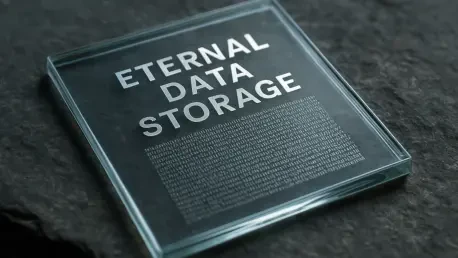
Project Silica utilizes borosilicate glass, the same durable material found in high-end laboratory equipment, to house information. By using ultra-fast femtosecond laser pulses, engineers create microscopic 3D distortions called voxels within the glass matrix. This creates a multi-layered storage environment where a single 2-millimeter-thick plate can house 2 terabytes of data, effectively turning a piece of glass into a high-density library. However, reading data from glass is significantly more complex than reading from a spinning disk. It requires high-speed optical microscopes to scan the layers and sophisticated machine learning models to decode the distorted light patterns into digital bits.
This reliance on advanced artificial intelligence creates a technological paradox where the storage medium may last 10,000 years, but the hardware required to read it remains some of the most complex equipment ever devised. Furthermore, while glass is stable, it is currently slow. With writing speeds hovering around 20 Mbps, Project Silica is outperformed by decades-old USB standards. For the technology to move from a laboratory curiosity to a viable enterprise solution, it must overcome this velocity gap to handle the high-speed data intake required by modern cloud infrastructures. The technical hurdles involve not just the durability of the glass, but the efficiency of the entire ecosystem surrounding it.
Expert Perspectives on the “Eternal” Business Model
Critics and industry analysts point to a significant flaw in the project’s commercial logic regarding the lack of recurring revenue. In a capitalistic tech market, a product that never needs to be replaced is a difficult sell to investors who rely on upgrade cycles. Furthermore, historians and tech skeptics argue that the civilization-saving narrative is a utopian fallacy. If a future society loses the industrial capacity to build lasers and decoders, a glass disk full of data becomes nothing more than a high-tech paperweight. Experts suggest that for Project Silica to succeed, it must find a middle ground between eternal aspirations and the immediate economic needs of sectors like medicine and entertainment.
The challenge lies in convincing the market that longevity is worth the initial investment in specialized reading and writing hardware. Most corporations operate on quarterly or yearly timelines, making a ten-millennium storage solution seem like an unnecessary luxury. However, for institutions tasked with preserving national secrets, medical records, or cultural masterpieces, the value of a tamper-proof and indestructible archive is immense. The success of the “eternal” model depends on identifying these niche markets where the cost of losing data outweighs the high entry price of a new and specialized storage format.
Navigating the Future of Data Preservation
Strategic planners identified that organizations must distinguish between hot data that is frequently accessed and cold data that serves as a historical record. They recognized that Project Silica was strictly for the latter, serving as a write-once, read-maybe solution for information that required maximum protection. These experts assessed the long-term carbon footprint of current storage migration cycles and determined that the one-time energy cost of glass etching provided a superior environmental alternative. They prioritized the elimination of the constant power draw associated with cooling and spinning traditional drives in large-scale facilities.
The most realistic path forward involved a tiered system rather than the total replacement of magnetic media. Within this framework, solid-state drives handled immediate tasks, magnetic tape managed mid-term backups, and glass plates served as the hardened final archive for humanity’s most critical information. Decision-makers evaluated these hybrid infrastructures as the only way to balance the need for speed with the necessity of permanence. They concluded that while the technology was still maturing, the integration of glass storage into a broader preservation strategy offered a viable defense against the digital dark age. These steps established a foundation for a more resilient digital heritage that moved toward a future where data was no longer a perishable commodity.