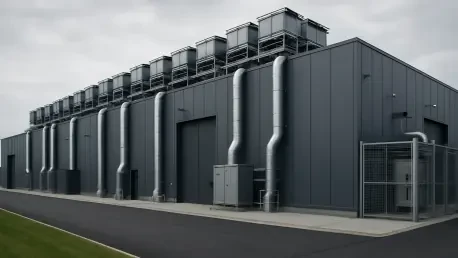

The digital infrastructure landscape witnessed an unprecedented surge in 2025, with total investment in data centers shattering previous records to reach an astonishing $61 billion across more than 100 separate transactions within the first eleven months alone. This explosion in capital deployment, eclipsing the full-year totals from any previous year, signals a monumental shift in the global economy’s backbone. The boom is not driven by a single factor but rather a powerful confluence of relentless hyperscaler expansion, intense interest from private equity firms, and a significant increase in available debt financing. This tidal wave of investment underscores the critical and growing role of data centers in powering everything from enterprise cloud services to the next generation of artificial intelligence, setting the stage for an era of accelerated digital transformation and infrastructure development on a global scale.
1. The Geographic Landscape of Investment
A closer look at the flow of capital reveals distinct regional trends, with North America firmly establishing itself as the epicenter of data center investment. The United States and Canada have attracted a colossal $160 billion since 2019, dwarfing other regions and solidifying their dominance. This leadership position is attributed to the heavy presence of major cloud providers, a mature financial market, and robust demand for digital services. Meanwhile, the Asia-Pacific region has seen substantial growth, with investment reaching nearly $40 billion over the same period, driven by burgeoning digital economies and increasing internet penetration. Europe, while still a significant market with $24.2 billion in investment, has been eclipsed by the rapid emergence of the Middle East as a key growth hub. Analysts note that global data center footprints are projected to expand at a faster rate over the next five years than in the previous five, a trend directly linked to the insatiable demand for energy and compute power required to support advanced AI workloads, which is reshaping investment priorities worldwide.
2. The Driving Forces of Hyperscale and AI
The current investment bonanza is largely propelled by the strategic decisions of hyperscalers, who are aggressively expanding their infrastructure to meet overwhelming demand. Rather than relying on leasing, these tech giants are leveraging their strong balance sheets and massive free cash flow to finance and construct new, purpose-built facilities. The number of data centers being built directly by hyperscalers nearly doubled in 2024 from a post-pandemic low, while their total utility power consumption more than doubled, indicating a move toward larger, more powerful sites. This growth trajectory is set to continue, with 114 hyperscaler data centers already planned or under construction for 2026. Recognizing the significant capital required for such ambitious projects, a new trend of collaboration has emerged. Hyperscalers, leading AI research labs, and major chipmakers are increasingly teaming up with financial sponsors, creating powerful consortiums to acquire assets or co-finance the construction of next-generation digital infrastructure capable of handling the immense processing demands of AI.
The long-term financial outlook for the data center sector is staggering, with projections indicating a need for $6.7 trillion in worldwide investment by 2030 to keep pace with the demand for compute power. This figure highlights that the record-setting investments of 2025 are merely the opening act of a much larger, decade-long build-out. A deeper analysis of this projection reveals the overwhelming influence of artificial intelligence, which is expected to require an incredible $5.2 trillion in dedicated capital expenditures. In contrast, the infrastructure needed to power traditional IT applications is projected to require a comparatively smaller, though still massive, $1.5 trillion. This dramatic split underscores a fundamental shift in infrastructure priorities. The focus is no longer just on expanding capacity but on re-architecting the digital foundation to support the unique, energy-intensive requirements of AI processing, heralding a new chapter in technological development and the capital markets that support it.
Navigating the Investment Frontier
In retrospect, the firms that successfully navigated this period of explosive growth were those that looked beyond immediate capital deployment and embraced multifaceted strategies. Investors who thrived were required to develop a nuanced understanding of demand projections, which were often shrouded in uncertainty due to the rapid evolution of AI models and use cases. The most successful investment approaches were designed to be scalable and adaptable. Furthermore, these companies recognized that innovating on compute efficiency was not just an option but a necessity for long-term viability. Critically, building supply-side resilience became a cornerstone of sustainable growth. This involved proactive measures to secure essential inputs, such as long-term energy contracts and priority access to advanced semiconductors, while also optimizing site selection and building unprecedented flexibility into their global supply chains.