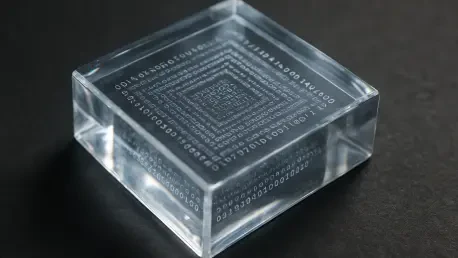

In an era defined by an insatiable appetite for data, the very foundation of our digital civilization rests on surprisingly fragile media, with hard drives failing and magnetic tapes degrading within a single decade. This escalating challenge of global data preservation has spurred the development of a groundbreaking solution that has emerged after decades of dedicated research: the 5D Memory Crystal. This revolutionary technology utilizes fused silica glass to create a near-eternal, high-capacity storage medium poised to transform the archival data industry. By encoding information within the structure of glass, this method offers an exceptionally stable and durable answer to the short lifespans and inherent vulnerabilities of conventional storage technologies. It promises not just to store data, but to preserve humanity’s most critical information for millennia, securing our digital legacy against the ravages of time.
The Science Behind Eternal Storage
How 5D Technology Works
The fundamental principle behind this innovation involves the use of extraordinarily precise femtosecond laser pulses, which etch infinitesimally small, three-dimensional pixels, known as “voxels,” directly into the internal structure of the glass. The true breakthrough, however, lies not just in writing these voxels but in the sophisticated method used to read the data they contain. These nanostructures exhibit a physical property called “birefringence,” which means the way they refract, or bend, light changes based on the polarization and direction of the light passing through them. Data is encoded across five distinct dimensions by capturing a voxel’s physical location in three-dimensional space (its x, y, and z coordinates) in conjunction with the orientation and the strength of the refracted light, which constitute two additional dimensions. This multi-dimensional approach is the key that unlocks the technology’s remarkable storage density, moving far beyond the two-dimensional limitations of conventional optical discs.
This advanced method represents a monumental leap over traditional storage technologies. Whereas compact discs and Blu-ray discs store data in a single layer of microscopic pits on a surface, 5D storage creates complex, multi-layered structures deep within the glass. The ability to control not only the spatial position of each voxel but also the subtle optical properties of light interacting with it is what exponentially increases the amount of information that can be stored in a given volume. Achieving this level of control requires an incredible degree of precision, manipulating laser pulses that last for mere quadrillionths of a second to create permanent, data-rich nanostructures. This process effectively transforms a simple piece of fused silica glass into one of the most sophisticated and information-dense objects ever created, overcoming scientific hurdles that have been pursued in research labs for decades. The result is a storage medium that is fundamentally different from anything that has come before it.
Unprecedented Durability and Density
Crafted from fused silica glass, a material renowned for its chemical inertness and physical robustness, the 5D Memory Crystal exhibits extraordinary durability that sets it far apart from any existing data storage solution. The startup commercializing the technology, SPhotonix, projects that the data encoded within the voxels can endure for an estimated 13.8 billion years, a timescale equivalent to the estimated age of the universe. This staggering longevity is maintained even when the medium is subjected to a constant temperature of 190 degrees Celsius. This level of resilience completely redefines the concept of archival storage, dwarfing the lifespans of all current options. Standard optical discs last between five and one hundred years, while specialized archival M-DISC technology advertises a lifespan of up to 1,000 years. Magnetic tapes and hard disk drives, the workhorses of today’s data centers, are even more fragile, susceptible to magnetic fields, humidity, and mechanical failure, often requiring replacement every five to ten years.
In addition to its near-eternal lifespan, the technology delivers a highly competitive storage capacity, capable of holding up to 360 terabytes of data on a single 5-inch glass platter. This impressive density has profound implications for the physical infrastructure of data storage. A single platter can hold the equivalent of tens of thousands of high-definition movies or the entire genomic data of thousands of individuals. For large-scale data centers, this means a drastic reduction in the physical footprint required for archival storage, leading to lower real estate and energy costs. The combination of extreme density and unparalleled durability creates a true “store and forget” solution, eliminating the costly and risk-laden cycle of data migration that organizations must currently undertake every few years. This powerful synergy addresses the two most pressing challenges in data preservation: the exponential growth in data volume and the critical need for a reliable, permanent archive.
From Lab to Market The SPhotonix Strategy
The Commercial Vehicle
The technology is being brought to market by SPhotonix, a Delaware-based company co-founded in 2024 by Professor Peter Kazansky of the University of Southampton, a pivotal researcher in the field, and his son, the entrepreneur Ilya Kazansky. While headquartered in the United States, the company maintains its core research and development operations in the UK and Switzerland, tapping into a global talent pool. SPhotonix recently announced the successful closure of a $4.5 million funding round. This crucial injection of capital is specifically earmarked to advance the technology from its current stage of maturity, Technology Readiness Level (TRL) 5, to TRL 6. In practical terms, this means moving from a state of technical validation within a relevant laboratory environment (TRL 5) to demonstrating a fully functional prototype system in an operational setting (TRL 6), a critical step toward proving its commercial viability and readiness for enterprise adoption.
The establishment of SPhotonix marks a significant turning point, representing the formal transition of this groundbreaking technology from a long-term academic research project into a focused commercial enterprise. The company’s leadership structure strategically combines the deep scientific expertise of Professor Kazansky, who has been at the forefront of this field for decades, with the business acumen and market-oriented drive of Ilya Kazansky. This synergy is designed to navigate the complex path from laboratory breakthrough to market dominance. The company’s narrative is not one of an overnight success but rather the culmination of a persistent scientific journey, now equipped with the necessary funding and strategic direction to translate its profound potential into a tangible, industry-changing product. SPhotonix embodies the critical bridge between pure research and real-world application, aiming to finally deliver on the long-held promise of truly permanent data storage.
Targeting the Cold Data Crisis
SPhotonix has articulated a sharply defined market strategy that focuses exclusively on the “cold data storage” sector for hyperscale data centers and business-to-business (B2B) clients. Ilya Kazansky draws a clear distinction between data types based on their retrieval speed requirements. “Hot data,” which needs to be accessed in under five milliseconds for applications like financial trading, will remain the domain of high-speed solid-state drives (SSDs). In stark contrast, “cold data” encompasses information that is infrequently accessed and can tolerate retrieval times of ten seconds or more. Citing industry statistics, Kazansky notes that this category accounts for an enormous 60 to 80 percent of all data stored globally. He argues that the industry’s current practice of using energy-intensive, failure-prone, and non-recyclable hard disk drives (HDDs) for this purpose is a significant misuse of technology driven by simple “inertia,” creating a massive market inefficiency that SPhotonix is poised to correct.
The market opportunity for a superior cold storage solution is rapidly expanding, driven by powerful global trends. Industry analyst firm IDC predicts that 394 trillion zettabytes of data will be generated annually by 2028, and the ongoing boom in artificial intelligence is placing immense pressure on the supply chains for high-capacity hard drives. This creates a perfect storm where the demand for storage is skyrocketing just as the limitations of existing technologies are becoming more apparent. The 5D Memory Crystal is positioned as the ideal tool for this use case, offering a sustainable, scalable, and ultra-durable alternative. Unlike HDDs, which consume constant power to maintain their state, the glass platters are a write-once, read-many medium that consumes no energy while in storage. This makes it an environmentally friendly solution that addresses not only the capacity crisis but also the growing concerns around data center energy consumption and electronic waste.
The Path to Commercialization
The Development Roadmap
SPhotonix has laid out a multi-year plan to bring its technology to market, with key objectives focused on improving performance and accessibility. Currently, the system operates at a write speed of 4 megabytes per second (MBps) and a read speed of 30 MBps. A primary goal over the next three to four years is to increase this to a competitive read/write speed of 500 MBps. Achieving this target is a crucial milestone, as it would make the technology’s performance directly comparable to established archival tape backup systems, a dominant solution in the cold storage market today. While SPhotonix has already demonstrated the technology’s capability by archiving significant datasets like the human genome, data retrieval is currently a process confined to the laboratory. To overcome this limitation, the company is working toward another major milestone: the development of a field-deployable read device within the next 18 months, which will finally allow customers to access their archived data on-site.
While the long-term vision is broad, the initial market entry will be highly targeted, a reality reflected in the projected costs of the hardware. The company estimates that the first generation of its read device will be priced at approximately $6,000, while the more complex write device will cost around $30,000. These significant initial costs reinforce the company’s strategic focus on large enterprise clients and hyperscalers, organizations that manage petabytes of archival data and can justify the investment based on the long-term savings in energy, maintenance, and data migration. This pricing structure makes it clear that the 5D Memory Crystal will not be a consumer product in the foreseeable future. Instead, it is being positioned as a high-end, industrial-grade solution designed to solve one of the biggest challenges for the world’s largest data generators, providing a realistic and phased approach to market adoption.
A Licensing Based Business Model
In a strategic move to accelerate market adoption and focus on its core strengths, SPhotonix revealed that its business model was not to become a hardware manufacturer. Instead, the company planned to operate as a technology licensor, following the highly successful examples set by industry giants like Arm Holdings and Nvidia. The intention was to develop the core enablement technology—the foundational science, processes, and intellectual property—and then form a consortium of established hardware partners. These partners would be responsible for manufacturing and distributing the read/write devices and media at scale, leveraging their existing production capabilities and supply chains. This capital-light approach would allow SPhotonix to avoid the immense expense and complexity of building its own manufacturing facilities, enabling it to concentrate its resources on continued research and development to further advance the technology’s capabilities.
This forward-looking strategy was bolstered by key personnel decisions and a clear understanding of the development timeline. The company made a significant move by hiring a former researcher from Microsoft’s Project Silica, a parallel research effort that also stemmed from the foundational work at the University of Southampton. This hire signaled a consolidation of top-tier talent within this highly specialized field, strengthening SPhotonix’s position as a leader in 5D optical storage. With a clear vision and a well-defined path to production, the company’s leadership anticipated that another three to four years of intensive research and development were necessary before the technology would be fully ready for widespread commercial deployment. This timeline reflected a realistic assessment of the challenges involved in moving from a functional prototype to a robust, market-ready product ecosystem.