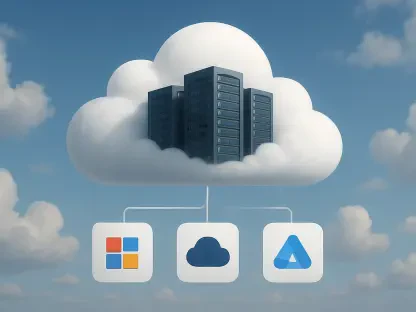

In a landmark strategic pivot that reshapes the cloud computing landscape, Amazon Web Services has officially moved beyond its historical “fortress mentality” to embrace a multi-cloud operational model, a decision unveiled at its re:Invent 2025 conference. This fundamental shift is a direct response to a convergence of powerful market forces, including the escalating demands of complex Artificial Intelligence workloads, the harsh lessons learned from recent high-profile cloud outages, and mounting regulatory pressures compelling enterprises to diversify their digital infrastructure. By launching a suite of products designed for interoperability, AWS is not merely acknowledging the multi-cloud reality but is actively positioning itself as a central, unifying hub in an increasingly distributed and interconnected cloud ecosystem, aiming to enhance the resilience, performance, and operational simplicity of next-generation AI applications.
A Pragmatic Acknowledgment of a Multi-Cloud Reality
The move reflects a pragmatic acceptance of the multi-cloud world that modern enterprises now inhabit, where single-vendor dependency is viewed as an unacceptable risk. The major cloud outages of 2025 served as a stark wake-up call for executives, elevating multi-cloud strategies from a niche technical consideration to a C-suite priority for ensuring business continuity and operational resilience. For years, organizations have been leveraging multiple cloud providers for a variety of reasons, including data sovereignty requirements, access to specialized services unique to a particular platform, or simple risk mitigation. Instead of fighting this trend, AWS is now building the essential tools not to compete directly on every workload but to facilitate seamless and secure operation across them, recognizing that the future of enterprise IT is inherently distributed and that its own success is tied to enabling, rather than restricting, this new paradigm.
This strategic direction is further fueled by the unique and formidable demands of modern “agentic AI” applications. These sophisticated systems, which can handle thousands of requests per hour, often need to synchronize state and access disparate data sources located across different cloud environments, creating an explosion of operational complexity that traditional tools cannot manage. Nandini Ramani, AWS VP of cloud operations, noted this generates a “telemetry explosion” that overwhelms existing monitoring solutions. Concurrently, stringent regulations like Europe’s Digital Operational Resilience Act (DORA) are compelling critical industries, particularly finance, to formally diversify their infrastructure as a matter of law. This makes multi-cloud adoption not just a technical best practice for mitigating vendor lock-in but a non-negotiable legal requirement for maintaining compliance and avoiding significant penalties.
The Centerpiece of a New Interconnected Strategy
The flagship of this new strategy is AWS Interconnect-multicloud, a service engineered specifically to tear down the stubborn networking barriers that have long existed between hyperscale providers. Launched in an initial collaboration with Google Cloud and built upon a jointly developed, open-source OpenAPI specification, this service provides private, high-performance connections that are completely isolated from the volatile public internet. It directly addresses one of the most significant historical pain points of multi-cloud architecture: the immense difficulty of establishing secure, low-latency, and reliable cross-provider communication. With integration for Microsoft Azure slated for later in 2026, the initiative signals a comprehensive vision for an open and interoperable cloud ecosystem where AWS acts as a foundational component rather than an isolated silo.
This new service represents a profound operational transformation, converting a process that once required weeks or even months of manual coordination, hardware provisioning, and complex router configurations into a streamlined, software-defined task that can be completed in minutes via an API call. Salesforce SVP Jim Ostrognai praised this innovation, stating it brings the ease of deploying internal AWS resources to the complex task of bridging to another major cloud. The service provides dedicated bandwidth scaling up to 100 Gbps and incorporates robust security features like end-to-end MACsec encryption and quad-redundancy across geographically separate facilities. Furthermore, a related service, AWS Interconnect-last mile, extends this automated networking paradigm to on-premises data centers, simplifying hybrid architectures and solidifying AWS’s role in the center of an enterprise’s entire distributed infrastructure.
Building a Holistic Ecosystem for Multi-Cloud Operations
Beyond foundational networking, AWS is rolling out a comprehensive suite of observability and orchestration tools designed to manage the full lifecycle of distributed AI applications. Amazon CloudWatch has been significantly enhanced with generative AI-specific observability features, allowing it to monitor key performance metrics such as latency, token usage, and error rates for applications built on frameworks like LangChain, regardless of where the AI agents are hosted. A key feature, Application Signals, provides automatic topology mapping without requiring manual instrumentation, giving operators an instant, clear view of complex application dependencies. This is complemented by AI-powered investigations that facilitate “Five Whys” root-cause analysis, drastically simplifying the troubleshooting process in labyrinthine, cross-cloud environments and reducing mean time to resolution.
This holistic approach also includes a major evolution of the Elastic Kubernetes Service (EKS) to better handle the challenges of multi-cluster orchestration at enterprise scale. With the general availability of new capabilities, including managed GitOps with Argo CD, AWS Controllers for Kubernetes (ACK), and a sophisticated Kube Resource Orchestrator, AWS is providing a higher-level, agent-centric abstraction for managing distributed applications. Described by Omdia analyst Torsten Volk as a “super orchestrator,” this toolkit is designed to abstract away the underlying infrastructure toil, freeing development and operations teams to focus on application logic and business value rather than the complexities of the various cloud platforms. While the ultimate cost of these managed services at scale remains a consideration, the move clearly aims to provide a unified control plane for the next generation of AI workloads.
A Resilient Future Forged by Interoperability
AWS’s strategic embrace of multi-cloud represented a fundamental evolution in its market approach, recasting the company from a walled garden into a foundational component of an interoperable and resilient cloud ecosystem. By launching AWS Interconnect-multicloud alongside a supporting suite of advanced observability and management tools, the company directly addressed the most pressing operational challenges posed by the next generation of AI. This calculated pivot was a direct response to persistent enterprise demands for greater flexibility, heightened resilience in the face of outages, and the critical need to comply with stringent new regulations. While questions around the total cost of ownership remained, the move positioned AWS to capture a central and indispensable role in the burgeoning multi-cloud AI landscape, transforming what was once a significant engineering hurdle into a streamlined, API-driven capability for businesses worldwide.