The impending arrival of 2026 signals a seismic shift for enterprise information technology, as artificial intelligence moves from a novel tool to the fundamental engine driving core business processes, workforce structures, and governance frameworks. This AI-driven transformation is not merely an upgrade; it is a powerful and unstable transition period, fueled by the rise of the “AI-native cloud.” This new ecosystem is compelling massive business investments and systematically remaking the IT landscape, creating an environment fraught with significant risks and unprecedented challenges. The effects of this disruption will cascade across the broader economy and society, ultimately producing a clear divide between organizations that successfully navigate the turbulence and those that fall behind. The stakes are incredibly high, as the decisions made in the coming year will determine market leadership and competitive advantage for the decade to follow, forcing every enterprise to confront a new reality where technological agility and strategic foresight are paramount for survival and success.
The Shifting Landscape of Cloud Infrastructure and Governance
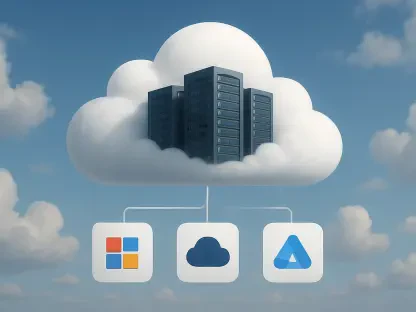
The established dominance of hyperscale cloud providers is set to be profoundly challenged by the emergence of specialized “neoclouds” designed specifically for artificial intelligence workloads. These agile and focused competitors are forecasted to aggressively capture new business, carving out a significant niche by securing an estimated US$20 billion in revenue, primarily within the burgeoning generative AI sector. This disruption will force the incumbent cloud giants to react decisively. They are not expected to remain static; instead, they will counter this new competition by accelerating their own innovation pipelines, with a specific focus on developing and deploying highly sophisticated AI offerings. A key area of their counter-strategy will revolve around advancing agentic capabilities—intelligent AI systems that can operate autonomously to understand intent, make decisions, and execute complex, multi-step tasks without direct human intervention, thereby raising the bar for what enterprise AI can achieve.
However, this transition toward advanced AI services will not be a monolithic move into public cloud environments. A significant counter-trend will emerge, driven by escalating concerns over data privacy, security, and digital sovereignty. Projections indicate that at least 15 percent of enterprises will actively pursue private AI strategies to insulate their sensitive corporate data from the perceived overreach and potential vulnerabilities of major cloud providers. This strategic pivot toward greater control will be further evidenced by a 20 percent adoption rate for “private AI factories” and a surprising resurgence of on-premises servers, which are expected to recapture a 50 percent share of the server market. This period of intense technological change and infrastructure upgrades will place unprecedented strain on the existing commodity cloud infrastructure, leading to significant instability. In fact, these pressures are explicitly warned to trigger at least two major, multiday cloud outages, disrupting services on a massive scale and testing the resilience of global digital operations.
Evolving Automation and the Rise of Cognitive Workflows
In the realm of enterprise automation, 2026 will mark a definitive shift away from the deterministic, rules-based systems of the past toward more adaptive, AI-driven cognitive autonomy. This evolution is expected to unlock substantial business value, with advanced automation and strategic robotics projected to enable 20 percent of new enterprise use cases, from intelligent supply chain management to dynamic customer service personalization. Despite the immense potential, enterprise adoption will be tempered with a healthy dose of caution. It is anticipated that less than 15 percent of firms will fully activate the most advanced agentic features within their intelligent automation suites, suggesting a measured and risk-averse approach to deploying fully autonomous systems that can act on their own behalf. In this complex environment, the role of process intelligence will become paramount, serving as a critical governance and optimization tool for ensuring project success and delivering a tangible return on investment.
As organizations navigate this new landscape, process intelligence is predicted to be the saving grace for many ambitious initiatives, rescuing an estimated 30 percent of otherwise failing AI projects by providing the necessary visibility and insights to optimize and govern intricate workflows. The central challenge for enterprises in 2026 will be to reconcile the relentless drive for innovation with the non-negotiable need for robust controls and oversight. As historically distinct automation markets—such as Robotic Process Automation (RPA), Integration Platform as a Service (iPaaS), and Business Process Management (BPM)—continue to converge into unified platforms, the most successful enterprises will be those that master the delicate balance of integrating adaptive AI intelligence with proven governance mechanisms. This mastery will unlock unprecedented speed and flexibility without sacrificing the trust and oversight essential for enterprise operations. A remarkable display of this new capability is expected when an agentic AI workflow autonomously anticipates and prevents a major operational outage, showcasing the profound potential of cognitive automation.
The Transformation of Enterprise Software and the Digital Workforce
The very definition of a workforce is set to be redefined as enterprise software applications evolve far beyond their traditional roles. The new paradigm will move from merely providing employees with digital tools to fully embracing and accommodating a “digital workforce” composed of sophisticated AI agents. Technology leaders will need to mentally and strategically prepare for a reality where entire business processes and complex workflows are digitized and executed by AI, often operating independently of their human counterparts. This profound shift will be reflected in mainstream business platforms; the top five Human Capital Management (HCM) platforms are expected to roll out new capabilities specifically designed for onboarding, managing, and monitoring these new digital employees alongside human staff. The impact will be widespread and transformative, with AI automating over 20 percent of all enterprise application workflows, from finance and procurement to human resources, fundamentally altering how work gets done.
In response to this new reality, a new layer of oversight will become essential. To manage the complexity and risks associated with highly autonomous systems, half of all Enterprise Resource Planning (ERP) vendors will launch specialized autonomous governance modules. These tools will be designed to oversee AI-driven processes, ensure compliance, and provide a transparent audit trail for decisions made by non-human agents. This focus on governance will extend deep into the world of software creation itself, which is projected to become the number one use case for AI. The innovation will extend far beyond simple code generation; in 2026, AI will be deeply integrated across the entire Software Development Life Cycle (SDLC), from initial planning and architectural design to automated testing and deployment. This will necessitate a new and intense focus on “engineering governance” to manage the quality, security, and maintainability of AI-assisted software development, ensuring that speed does not come at the cost of stability or reliability.
Navigating the AI Driven Future
As the dust settled on the tumultuous year of 2026, it became clear that the enterprises that thrived were those that had moved beyond experimentation and had successfully integrated AI into their core operational fabric. They had not only invested in new technologies but had also fundamentally re-architected their governance frameworks and talent strategies to accommodate a hybrid human-digital workforce. The predicted cloud outages had indeed occurred, serving as a stark reminder of the fragility of legacy infrastructure under the strain of AI workloads and prompting a significant re-evaluation of multi-cloud and private AI strategies. The organizations that had proactively built resilience and established robust data sovereignty policies were able to weather these disruptions with minimal impact, gaining a significant competitive advantage. They had treated AI not as a series of isolated projects but as a foundational capability that required a holistic and strategic approach, blending innovation with a pragmatic understanding of risk.
The critical talent shortage in software development proved to be one of the most significant bottlenecks to innovation, just as forecasted. The average time required to fill developer positions with the necessary AI and governance skills had doubled, slowing down progress for many unprepared firms. However, the leading companies had mitigated this challenge through aggressive internal upskilling programs, strategic partnerships with educational institutions, and the adoption of low-code platforms that empowered a broader range of employees to participate in the development process. They had also embraced the new discipline of “vibe engineering,” creating structured processes to translate high-level business intent into functional, AI-generated software. In the end, the year had solidified the fact that navigating the AI-driven future was less about having the best algorithms and more about building a resilient, adaptable, and well-governed organization capable of harnessing the power of intelligent automation responsibly and effectively.