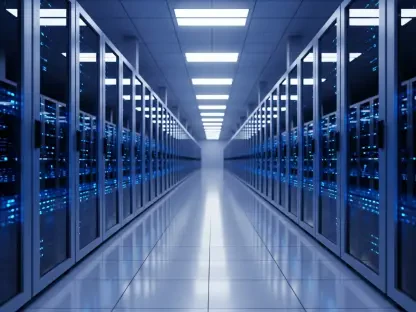

The sheer magnitude of the global capital reallocation toward artificial intelligence infrastructure suggests that the industry is no longer merely a software-driven phenomenon but a full-scale industrial revolution. As 2026 unfolds, technology giants are transitioning away from the lean, code-centric growth models that defined the previous decade in favor of a heavy-industry approach that demands immense physical assets. Industry leaders now estimate that building the necessary hardware and data centers to sustain this development could require a staggering $4 trillion investment by the end of the decade. This fundamental shift requires total hardware dominance and stable energy supplies, turning tech companies into some of the world’s largest property owners and energy consumers. Nvidia CEO Jensen Huang recently highlighted that this reallocation of capital is not just a temporary surge but a foundational rebuilding of the world’s computing stack. This transition underscores a new era where the ability to secure physical resources is just as vital as the algorithms themselves.
The Strategic Realignment: Why Exclusive Partnerships Are Fading
The evolution of the partnership between Microsoft and OpenAI serves as a blueprint for this new era of high-stakes investment, where early strategic bets are transforming into massive financial commitments. What began as a $1 billion deal in 2019 has ballooned into a $14 billion commitment, effectively turning Microsoft’s Azure cloud into the primary engine for generative AI workloads. However, as the scale of required resources grows, these once-exclusive alliances are becoming increasingly fluid to accommodate the sheer volume of computation needed for next-generation models. OpenAI is currently diversifying its infrastructure needs to avoid over-reliance on a single provider, moving away from cloud exclusivity to explore a more fragmented but resilient supply chain. This shift forces cloud giants to adapt their strategies, ensuring that their platforms remain competitive and capable of hosting diverse foundational models regardless of their primary business affiliations or long-standing partnerships.
Oracle has recently emerged as a formidable powerhouse in this infrastructure race, challenging the long-standing dominance of Google and Microsoft through aggressive capital expenditure and strategic positioning. By securing a massive $30 billion cloud services agreement and pledging a $300 billion commitment for future computing power starting in 2027, Oracle is positioning itself as a central pillar of the global AI ecosystem. This expansion illustrates how secondary players in the cloud market are leveraging their financial weight to capture a significant share of the hyperscale segment. Oracle’s ability to move quickly and secure massive contracts indicates that the competitive landscape is no longer limited to the traditional “Big Three” cloud providers. As these companies race to provide the high-capacity environments necessary for training trillion-parameter models, the market is becoming a battleground for physical scale, where the winners are determined by their ability to deploy tens of thousands of GPUs in record time.
The Backbone of Computation: Hardware Cycles and Proprietary Power
Nvidia stands at the center of this infrastructure surge, acting as both the primary supplier of the Graphic Processing Units essential for AI training and a major financier for its own customers. The company has pioneered a unique financial cycle, investing billions into AI startups and established firms with the understanding that those funds will be spent directly on Nvidia’s own high-end hardware. While this “revolving door” economy has driven the company to record valuations, it also draws intense scrutiny from regulators and investors who worry about the long-term sustainability of such an interconnected and hardware-dependent market. The concentration of power in a single hardware provider creates a bottleneck that the entire industry must navigate, as any supply chain disruption could stall the progress of the world’s most advanced AI research. This dynamic has forced developers to consider alternative hardware solutions, though Nvidia’s dominance remains unchallenged due to its robust software ecosystem and manufacturing leads.
In contrast to competitors who rely on third-party cloud agreements, Meta is doubling down on a strategy of total self-sufficiency through proprietary infrastructure located within the United States. CEO Mark Zuckerberg has committed hundreds of billions toward building domestic hyperscale data centers, such as the massive Hyperion and Prometheus projects, which represent a significant portion of the company’s capital expenditure. These facilities are designed to handle unprecedented power loads, sometimes reaching several gigawatts, as Meta seeks to control every aspect of its AI pipeline—from the foundational models to the physical power sources that run them. By investing in projects that explore natural gas and potentially nuclear energy, Meta is attempting to insulate itself from the volatility of the public energy grid. This move toward vertical integration ensures that the company can maintain the high-duty cycles required for constant model training without being subject to the pricing or availability constraints that affect its more cloud-dependent rivals.
National Strategic Initiatives: The Stargate Project and Financial Projections
A new level of collaboration is appearing in the form of the Stargate project, a $500 billion initiative aimed at cementing American leadership in the AI sector through massive infrastructure development. This partnership between SoftBank, Oracle, and OpenAI, which receives significant federal backing, focuses on building a network of high-density data centers across the United States. Proponents view this as a vital national interest, ensuring that the critical infrastructure for the next generation of intelligence remains on domestic soil. However, market observers remain cautious about the regulatory and logistical hurdles involved in constructing such high-density computing hubs in a short timeframe. The project aims to establish eight major data centers in Abilene, Texas, by the end of 2026, representing a monumental engineering challenge. This initiative reflects a broader trend where AI infrastructure is no longer just a corporate priority but a matter of national security and economic competition on a global scale.
Despite the optimism surrounding these projects, the sheer scale of projected spending for the current year raises significant questions about financial and environmental stability. With companies like Amazon and Google planning to spend between $175 billion and $200 billion annually on data centers, the industry is facing a “winner-takes-all” scenario where the cost of entry is becoming prohibitively high. As these hyperscalers navigate rising energy demands and local environmental regulations, the focus is shifting from the excitement of building this $4 trillion foundation to the difficult task of proving its long-term profitability. The financial burden of these investments is immense, often requiring companies to take on significant debt or reallocate funds from other vital departments. Investors are increasingly looking for evidence that these massive data centers will translate into tangible revenue streams, as the period of speculative growth begins to give way to a demand for concrete returns.
Future Considerations: Navigating Environmental Constraints and Economic Returns
The transition toward a fully integrated AI economy was marked by a collision between technological ambition and the physical limits of the existing energy infrastructure. As data centers grew in size and power consumption, the industry had to pivot toward more sustainable energy solutions, including modular nuclear reactors and advanced carbon capture technologies. This shift was not merely an environmental choice but a logistical necessity, as traditional power grids in many regions reached their maximum capacity, leading to project delays and increased operational costs. Companies that successfully integrated their own power generation capabilities gained a significant advantage, while those relying on external utilities faced mounting regulatory pressure and rising prices. This period demonstrated that the future of AI is as much about energy innovation as it is about algorithmic breakthroughs, requiring a multidisciplinary approach to infrastructure that spans beyond the traditional boundaries of the technology sector.
To ensure long-term viability, the technology industry focused on moving from a phase of massive capital deployment to one of operational efficiency and revenue generation. The focus shifted toward the development of specialized hardware that reduced the energy footprint of inference, allowing for more cost-effective scaling of AI services to the general public. Leaders in the space prioritized the creation of localized data networks and sovereign AI capabilities to address growing concerns over data privacy and national security. By diversifying their investment portfolios and fostering a more competitive hardware market, the major players mitigated the risks associated with the closed-loop economic models that characterized the early years of the infrastructure surge. The successful navigation of these challenges allowed the $4 trillion investment to serve as a stable foundation for a mature AI economy, where the benefits of advanced computation were balanced against the realities of environmental stewardship and financial responsibility.