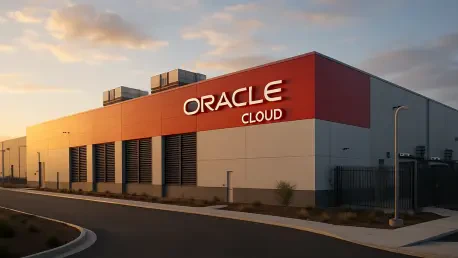

A single, weather-related power outage at a data center recently sent ripples far beyond the affected servers, shaking investor confidence in one of the world’s largest technology firms and highlighting the immense pressure on cloud providers to deliver flawless service. Oracle’s stock experienced a notable downturn after the company confirmed its infrastructure was the source of a widespread service disruption for U.S. TikTok users, a high-profile client whose stability is a testament to the cloud platform supporting it. Shares dropped 1.2% to close at $172.80 during a session marked by unusually high trading volume, with 35.4 million shares changing hands, a figure significantly above the 50-day average. This single point of failure has ignited a broader conversation about the resilience of Oracle’s cloud infrastructure at a time when the company can least afford to display weakness, forcing the market to re-evaluate the stability of a platform central to its future growth strategy.
The Fragility of Cloud Confidence
The Ripple Effect of a Single Outage
The recent disruption impacting TikTok’s massive user base was attributed by Oracle to a severe weather event that caused a power failure at one of its critical data centers. While such events are not entirely preventable, the incident immediately cast a shadow over Oracle’s core value proposition: unwavering reliability. In the hyper-competitive cloud computing arena, where uptime is the ultimate currency, any high-profile failure is magnified. This event provides ammunition for rivals like Microsoft Azure and Amazon Web Services, who dominate the market and build their reputations on robust, fault-tolerant architectures. For Oracle, which has been aggressively marketing its cloud infrastructure as a superior alternative, this outage represents a significant public relations setback. It raises questions not just about its disaster recovery protocols but also about the underlying resilience of a network that is foundational to its ambitious growth plans and its ability to support enterprise-level, mission-critical applications for major clients.
The market’s reaction underscores the sensitivity of investors to any perceived weakness in Oracle’s cloud offerings. The promise of the cloud is not just about scalability and cost-efficiency but also about a level of stability that surpasses what most companies can achieve on their own. When a provider fails to deliver on this promise, especially for a client as visible as TikTok, it erodes the trust that is essential for winning and retaining large enterprise contracts. The incident forces potential customers to weigh the risks of migrating their operations to Oracle’s platform. This is particularly damaging as the company is heavily investing in expanding its data center footprint to better compete globally. The failure suggests that simply building more infrastructure is not enough; ensuring that infrastructure is fail-safe and can withstand localized disruptions without cascading effects is paramount. For investors, this translates into a tangible risk that could slow customer acquisition and impact long-term revenue growth in a segment vital to Oracle’s future.
Amplified Financial Apprehensions
The TikTok outage occurred against a backdrop of already fragile investor sentiment surrounding Oracle’s financial trajectory. The company’s stock is often viewed as a high-beta investment, its performance closely tied to the volatile cycles of corporate spending on AI and cloud services. This sensitivity was exacerbated by Oracle’s December quarterly forecast, which fell short of market expectations and signaled potential headwinds. The recent service disruption, therefore, was not an isolated event in the eyes of investors but rather another piece of evidence that could suggest deeper operational or strategic challenges. It fuels a narrative of uncertainty, making it harder for the market to look past the company’s ambitious promises and focus on tangible, consistent performance. The concerns are now twofold: whether the company can execute its technological vision and whether it can manage its finances prudently while doing so, a balance that now appears more precarious.
Adding significant fuel to these financial concerns is Oracle’s aggressive plan to increase its capital spending by $15 billion for the fiscal 2026. This massive investment is intended to build out the necessary infrastructure to support its AI and cloud ambitions. However, in light of the recent outage, investors are questioning whether this capital is being deployed effectively to enhance resilience or if the rapid expansion is creating new points of failure. Furthermore, such a substantial increase in spending has stoked worries about the impact on the company’s profit margins. Analysts and shareholders are now scrutinizing how this expansion will be funded and what the return on this investment will look like, especially if service reliability issues persist. The fear is that Oracle could find itself in a difficult position, spending heavily to catch up to its competitors while simultaneously struggling to maintain the trust required to win the very customers this new infrastructure is designed to serve, potentially leading to shrinking margins without a commensurate growth in market share.
Navigating Economic Headwinds and Future Expectations
The Macroeconomic Context
Compounding Oracle’s specific challenges is a broader macroeconomic environment characterized by caution and uncertainty. The Federal Reserve’s recent decision to maintain its benchmark interest rate, signaling a prolonged pause, has left the market in a state of suspended animation. While the Fed acknowledged the resilience of the economy, its wait-and-see approach has introduced a level of unpredictability that affects high-growth technology stocks disproportionately. For Oracle, this means that its efforts to win investor confidence are being conducted on shakier ground. Traders are now forced to balance the company’s internal issues, such as the reliability of its cloud services and its heavy capital expenditures, with external pressures like persistent inflation and the potential for a future economic slowdown. This macroeconomic overlay makes it more difficult for Oracle’s growth story to shine through, as investors may prefer to hedge their bets and avoid companies with any hint of operational or financial risk until a clearer economic path emerges.
The prevailing economic climate directly influences corporate spending, which is the lifeblood of Oracle’s business. With interest rates holding steady at elevated levels, the cost of capital remains high for the enterprises that constitute Oracle’s primary customer base. This can lead to delays or reductions in large-scale IT projects, including major cloud migrations and AI initiatives. Consequently, Oracle’s ambitious sales targets and revenue forecasts become harder to achieve. The company finds itself in a position where it must not only convince potential clients of its technological superiority and reliability but also justify the significant investment at a time when budgets are under intense scrutiny. The Fed’s cautious stance acts as a subtle but powerful headwind, tempering the very corporate enthusiasm for digital transformation that Oracle is counting on to fuel its expansion and validate its massive infrastructure investments in the coming quarters.
A Critical Quarter Ahead
The immediate path forward for Oracle hinged on two critical fronts that investors watched with intense focus. The first was the complete and sustained restoration of TikTok’s services. Any further glitches or performance issues would have been seen as confirmation of deeper systemic problems within Oracle’s cloud infrastructure, a perception that could have caused irreparable damage to its brand. A smooth and stable operational period was required to begin the process of rebuilding trust and demonstrating that the outage was an isolated incident rather than a symptom of a larger flaw in its architecture. This operational test was viewed as a real-time indicator of the company’s ability to manage its expanding network under pressure and deliver the high-availability service it had promised to its enterprise clients, making it a crucial, non-financial benchmark for market analysts.
Simultaneously, all eyes were on the company’s fiscal third-quarter earnings report, which was anticipated in mid-March. This financial disclosure was expected to provide the first concrete updates on the company’s performance following the period of heightened scrutiny. Investors were particularly keen to see how management would address the reliability concerns and what strategic adjustments, if any, were being made to fortify its infrastructure. Furthermore, the report was expected to offer crucial details on the company’s plan for managing its significant expansion costs and its outlook on profit margins. The narrative that Oracle’s leadership presented during the earnings call, combined with the hard financial data, was set to play a pivotal role in shaping market sentiment. It was a moment where the company had to provide a clear, convincing strategy for reinforcing its service reliability while navigating a challenging economic landscape and justifying its substantial capital investments to a skeptical audience.