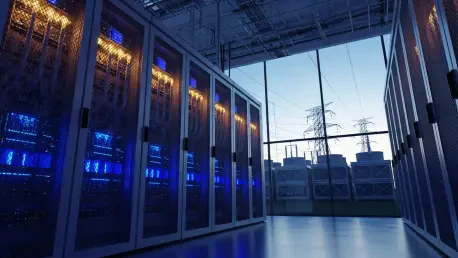

The global semiconductor industry and hyperscale datacenter operators have entered a phase of capital expenditure that dwarfs previous technological cycles, with total investments in artificial intelligence infrastructure now projected to reach one point three trillion dollars. This massive financial commitment reflects a pivot from experimental models to industrial-scale deployment across every major sector. Companies like Microsoft, Amazon, and Meta are no longer just purchasing chips; they are redesigning the very fabric of digital architecture to support the intense computational demands of trillion-parameter models. This transition has triggered a chain reaction throughout the supply chain, forcing an overhaul of procurement strategies and facility designs. As these enterprises race to secure their dominance, the focus has shifted toward building resilient environments that can sustain continuous training workloads without interruption or latency bottlenecks. These investments signify a long-term belief in the transformative power of intelligence globally.
Physical Infrastructure: Silicon and Power
Hardware Optimization: Specialized Accelerators
The volume of capital flowing into specialized hardware has accelerated the development of next-generation accelerators that prioritize energy efficiency alongside raw performance. Current procurement trends indicate a move away from general-purpose CPUs toward customized silicon, such as the latest iterations of NVIDIA GPU architectures and Google Tensor Processing Units. These components are being integrated into massive clusters that require sophisticated interconnects to facilitate the rapid exchange of data between tens of thousands of nodes. Furthermore, the rising thermal design power of these chips has rendered traditional air cooling obsolete in high-performance settings. Consequently, a substantial portion of the trillion-dollar investment is being directed toward liquid cooling technologies. These cooling innovations are no longer optional luxuries but essential infrastructure components required to prevent thermal throttling and ensure the longevity of expensive hardware assets in dense server racks.
Energy Management: Grid Stability and Nuclear
As the digital infrastructure landscape expands, the primary constraint on growth has transitioned from chip availability to power grid capacity and electrical stability. Hyperscale operators are increasingly forced to act as their own utility providers, investing in dedicated renewable energy projects and exploring advanced nuclear options such as small modular reactors to guarantee a steady supply of electricity. The integration of massive battery storage systems and microgrids has become a standard feature of modern datacenter blueprints to mitigate the risks of regional grid instability. This shift represents a change in how technology companies approach site selection, with access to high-voltage transmission lines now carrying more weight than proximity to urban centers or fiber hubs. Moreover, the industry is witnessing a surge in energy-aware scheduling algorithms. This approach to power management is essential for sustaining forecasted spending levels while adhering to strict sustainability mandates.
Strategic Allocation: Sovereign Clouds and ROI
National Initiatives: Compute Independence
The movement toward sovereign artificial intelligence has become a major driver of global infrastructure spending, as nations recognize that computational power is a critical component of national security and economic autonomy. Governments in regions such as the Middle East, East Asia, and Europe are allocating billions to build domestic computing clusters that reduce their reliance on foreign cloud providers. These initiatives are designed to foster local ecosystems by providing startups and researchers with resources to develop models tailored to specific cultural and linguistic contexts. For instance, massive investments in the United Arab Emirates and Saudi Arabia are being used to establish some of the world’s most powerful supercomputers, positioning these nations as regional hubs for innovation. This trend is also influencing the supply chain, as countries offer incentives for semiconductor manufacturing facilities to be built within their borders. By diversifying compute, these programs are reshaping the digital world.
Future Implementation: Efficiency and Scalability
Industry leaders recognized that the successful deployment of such vast capital required a shift from brute-force scaling to precision architectural efficiency. Organizations that flourished during this period prioritized the integration of software-defined infrastructure to maximize the utilization rates of their hardware assets. It became clear that simply building larger datacenters was insufficient; the focus shifted toward optimizing the entire stack, from low-level firmware to high-level orchestration layers. Decision-makers evaluated their investments based on the total cost of ownership and the ability to pivot as new architectures emerged. For businesses looking to navigate this landscape, the path forward involved securing long-term power agreements and fostering deep partnerships with vendors to ensure a stable supply of components. Those who implemented modular datacenter designs scaled more rapidly than competitors. The era of trillion-dollar spending proved successful players were agile.