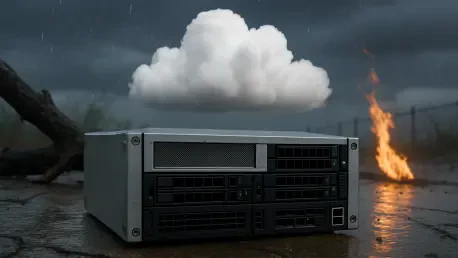

The reliability of modern cloud computing faced a profound physical challenge on March 1 when a catastrophic fire at an Amazon Web Services facility in the Middle East triggered widespread service disruptions. The crisis began at approximately 4:30 AM PST when external objects physically struck a data center located within the mec1-az2 Availability Zone in the United Arab Emirates. This impact ignited a structural fire that necessitated an immediate response from local emergency teams, who were forced to terminate both primary and backup power supplies to ensure safety. Consequently, a sudden blackout caused the immediate collapse of Elastic Compute Cloud instances, Elastic Block Store volumes, and various localized databases. This event demonstrates that even the most sophisticated digital ecosystems remain deeply tethered to the integrity of their physical hardware. Organizations across the region found themselves unable to access essential resources, highlighting a significant vulnerability in localized infrastructure management.
Physical Infrastructure Vulnerabilities and Immediate Operational Impact
The fallout from the structural fire was immediate and extensive, primarily devastating the ME-CENTRAL-1 region in the United Arab Emirates and eventually spilling over into the ME-SOUTH-1 region in Bahrain. In the UAE alone, over 38 essential services were rendered inaccessible, including critical developer tools such as AWS Lambda and the Amazon Elastic Kubernetes Service. While engineers managed to maintain or quickly stabilize storage services like S3, the core networking APIs suffered from prolonged failures that prevented administrators from managing their environments. This situation created a ripple effect where even secondary systems that relied on these APIs for health checks or automated scaling began to falter. The physical destruction of the power delivery system meant that traditional redundancy within the specific building was irrelevant, as the emergency responders had to prioritize fire containment over uptime. This incident serves as a stark reminder that the cloud is not an abstract entity but a collection of physical assets vulnerable to real-world accidents.
As the day progressed, the crisis expanded beyond the immediate vicinity of the fire, leading to a secondary wave of connectivity issues that impacted the Bahrain region. Technical logs indicated that 46 additional services, including the AWS Web Application Firewall and CloudFormation, experienced significant API connectivity degradations. This broader regional instability forced many organizations into a state of operational paralysis, especially those that had not configured their workloads for cross-region resilience. AWS technical teams worked around the clock to reroute traffic away from the damaged Availability Zone, yet the sheer volume of redirected requests placed an immense strain on the remaining infrastructure. The transition from a localized hardware failure to a multi-region service degradation underscored the complex interdependencies within the cloud provider’s global network. By late evening, the focus shifted from fire suppression to the complex task of restoring power and validating the integrity of data stored on the affected hardware.
Strategic Resilience and the Future of Cloud Architecture
To mitigate the damage during the height of the outage, AWS engineers advised clients to leverage multi-AZ redundancy strategies, which proved to be the only effective shield for many businesses. Those organizations that had proactively designed their architectures to span multiple Availability Zones remained largely operational, as their traffic automatically shifted to unaffected data centers. This event has validated the design for failure philosophy, which posits that every component of an infrastructure must be assumed to be temporary and prone to total loss. In contrast, businesses relying on a single zone faced total outages, losing access to customer-facing applications and internal data processing pipelines. The incident has spurred a renewed conversation regarding the critical necessity of geographical redundancy and the implementation of automated failover mechanisms. Moving forward, the industry must prioritize the deployment of cross-region architectures to ensure that a single physical disaster cannot disrupt entire economic sectors or critical public services.
The response to this catastrophic failure provided actionable insights into how cloud-native organizations should evolve their disaster recovery protocols through 2027 and 2028. Engineering teams observed that the most successful recovery efforts involved the use of infrastructure as code to rapidly redeploy environments in alternative regions, such as those in Europe or Asia. It became clear that relying on a single geographical cluster, regardless of its perceived stability, represented a significant business risk that required immediate remediation. Technical leaders advocated for the adoption of more robust health-checking systems that can detect physical infrastructure failures faster than standard API timeouts. Furthermore, the incident highlighted the importance of maintaining up-to-date offline backups for mission-critical data that might be trapped in a physically damaged facility. By integrating these strategies into their long-term planning, organizations ensured they were better prepared for unpredictable external threats, ultimately turning a moment of crisis into a foundation for building more resilient digital systems.