The Digital Divide: Why Datacenters Are Choosing Urban Cores or Rural Expanses
The physical backbone of our digital world is undergoing a strategic split, creating a new geography of data processing that mirrors a classic city-versus-country divide. As data consumption soars, foundational analysis reveals that datacenter operators are not expanding uniformly; instead, they are separating into two distinct camps with fundamentally different location strategies. This article explores the great divergence between “city slicker” colocation providers who cluster in dense urban centers and “country bumpkin” hyperscalers who build massive campuses in rural regions. It delves into the economic incentives driving these choices and examines the emerging hybrid model poised to define the future of digital infrastructure.
From Server Rooms to Server Farms: The Evolution of Digital Infrastructure
Historically, corporate datacenters were housed on-premise in an office building’s server room. As the internet grew, a need for specialized, third-party facilities gave rise to the colocation industry, with these early datacenters typically built near the businesses they served, establishing a precedent for urban placement. However, the dawn of the cloud era, driven by hyperscale giants, introduced a new paradigm. The sheer scale of processing and storage required by these companies created a new set of economic demands, shifting the focus from mere proximity to massive operational efficiency. This fundamental shift from localized support to global-scale computing is the critical backdrop for understanding the geographic split seen today.
The Great Divergence: Unpacking Colocation and Hyperscale Strategies
The Urban Imperative: Colocation’s Bet on Proximity and Performance
Colocation providers, which rent datacenter space and services to a multitude of clients, continue to anchor their operations in major metropolitan areas. This approach is dictated by the needs of their primary customers, particularly in industries like finance and healthcare. For these clients, low latency—the time it takes for data to travel—is a competitive necessity. A trading firm executing millions of transactions a second requires near-instantaneous data access that only a nearby facility can provide. Furthermore, urban datacenters offer robust physical security and easier access required to meet strict regulatory and compliance standards, making them the default choice for businesses valuing performance over raw scale.
The Rural Advantage: Hyperscalers’ Quest for Scale and Efficiency
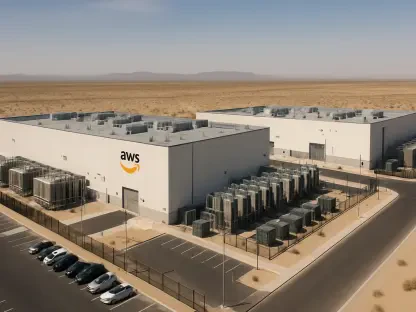
In stark contrast, hyperscale cloud providers have embraced a rural strategy, building sprawling server farm campuses in lower-density regions where they can achieve massive economies of scale. Locating outside cities allows them to acquire vast tracts of land and access cheaper electricity—both critical for facilities that can consume as much power as a small city. These locations are not chosen randomly, however. They must sit at the intersection of critical infrastructure: abundant power, sufficient water for cooling, and high-capacity fiber optic networks. Northern Virginia stands as the world’s premier example, attracting an estimated 10-15% of global hyperscale capacity because early network investments established it as a critical crossroads for digital traffic.
AI and Global Pressures: Reshaping the Geographic Blueprint
The rural strategy is being further entrenched by the rise of Artificial Intelligence and global market pressures. Many intensive AI workloads, such as model training, are less sensitive to latency and can be processed far from end-users, placing an even greater premium on access to cheap, plentiful power over urban proximity. This trend is not confined to the U.S. In Europe, high land and energy costs in primary hubs like London and Frankfurt are pushing hyperscale investment toward emerging secondary markets such as Oslo and Madrid. This global shift demonstrates that as computational demand grows, the search for resource-rich locations will increasingly lead operators away from traditional city centers.
The Hybrid Horizon: Merging Urban Edge with Rural Core
Looking ahead, the rigid divide between city and country is expected to blur, giving way to a more sophisticated hybrid pattern. The two models are predicted to work in concert, creating a more resilient and efficient digital ecosystem. In this scenario, massive hyperscale hubs in rural regions will handle the heavy lifting of bulk data processing, storage, and AI training. These will be complemented by a strategic network of smaller colocation and edge datacenters in urban areas, tasked with managing latency-sensitive applications like real-time analytics, online gaming, and IoT device communication. This “hub-and-spoke” model leverages the unique strengths of each location type, optimizing for both scale and speed.
Strategic Takeaways: Aligning Your Infrastructure with Business Needs
The key takeaway from this geographic split is that there is no one-size-fits-all datacenter solution. The analysis provides a clear framework for businesses to make informed infrastructure decisions based on core priorities. If operations depend on split-second response times and serving a dense customer base, a colocation facility in a major metropolitan hub is the logical choice. Conversely, if the primary need is cost-effective storage and massive-scale data processing for applications where latency is less critical, leveraging a hyperscale cloud provider with infrastructure in a low-cost rural region is the more strategic path. Understanding this distinction is crucial for optimizing performance and managing costs.
The Future is Distributed: Navigating the Datacenter’s New Geography
The strategic split between urban and rural datacenter locations is a direct and logical response to diverse economic and technological demands. It is not an arbitrary trend but a calculated balancing act between the need for speed and the pursuit of scale. As our reliance on data-intensive technologies like AI and the IoT continues to accelerate, the importance of this distributed infrastructure model will only grow. The future of the internet is not being built in one place but across a carefully orchestrated geography of interconnected urban and rural hubs, each playing a vital role in our digital lives.