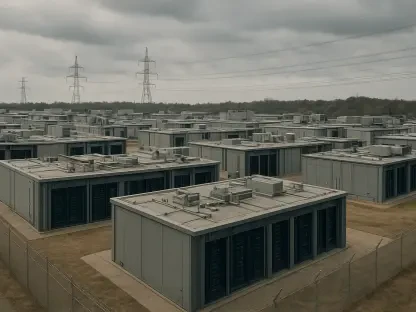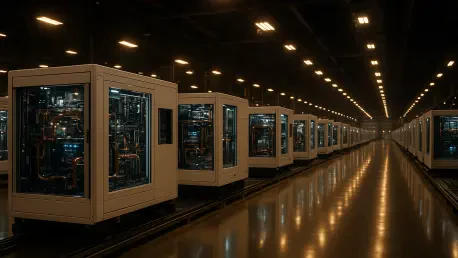

Alibaba Cloud has secured European CE certification and Southeast Asian product access certifications to standardize its rapid-deployment model across diverse international markets. This milestone signals a profound shift in how global digital foundations are laid, moving away from the sluggish timelines of the past toward an era defined by immediate scalability and high-density performance. This strategic move underpins a massive initiative to more than triple the production capacity of its modular data center systems, responding directly to the skyrocketing demand for high-performance computing fueled by generative artificial intelligence. By leveraging its technical prowess, the company intends to turn infrastructure speed into a decisive commercial advantage, effectively outpacing the slower, conventional construction methods that have long defined the industry. The cornerstone of this expansion is the CUBE 5.0 architecture, a next-generation framework designed to eliminate the bottlenecks that typically stall large-scale cloud projects during the initial build phase.
Transforming Infrastructure Through Modular Innovation
Building Block Logic: The Evolution of CUBE 5.0 Architecture
The architectural philosophy behind CUBE 5.0 represents a clean break from the past, moving away from customized, site-specific engineering toward a standardized “building block” methodology. While the broader industry has struggled to push modularization beyond the thirty percent mark, this latest iteration has achieved an unprecedented ninety percent modularization rate. This means that almost every critical component—from power supply units and advanced cooling systems to sophisticated security and fire suppression frameworks—is integrated into a cohesive, pre-engineered module. By adopting a parallel production model, the company can manufacture these high-tech components in a climate-controlled factory environment at the same time as the physical ground is being broken at the data center site. This synchronized approach ensures that the infrastructure components are ready for shipping and installation the moment the foundation is dry, drastically reducing the idle time that usually plagues large infrastructure projects.
Rapid Deployment: Shattering Global Delivery Timelines
The standard timeline for commissioning a world-class data center has traditionally spanned eighteen months in the United States and approximately one year in China, creating a significant lag between investment and operation. Alibaba Cloud has effectively disrupted this status quo by establishing an aggressive one-hundred-day delivery benchmark for its specialized AI data centers. This streamlined cycle is divided into precise phases: thirty days for intensive factory production of the modular units, fifty days for the physical on-site installation of pre-fabricated modules, and a final twenty days reserved for rigorous commissioning and performance validation. Such agility is no longer just a logistical convenience; it is a vital necessity for enterprises that must scale their GPU clusters rapidly to keep pace with the accelerating development cycles of large language models. By cutting months off the delivery schedule, the company provides its clients with a faster route to market, ensuring that the necessary hardware is online precisely when the demand peaks.
Economic Efficiency and Performance Standards
High-Density Scaling: Optimizing Costs and Power Density
Designing infrastructure for the modern era requires balancing three conflicting variables: speed of delivery, overall quality, and cost efficiency. The CUBE 5.0 architecture successfully navigates this “impossible triangle” by reducing construction costs per kilowatt by more than ten percent compared to previous iterations. Beyond cost savings, the system is specifically engineered to handle the intense thermal and electrical demands of modern AI workloads, offering a computing power density that is five to ten times higher than traditional data centers. This jump in density is critical because today’s high-end GPUs require massive amounts of power and specialized airflow that standard facilities simply cannot provide without significant and expensive retrofitting. By embedding this high-density capability into the core design of each module, the framework allows for the deployment of massive GPU clusters in a footprint that is far more compact than traditional layouts, maximizing the utility of physical space and reducing long-term overhead.
Engineering Resilience: Sustainability and Environmental Reliability
Environmental stewardship and operational reliability have become non-negotiable requirements for global cloud providers, especially as power consumption for AI continues to climb. CUBE 5.0 maintains an industry-leading Power Usage Effectiveness rating as low as 1.10 for liquid-cooled configurations, representing a significant leap in energy efficiency. The modular design is inherently flexible, allowing for a seamless transition between traditional air cooling and advanced liquid cooling technologies depending on the specific hardware requirements and regional climate conditions. This flexibility contributes to a smaller energy footprint and reduces the total number of transformers needed on-site, further lowering the environmental impact of the facility. Additionally, the shift toward factory-based manufacturing ensures a level of precision that is nearly impossible to achieve with on-site labor. Controlled environments allow for more stringent quality checks, resulting in a near-perfect success rate during the initial testing phase and ensuring long-term operational stability.
Global Expansion and Financial Drivers
Market Access: Strategic Certification for Global Growth
To facilitate its ambitious plan to triple global production capacity, the company has prioritized obtaining the necessary legal and technical certifications for international operations. Securing the European CE mark and various Southeast Asian product access standards was a critical hurdle, as these certifications validate that the modular architecture adheres to the strict safety and performance regulations of different geopolitical zones. These approvals allow for a standardized rollout of infrastructure across both mature Western economies and rapidly growing emerging markets without the need for extensive redesigns for every new country. Pilot programs conducted in regions like Ulanqab have already demonstrated the scalability of this model, proving that the prefabricated modules can be transported and assembled in diverse geographic and climatic conditions with consistent results. This standardized approach not only lowers the risk for international clients but also creates a predictable blueprint for expansion that can be replicated across a global network.
Forward Outlook: Financial Growth Fueled by AI Services
The final shift in corporate strategy became evident when financial reports highlighted how deeply AI-related products and Model-as-a-Service platforms had begun to drive revenue growth. Recent data confirmed that artificial intelligence services accounted for more than thirty percent of external revenue, with annual recurring earnings from the AI division reaching the multi-billion dollar mark. Decision-makers successfully integrated the high-performance CUBE 5.0 infrastructure with advanced software layers, positioning the organization to capture maximum value from the evolving digital economy. Forward-looking strategies prioritized the refinement of liquid-cooling technologies and the expansion of standardized modular hubs into underserved regions. Organizations that sought to modernize their digital assets utilized these rapid-deployment models to avoid the pitfalls of traditional infrastructure lag. Ultimately, the transition to modular, high-density environments provided a sustainable solution for the massive compute requirements that defined the technological landscape.