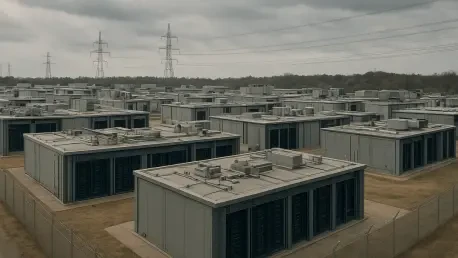

The tension between the insatiable demand for AI processing and the physical reality of power grid limits is reshaping the data center infrastructure market. The Data Center Physical Infrastructure market reached $14 billion in manufacturer revenue during the second quarter, representing a 27% year-over-year increase. While this shows robust momentum, growth has slowed slightly compared to previous quarters. This deceleration is not due to a lack of interest in AI capacity but stems from the increasing difficulty of obtaining permits and rising community opposition. Siting and permitting are now the most significant near-term obstacles to market expansion as project timelines stretch due to power shortages and equipment delays. Hyperscalers are eager to spend, yet they face a physical world that cannot always keep pace with digital ambitions. The industry is now forced to navigate a complex environment where securing a location is just as difficult as designing the technology within it.
Innovations in Thermal and Power Systems
Technological responses to these constraints are driving a rapid transition toward managing the extreme heat produced by AI clusters. Thermal management emerged as the fastest-growing segment, expanding by more than 40% year-over-year. This growth is primarily fueled by direct liquid cooling and advanced heat rejection systems like high-efficiency chillers. As AI hardware becomes more dense, traditional air-cooling methods are proving insufficient, making liquid-to-chip interfaces a new industry standard. Manufacturers are prioritizing integrated systems that can handle power densities that were previously unimaginable. This shift is essential because thermal efficiency directly impacts the performance and reliability of high-cost computing assets. The redesign of the server rack is central to this evolution, with vendors focusing on modular cooling units that can be deployed quickly. These innovations allow operators to maximize capacity even when they cannot secure additional land for facilities.
Electrical infrastructure is also evolving to support these high-density workloads while addressing energy scarcity. The market for Uninterruptible Power Supplies grew by 20%, with a clear shift toward large three-phase systems and megawatt-class power blocks. Engineers are exploring medium-voltage designs and 800 VDC architectures to improve efficiency and reduce power conversion losses. These designs are critical for maximizing the utility of available grid connections, which have become a precious commodity. Vendors are moving deeper into on-site power generation and microgrid technology to provide facilities with greater energy independence. This move helps mitigate the impact of long-lead equipment delays and the uncertainty of traditional utility upgrades. By integrating energy storage and more efficient distribution methods, data center operators can bypass some of the grid-related hurdles that currently plague the market. Efficiency is no longer just about cost; it is a fundamental strategy for viability.
Market Geography and Regulatory Realities
Customer dynamics are shifting as a new hierarchy of data center users emerges to meet the demands of the AI era. Colocation providers remain the largest customer group, but the fastest-growing segment consists of AI model builders and neoclouds. These entities are prioritizing rapid deployment of massive computational clusters, often at the expense of traditional enterprise workloads which continue to dwindle. Geographically, North America remains the primary hub for investment, yet the EMEA region is seeing its fastest growth since 2021. This surge is driven by sovereign AI initiatives and a wave of new colocation projects across Europe as countries seek to maintain digital autonomy. These new players are willing to pay a premium for space that is already permitted and powered, leading to a highly competitive environment for existing capacity. The rise of these specialized clouds is forcing established providers to rethink their service models to accommodate specialized machine learning needs.
Regulatory resistance eventually hardened into statewide policies that dictated the market’s trajectory through the mid-2020s. New York implemented a data center moratorium, while Pennsylvania ended its fast-track permitting, forcing developers to adopt more transparent and sustainable building practices. In Texas, the ERCOT interconnection queue became a major bottleneck as audits for large-load studies delayed dozens of projects. Industry leaders responded by pursuing strategic mergers that focused on self-sufficiency and on-site resource management. Ecolab acquired CoolIT Systems to enhance thermal efficiency, and Vertiv expanded into microgrids to offer localized power solutions. These actions stabilized the sector by reducing its reliance on strained public infrastructure and addressing community concerns regarding resource consumption. Companies that prioritized water recycling and energy storage found a clearer path toward approval. The industry moved toward a resilient model that balanced AI growth with social reality.