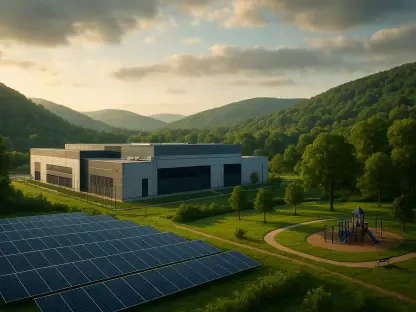

Crusoe’s modular factories successfully ran frontier AI models, including the DeepSeek-V3 671B, with the same per-GPU throughput measured in traditional high-density clusters. This achievement represents a fundamental pivot in how the industry perceives high-performance computing, moving away from the necessity of sprawling, multi-year construction projects toward agile, prefabricated solutions. By securing the NVIDIA Exemplar Cloud performance status, the company has effectively bridged the gap between modular flexibility and hyperscale computational density. The validation of the Spark modular AI factories signifies that the internal architecture and power integration of a facility are now far more critical than the exterior walls themselves. This shift enables rapid scaling in response to the explosive demand for generative models, ensuring that infrastructure can keep pace with the swift evolution of the Blackwell Ultra GPU architecture without the typical delays associated with traditional data center expansion.
Performance Validation: The NVIDIA Exemplar Initiative
Standardized Benchmarking for Real-World Workloads
The NVIDIA Exemplar Cloud initiative serves as a definitive yardstick for measuring the actual utility of cloud infrastructure in real-world environments. Rather than relying on theoretical peaks or isolated hardware metrics, this program utilizes the comprehensive NVIDIA Performance Benchmarking Suite to evaluate the entire system under the stress of production-grade workloads. For an organization like Crusoe, participating in this program was a necessary step to prove that modular units do not compromise on the throughput required for training the largest Large Language Models in the market. By focusing on end-to-end performance, the initiative ensures that every component—from the storage controllers to the networking fabric—is operating in perfect harmony with the GPU clusters. This transparency provides potential users with the confidence that their most complex training jobs will behave predictably, effectively standardizing expectations across various cloud providers.
Reliability and Predictability in AI Training
By aligning with the NVIDIA reference architecture, Crusoe has eliminated the ambiguity that often plagues early adopters of new hardware generations. This certification acts as an objective, third-party validation that the internal orchestration of the Spark modular units is identical to the most advanced traditional data centers in existence. Developers and researchers often face significant risks when moving large-scale jobs to new providers, fearing that non-standard configurations might result in suboptimal throughput or unexpected downtime. However, the Exemplar status guarantees that the software stacks and hardware interconnects have been vetted against the highest industry standards. This level of verification is particularly important as training workloads grow in complexity, requiring precise synchronization across thousands of GPUs. The result is a reliable environment where the focus remains on algorithmic innovation rather than troubleshooting underlying infrastructure inconsistencies.
Technical Specifications: The Blackwell Ultra Advantage
Computational Superiority of the HGX B300
The technical foundation for this performance milestone was the integration of the NVIDIA HGX B300 systems, which utilize the Blackwell Ultra architecture to push the limits of modern computing. These systems represent a drastic improvement in efficiency, offering roughly one and a half times the dense compute performance compared to the previous generation of hardware. This leap is essential for handling the massive mathematical operations required for generative AI training and inference. Furthermore, the B300 systems provide double the attention-layer performance, a metric that is specifically tailored to the Transformer architectures that dominate the current AI landscape. By housing these high-density systems within modular enclosures, the infrastructure demonstrates that peak thermal and electrical loads can be managed effectively outside of traditional settings. This capability ensures that the most advanced silicon available can operate at its full potential in a portable format.
Networking Bandwidth and Scale-Out Fabric
Networking bandwidth has emerged as a primary bottleneck in distributed AI training, but the modular units address this challenge through a robust scale-out fabric. With 1.6 terabytes per second of networking bandwidth, these systems have effectively doubled the capacity of the previous generation, allowing for seamless communication between nodes. This high-speed interconnect is critical for maintaining high GPU utilization rates during the training of models with billions of parameters. Additionally, the inclusion of 2.1 terabytes of total high-bandwidth memory per system ensures that even the most memory-intensive tasks can proceed without the latency issues that often hamper smaller clusters. The combination of increased memory capacity and massive networking throughput allows the modular factories to behave as a single, cohesive supercomputer. This technical superiority ensures that the infrastructure can support the next wave of frontier models, which require massive data movement.
Design Efficiency: Modular Parity and Performance
Eliminating the Performance Gap in Modular Enclosures
A long-standing concern in the technology sector was the existence of a “modular discount,” where prefabricated units were assumed to be less efficient than their larger, static counterparts. The recent validation on the Blackwell Ultra platform has effectively debunked this myth by showing that performance parity is entirely achievable. During the testing phase, Crusoe ran frontier models across various precisions, including BF16, FP8, and the advanced NVFP4. The results indicated that the per-GPU throughput measured in the Spark factories was identical to the metrics recorded in traditional high-density clusters. This finding proves that the physical form factor of the data center does not dictate the efficiency of the silicon inside. Instead, it is the quality of the thermal management and power delivery systems that determine success. By proving that modular units can maintain these high standards, the industry has gained a level of freedom in how and where compute is deployed.
Consistent Throughput for Massive Frontier Models
The scope of the validation included some of the most complex AI architectures currently being developed, including large-scale Mixture of Experts and dense models. Systems like the DeepSeek-V3 671B and the Llama 3.1 405B were utilized to push the boundaries of what these modular factories could handle in a production environment. Successfully running these models requires more than just raw power; it demands a sophisticated understanding of how data flows through the entire cluster. The fact that these massive models performed as well in a modular unit as they would in a traditional hyperscale facility is a testament to the engineering precision behind the Spark design. This consistency allows AI development teams to scale their operations horizontally without worrying about diminishing returns as they add more modular units to their fleet. The ability to rely on standardized performance metrics is a vital component for long-term project planning in the competitive AI sector.
Operational Excellence: Integration and Rapid Scale
Uniform Software and Hardware Interconnectivity
Engineering consistency is at the heart of the Crusoe philosophy, particularly regarding the software and hardware integration within their modular factories. The company has made a strategic decision to utilize the exact same technical stack across all of its facilities, regardless of whether they are massive campuses or compact Spark units. This includes the use of Ubuntu 24.04 as the base operating system, integrated with the latest NVIDIA CUDA and DOCA-OFED drivers to ensure hardware compatibility. By maintaining this level of uniformity, the infrastructure provides a seamless experience for developers who may be moving workloads between different sites. The orchestration layer, utilizing Slurm cluster configurations and container runtimes like Enroot and Pyxis, is also identical across the entire network. This approach minimizes the friction associated with deploying new capacity, as the software environment remains constant, allowing teams to focus on their models rather than infrastructure.
Precision Engineering: The Spark Deployment Philosophy
The Spark AI factory model redefines the data center as a high-precision machine that can be manufactured with the same consistency as the servers it houses. These units are prefabricated in controlled off-site environments, where every detail of the power distribution and cooling system is managed to handle the extreme heat rejection required by Blackwell GPUs. This manufacturing-centric approach allows for a level of quality control that is difficult to achieve on a traditional construction site where environmental factors and labor variations can impact the final build. Each unit is equipped with integrated fire suppression and remote monitoring systems, creating a self-sufficient environment that is optimized for high-density compute. By treating the facility as a product rather than a project, the company can innovate and iterate on the design much faster than traditional builders. This precision engineering ensures that each factory is ready to perform from the moment it is commissioned.
Strategic Integration: Sustainability and Vertical Control
Energy-First Philosophy and Renewable Power
Sustainability is a core component of the modular factory design, which prioritizes an “energy-first” strategy to power its high-performance clusters. This approach was recently demonstrated in Nevada, where HGX B300 systems were powered using a combination of large-scale solar arrays and repurposed electric vehicle batteries. This setup proves that even the most demanding frontier-scale AI training can be conducted using renewable energy without sacrificing the performance required for NVIDIA Exemplar status. By integrating energy storage directly into the infrastructure plan, the modular units can maintain a consistent power supply even when solar or wind resources are intermittent. This focus on sustainable power is not just an environmental choice but a strategic one, as it allows for the deployment of AI capacity in regions where the traditional power grid may be constrained. This model provides a blueprint for how the technology sector can balance growing energy needs with global decarbonization goals.
Domestic Manufacturing and Global Scalability
A significant part of the company’s competitive advantage stems from its extensive domestic manufacturing footprint, which spans approximately one million square feet across the United States. With major facilities in Colorado, Oklahoma, and Louisiana, the company has established a robust pipeline for the engineering and assembly of its modular AI factories. This American-based manufacturing strategy allows for direct oversight of the production process, ensuring that every unit meets the stringent requirements of the NVIDIA Blackwell architecture. The operation employs a dedicated workforce of 15,000 skilled professionals, including specialized welders and electrical engineers. This massive investment in human capital and physical infrastructure is what enables the rapid 90-day turnaround for new units. By keeping the manufacturing process domestic, the company can also mitigate the risks associated with international shipping, providing a more stable supply of high-performance compute.
Strategic Outlook: Future of High-Density Infrastructure
The industry recognized that the era of the fixed, massive data center campus was beginning to evolve into a more fragmented and responsive model. The successful validation of modular AI factories proved that performance was no longer tied to a specific physical location or building type. Decision-makers within the artificial intelligence sector realized that they could now prioritize proximity to renewable energy and speed of deployment without sacrificing the integrity of their training cycles. The achievement established a clear path for future infrastructure investments, emphasizing that vertical integration and manufacturing control were the primary drivers of success in the computational arms race. Organizations that adopted these modular philosophies found themselves better equipped to handle the rapid hardware cycles inherent in the Blackwell era. Ultimately, the transition toward high-density, rapidly deployable units provided the necessary agility to support a global landscape of sustainable, high-performance artificial intelligence.