
Lead: A Sharper Question About AI Scale
Budgets shifted, data maps sprawled, and a tougher question cut through the noise: who truly commands AI at enterprise scale when chips, models, data, and power constraints collide in the same boardroom conversation? On stage at Next, Google Cloud offered an audacious answer that threaded the needle between control and choice. The company pledged vertical integration “from chip to model to application” and insisted it could do that without locking customers in.
That promise sounded counterintuitive at first blush. History says tight integration tends to close doors, not open them. Yet the pitch landed because it flipped the usual calculus: integrate to win performance, interoperate to meet customers where their data already lives. The outcome, if delivered, would recast how enterprises budget for compute, architect data access, and judge the reliability of AI agents in live workflows.
Nut Graph: Why This Story Matters Now
Agentic AI has moved beyond flashy demos into expense approvals, claims processing, merchandising plans, and software release pipelines. In these settings, the winners are not the models that pass a benchmark in isolation but the systems that reach governed data fast, reason with context, and keep latency predictable under load. This is where enterprise AI is now contested: in the plumbing between knowledge and action, not just in parameter counts.
The market is already multicloud, and migrations have proven slower and riskier than expected. Customers want price-performance gains without breaking lineage, permissions, or existing analytics estates. Meanwhile, power and emissions have become procurement variables as clusters scale toward gigawatts. In short, performance leadership now depends on system-level design, while trust requires cross-cloud security and transparent operations. That is the backdrop for Google’s “open by design” refrain.
Inside the Bet: Co-Design Without Lock-In
At the heart of the message were eighth-generation accelerators: TPU 8t for training and TPU 8i for inference. Splitting the line acknowledged a practical reality—training craves scale and bandwidth, while production agents live and die by latency and cost per query. Google described “chips for Gemini and Gemini for chips” as an operating model, signaling that silicon roadmaps and model architectures were negotiated together years in advance. The claimed outcomes were lower cost per token, faster iteration loops, and smoother deployment at scale.
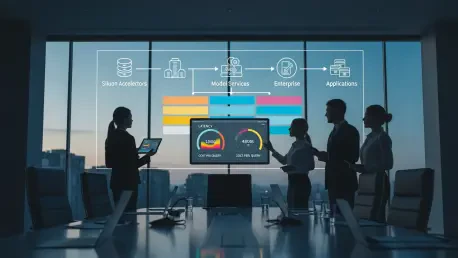
The stagecraft backed that claim with a simple refrain: “from chip to model to application.” It telegraphed that Google DeepMind and the infrastructure teams had aligned on bottlenecks early—interconnects, memory bandwidth, scheduling, and compiler optimizations—so that a gain at one layer did not create a choke point at another. Industry research has increasingly pointed to this kind of full-stack co-design as the new route to performance leadership across hyperscalers. In that light, the TPU 8t/8i split read as more than a product update; it looked like an organizational commitment.
Crucially, the vertical story arrived with a pressure valve. Google reaffirmed first-class support for Nvidia—name-checking forthcoming systems like the Vera Rubin NVL72—and framed TPUs as a choice, not a cage. The company argued that customers could map workloads to the best-fit accelerator while still using Gemini where it led, or routing task-specific jobs to alternatives where they excelled. “Open by design,” repeated from the stage, served as both mantra and market hedge.
Data as Fuel: Building a Cross-Cloud Fabric
Integration loses its edge without data, and here Google leaned into two planks: Knowledge Catalog and a Cross-cloud Lakehouse built on Cross-Cloud Interconnect. Knowledge Catalog promised to auto-enrich content on ingest—extracting entities, mapping relationships, and learning domain terms—to strip out manual tagging and brittle taxonomies. The aim was to feed agents with precise, contextual knowledge without placing new burdens on data engineering teams.
The cross-cloud fabric targeted a thornier problem: acting on data where it already sits. By anchoring to open table formats like Apache Iceberg and hardening high-bandwidth interconnects, Google argued that agents could operate across warehouses, lakes, and app stores with governance intact. That assumption mattered. Enterprises had learned the hard way that ETL-heavy migrations crack lineage and permissions, and that connectors rarely keep pace with API churn. A synchronized metadata plane—stretching to Unity Catalog, Polaris, and object stores like Amazon S3—offered a more resilient route.
Field anecdotes echoed the appeal. Retailers balked at re-platforming historical demand data for fear of losing audit trails. Insurers cited latency spikes that undermined adjuster tools when connectors throttled. By foregrounding catalog automation and managed interconnects, Google pitched a way to reduce both fragility and wait times. If it holds, the payoff is shorter time-to-value and fewer night calls to fix broken pipelines.
Openness, Partners, and Proof Points
Openness showed up less as slogan and more as connective tissue. On security, the Wiz integration was cast as a multi-cloud baseline that traveled with the customer—policies, identities, and data loss prevention spanning AWS, Azure, Oracle, Salesforce, SAP, and more. In regulated industries, that mattered; boards now asked whether one policy could govern everywhere rather than paying a compliance tax in each environment. If the promise is credible, it shrinks the surface area of drift between clouds.
On models, Google paired conviction with hedging. Gemini took center stage, but Anthropic access stood beside it, a quiet admission that no single model would dominate every task. The message was pragmatic: standardize on a platform that runs first-party and third-party models, measure by workload class—RAG, code, agents, batch inference—not brand, and route requests through evaluation gates. Enterprises heard a welcome nuance: choice without chaos.
Evidence from peers supported the system-first thesis. Across hyperscalers, the performance curve increasingly bent not on raw FLOPs alone but on orchestration, compiler stacks, and fabric design. Meanwhile, customer outcomes for agents improved most when data governance and low-latency access were solved up front. That consensus set the conditions for Google’s bet to resonate.
The Sustainability Gap: Efficiency Meets Power Reality
For all the polish, one blank spot stood out. Google touted performance-per-watt improvements—liquid cooling generations, better density, fewer joules per token—but stopped short of naming sites, energy mixes, or net emissions trajectories. Jevon’s paradox hovered in the wings: when efficiency rises, total consumption often does too. With Anthropic projecting multiple gigawatts of TPU capacity in the U.S. by the end of the decade, absolute power draw looked poised to climb even if each inference got greener.
Customers noticed. Procurement teams now asked for power and water dossiers by region—energy mix, PUE, WUE, heat reuse commitments—alongside the usual latency and availability SLOs. Utilities and permitting agencies demanded clarity on grid impact. Absent specifics, efficiency gains risked being overshadowed by scale, and the environmental narrative that once felt like a strength for cloud computing began to wobble under AI’s appetite.
The strategic implication was straightforward: transparency could become a differentiator as compelling as throughput. If siting, sourcing, and heat reuse matured from slideware into contract language, that would calm boards and speed installs. Until then, sustainability remained the conspicuous asterisk on an otherwise confident story.
What Comes Next: A Playbook for Decision-Makers
The strategy encouraged practical steps rather than leaps of faith. Teams could adopt a dual-accelerator stance, steering training-heavy runs to TPU 8t while packing latency-sensitive inference on 8i, and keeping Nvidia in the mix where ecosystem depth or ISV dependencies made that prudent. Success would hinge on measuring price-performance by workload class, not by model family, and letting evaluation gates arbitrate when Gemini or Claude best served a task.
On data, a targeted pilot beat grand migration plans. Rolling out Knowledge Catalog in one high-value domain—say, post-sale support or risk analytics—created a controlled proof that reduced manual tagging and tightened agent accuracy. In parallel, building a cross-cloud fabric with defined latency SLOs, cache rules, and lineage propagation set expectations early and prevented outages later. The connective thread, from storage to agent action, became an architecture discipline rather than a hopeful diagram.
Governance needed the same intentionality. Standardizing on cross-cloud security controls and validating Wiz integrations against policy-as-code, identity, and DLP requirements gave compliance teams something durable to audit. Establishing a shared metadata contract across Unity Catalog, Polaris, and Google services helped keep permissions synchronized as agents crossed boundaries. None of this was glamorous, but this is where pilots either became products or died under their own complexity.
Conclusion: The Choice That Defined the Next Wave
In the end, the case that won the room had balanced two instincts—integrate for advantage, and interoperate for reality. The co-design of TPU 8t/8i with Gemini had promised price-performance gains that mattered to CFOs, while the cross-cloud data fabric acknowledged that value lived beyond a single provider. The partnerships with Anthropic, Nvidia, and Wiz had stabilized the story by making choice look intentional rather than reluctant.
The smart play was to move on three fronts at once: lock in workload-specific price-performance baselines, wire a governed data fabric that met latency SLOs across clouds, and demand verifiable power and water disclosures tied to growth plans. Effective teams had treated agents as production software—rolling out canaries with rollback and cost guardrails, and instrumenting business KPIs, not just token counts. The path forward rested on a simple truth that the conference made plain: in enterprise AI, the edge belonged to those who engineered the whole system—and kept the doors open.