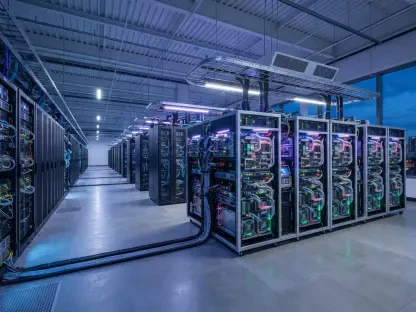

The divergence between Oracle’s white-hot cloud infrastructure growth and its contracting traditional software segment illustrates the massive scale of current AI hardware demand. As the global market traverses the later stages of 2026, the transition from speculative investment in artificial intelligence to the construction of heavy physical infrastructure has become the primary driver of economic activity. This shift is not merely about the deployment of new software tools, but rather the fundamental rebuilding of data center capabilities and energy grids to support the gargantuan processing needs of next-generation models. Large enterprises are no longer content with pilot programs; they are now committing hundreds of billions of dollars to long-term infrastructure contracts, signaling a move toward a more industrialized and capital-intensive era of technology. This period is defined by a clear separation between those providing the foundational silicon and cloud environments and those struggling to translate these capabilities into immediate, consistent profitability.
Part 1. Oracle: The Infrastructure Foundation of the New Economy
Oracle Corporation has successfully navigated a high-stakes transformation, moving from a legacy database firm to a central pillar of the global AI infrastructure. In its most recent fiscal performance for the first quarter of 2027, the company reported total revenue of $19.35 billion, which represented a robust 30% increase from the previous period. This growth was almost entirely propelled by the Cloud Infrastructure division, which saw its revenue skyrocket by 121% to reach $7.4 billion. This specific segment has become the primary engine of the company’s valuation, as it provides the raw computing power required to train and run the world’s most advanced artificial intelligence models. While the cloud business surged, the company’s traditional software segment contracted by 3%, generating $5.5 billion, which further underscores the massive market shift toward high-performance cloud environments over localized software installations.
The depth of this transformation is further reflected in the company’s remaining performance obligations, or backlog, which reached an unprecedented $664 billion. This figure was bolstered by over $30 billion in new cloud contract bookings secured in just a single quarter, reflecting a desperate scramble among technology firms to secure guaranteed access to computing resources. Approximately half of this massive backlog is expected to be recognized as revenue within the next 36 months, providing the organization with an extraordinary level of financial stability and long-term visibility. By positioning itself as a neutral provider in the cloud space, the company has finalized significant multi-cloud expansions with both Microsoft Azure and Amazon Web Services. These partnerships have resulted in 70 multi-cloud database regions and 119 availability zones, allowing the firm to serve as the backbone for diverse AI ecosystems including those developed by Nvidia, Uber, and OpenAI.
To keep pace with this unrelenting demand, the corporation has entered a period of extreme capital intensity, committing to a total annual expenditure of approximately $70 billion. A significant portion of this investment, roughly $20 billion to $25 billion, has been directed toward prepayments for essential hardware components, including the 300,000 high-end GPUs delivered to customers during the current quarter. Management has remained aggressive in its financial outlook, raising revenue expectations for the current fiscal year to at least $90 billion. This level of spending, while temporarily impacting free cash flow, is seen as a necessary cost to secure dominance in the global data center race. The strategy highlights a broader trend where the success of a technology giant is increasingly measured by the size of its physical footprint and its ability to manage complex supply chains for specialized silicon.
Part 2. Adobe: Navigating the Monetization Gap in Creative Software
Adobe Inc. presents a different facet of the current market evolution, where the primary challenge is not building infrastructure, but effectively monetizing the AI tools integrated into existing workflows. Despite posting record revenue of $6.76 billion and reaching a milestone of one billion monthly active users, the company’s stock faced downward pressure following its third-quarter report. The central concern for investors is the “guidance gap,” where the pace of new revenue generation from AI-powered creative suites appears slower than the lofty expectations set by the initial hype cycles. While the organization reported record remaining performance obligations of $22.16 billion, its outlook for the final quarter of the year fell slightly short of analyst projections, suggesting that the conversion of its massive user base into high-paying AI subscribers is a gradual process rather than an overnight transformation.
This period of transition is occurring alongside a major shift in the company’s leadership, as Anil Chakravarthy is set to take over the CEO role in late 2026. Chakravarthy’s background in the marketing and analytics unit, rather than the flagship creative division, has sparked significant debate regarding the future direction of the company. Investors are closely watching whether a leader with a focus on data and marketing can effectively navigate the existential threat posed by competing generative AI models that are rapidly lowering the barrier to high-quality content creation. The challenge for the new leadership will be to prove that their proprietary models can offer a level of precision, copyright safety, and professional integration that open-source or lower-cost competitors cannot match. This dynamic reflects the broader struggle among established software giants to defend their premium pricing models in an era of automated content generation.
The market’s reaction to the company’s conservative guidance illustrates a growing demand for tangible proof of AI’s return on investment. While the integration of generative tools into flagship products like Photoshop and Illustrator has been technically successful, the path to significant and immediate top-line growth is complex. Customers are increasingly scrutinizing the value of AI add-ons, forcing providers to offer more sophisticated features that go beyond simple image generation. To maintain its market position, the firm must focus on deeply specialized tools that cater to the exacting needs of enterprise-level design teams and marketing departments. This involves moving beyond the “novelty” phase of generative AI and focusing on high-utility features that significantly reduce production time for complex professional projects, thereby justifying the continued investment from long-term corporate clients.
Part 3. Automotive Consolidation: The Rise of Digital Wholesale Platforms
In the automotive sector, the current economic climate has favored the consolidation of fragmented markets into comprehensive digital ecosystems. The acquisition of ACV Auctions by Copart for $1.9 billion marks a significant turning point in how vehicles are bought and sold at the wholesale level. By offering a 45% premium for the digital marketplace, the salvage giant is effectively moving to control a much larger portion of the vehicle lifecycle, extending its reach from totaled or salvaged cars into the everyday used-car dealer market. This horizontal expansion allows the combined entity to leverage a massive global infrastructure of physical yards while integrating sophisticated digital inspection and bidding tools. This move represents a strategic attempt to capture a greater share of the $300 billion total addressable market for whole-car transactions through a single, unified platform.
The integration of advanced data tools and inspection technologies from digital-native startups into the operations of established industrial giants is a key theme of the 2026 market. For a company like Copart, which has long dominated the physical side of vehicle disposal, the acquisition of a sophisticated digital interface provides the necessary technological edge to compete in an increasingly transparent and data-driven marketplace. ACV’s platform will continue to operate as a distinct unit, but it will now have access to the financial reserves and logistics network of its parent company. This strategy of using existing cash flow to buy innovation allows mature firms to bypass the risks of internal research and development while immediately neutralizing potential disruptors. It also signals to the broader market that the future of automotive wholesale lies in a hybrid model that combines regional physical presence with high-fidelity digital reporting.
The success of this acquisition is contingent on the ability to maintain the agility of a digital startup while scaling it across a massive international network. As interest rates and economic conditions fluctuate, companies with strong balance sheets are increasingly looking for ways to deploy capital that will yield long-term structural advantages. The move into the whole-car wholesale space is a direct response to the increasing digitalization of the dealership experience, where buyers expect detailed, transparent data on vehicle condition before committing to a purchase. By securing this technological capability, the organization is positioning itself to be the primary intermediary for vehicle transfers across all stages of a car’s life. This consolidation of physical assets and digital intelligence is becoming the standard blueprint for industrial companies looking to thrive in an era where data is as valuable as the hardware it describes.
Part 4. OpenAI: The Professionalization of Financial Intelligence
OpenAI has significantly expanded its commercial footprint by launching a dedicated financial services suite designed for the most demanding professional environments. This new product, built upon the GPT-6 Astra model, represents a shift away from general-purpose assistants toward highly specialized tools that can handle complex financial modeling and reasoning. The platform is specifically tailored for equity researchers, investment bankers, and corporate finance professionals who require a level of precision and data integrity that previous models could not guarantee. By focusing on “reasoning-heavy” tasks, the company is attempting to embed its technology into the core workflows of Wall Street, moving the conversation from AI as a chatbot to AI as a sophisticated analytical engine capable of producing audit-ready financial insights.
To solve the persistent issue of “hallucinations” and factual errors, the company has forged strategic partnerships with premier data providers such as PitchBook, Daloopa, and LSEG News. These integrations allow the AI to access real-time private market intelligence, audited financial models, and global news feeds directly within its interface. A cornerstone of this new service is a robust “line-item citation” system, which enables users to click on any figure or claim generated by the AI to immediately see the original source, such as a specific paragraph in an SEC filing or a quote from an earnings transcript. This level of transparency is essential for meeting the rigorous compliance and accuracy standards of the institutional finance sector. By providing a clear trail of evidence for its outputs, the firm is addressing the primary barrier to the adoption of artificial intelligence in high-stakes professional decision-making.
The launch of these specialized enterprise tools is a critical part of the company’s strategy to diversify its revenue streams ahead of an anticipated initial public offering. Enterprise clients now represent roughly half of the organization’s total revenue, signaling a shift in focus from the consumer market to high-margin corporate contracts. This move also sets the stage for an intense competitive battle with other AI research firms that are also targeting the professional sector. The ability to secure exclusive data partnerships and provide specialized features like automated pitch book creation and audited research briefs will likely determine which firm achieves dominance in the lucrative financial services market. For the broader economy, this represents the beginning of a trend where AI models are judged not by the breadth of their knowledge, but by the depth and accuracy of their specialized professional capabilities.
Part 5. Geopolitics: The Regulatory Hardships of Global EV Manufacturers
The electric vehicle industry is currently navigating a period of profound uncertainty, driven by a tightening web of geopolitical regulations and trade restrictions. Polestar Automotive has become a prominent example of these challenges, as its stock value has faced significant decline following a U.S. government ban on vehicles containing software linked to specific foreign jurisdictions. This regulatory shift has effectively prevented the company from selling its newest models in the United States, a move that has resulted in hundreds of millions of dollars in financial charges and a strategic retreat from one of the world’s largest automotive markets. This situation underscores the growing reality that technological origins and software supply chains are now treated as critical matters of national security, directly impacting a company’s ability to compete on a global scale.
In response to these regional barriers, manufacturers are being forced to dramatically reconfigure their global sales and production strategies. For firms heavily impacted by North American restrictions, the focus has shifted almost entirely to the European market, which now accounts for the vast majority of their sales volume. However, even in favorable regions, the path to profitability is hindered by slower-than-expected volume growth and the high costs associated with transitioning to new vehicle platforms. The reliance on a single geographic region for growth introduces new risks, particularly as other governments consider similar software-based trade restrictions. This geopolitical fragmentation is creating a two-tiered global market where the availability of advanced technology is increasingly dictated by international relations rather than consumer demand or technical merit.
The struggle to achieve profitability in this environment is further complicated by the high capital requirements of developing new models that comply with differing regional standards. Companies are now forced to invest in redundant development cycles or localized software stacks to maintain access to key markets, significantly inflating their research and development budgets. As the industry moves into 2027, the focus for many manufacturers will be on survival and stabilization rather than rapid expansion. The ability to navigate these complex regulatory waters will separate the winners from those who are forced to consolidate or exit the market entirely. This era of “technological nationalism” is fundamentally reshaping the automotive landscape, making geopolitical strategy just as important to a car company’s success as its engineering prowess or design aesthetic.
Part 6. Labor Retention: Amazon’s Strategic Shift in Physical Retail
Amazon has pivoted its strategy for physical retail by making a multi-million dollar investment in the workforce of its Whole Foods Market subsidiary. This move, which focuses on wage increases and the expansion of healthcare benefits, represents a significant departure from the company’s previous emphasis on aggressive automation and cashier-less technology. By raising the average wage to over $21 per hour and simplifying the pay structure to reward tenure rather than subjective performance reviews, the organization is prioritizing labor stability as a primary competitive advantage. This strategic shift suggests a recognition that in the brick-and-mortar environment, the quality of the customer experience is still largely dependent on the presence and expertise of human workers, who remain difficult to replace with automated systems.
The decision to integrate grocery employees into the broader corporate benefits package, including access to specialized primary care services, is designed to reduce the high turnover rates that have historically plagued the retail industry. By creating a more predictable and well-compensated career path, the company aims to build a more loyal and experienced workforce that can support its plans for physical expansion. This includes the opening of dozens of new locations and the repurposing of older, less successful retail concepts into modern grocery hubs. The investment in human capital is being positioned as a long-term strategy to stabilize the retail segment’s growth, which has faced a slowdown compared to the high-performing cloud and advertising divisions. It highlights a broader economic realization that automation has its limits, and human labor remains a critical component of high-touch service industries.
This reinvestment in the workforce occurs at a time when the retail sector is facing increased scrutiny over labor practices and the impact of automation on job security. By opting for higher wages and better benefits, the organization is attempting to position itself as an employer of choice in a tightening labor market. This approach not only helps in attracting and retaining talent but also serves as a hedge against the potential for labor unrest or regulatory intervention. For investors, the move is a signal that the company is willing to sacrifice short-term retail margins to ensure the long-term viability of its physical storefronts. The success of this strategy will be measured by its ability to improve store performance and customer loyalty, providing a stable foundation for the company’s broader ecosystem of services and logistics.
Part 7. Strategic Realities: Navigating the Future Market Landscape
The global market has undergone a significant transformation where the integration of physical infrastructure and specialized data has redefined the requirements for corporate success. The rapid expansion of cloud capacity and the focus on high-fidelity data feeds have shifted the competitive landscape toward those who can manage both silicon supply chains and rigorous accuracy standards. As the initial excitement surrounding general AI has cooled, the demand for industrial-grade reliability has taken its place, forcing organizations to prove the tangible value of their technological investments. This transition was characterized by a move away from speculative “black box” solutions toward transparent, citation-heavy platforms that could survive the scrutiny of high-stakes professional environments like law and finance.
Geopolitical and labor dynamics have further complicated the path forward for multinational corporations, creating a fragmented environment where regional strategy was as vital as technical innovation. The forced restructuring of the electric vehicle market and the renewed focus on human capital in retail emphasized that software alone was not a universal solution for economic challenges. Successful organizations were those that recognized the limitations of automation and the critical importance of maintaining a stable, well-compensated workforce to support physical expansion. This period demonstrated that the most resilient business models were those that balanced aggressive technological growth with a pragmatic approach to regulatory compliance and labor retention.
The market eventually consolidated around a few dominant players who were able to secure the necessary infrastructure and data partnerships to provide comprehensive, industry-specific solutions. These leaders managed to turn the massive capital expenditures of the early decade into predictable, high-margin revenue streams by becoming the indispensable bedrock of the digital economy. The key takeaway for participants was the necessity of moving beyond technical novelty to focus on the deep integration of verified information into core professional workflows. Organizations that prioritized data integrity, regulatory adaptability, and labor stability found themselves better positioned to navigate the complexities of the global economy, setting the stage for a period of more sustainable and utility-driven growth in the years that followed.