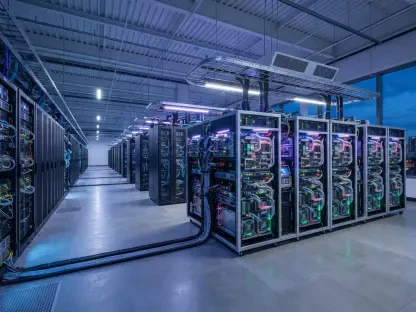

Echelon Data Centres is currently managing a massive pipeline of over 1.4GW of capacity that necessitates the adoption of high-performance liquid cooling. As artificial intelligence continues to permeate every facet of the global economy, the sheer density of compute required to train large language models has pushed traditional air-cooled infrastructure to its physical limits. Standard server racks that once consumed 15kW are being replaced by high-density configurations exceeding 100kW per rack. This evolution is not a preference for newer technology but a fundamental requirement for survival in a market where thermal management determines operational viability. By integrating liquid cooling solutions, operators are able to handle the intense heat generated by modern GPUs while simultaneously reducing the physical footprint of the data center. This transition marks a departure from reliance on massive HVAC systems, moving toward a more targeted approach that utilizes the superior thermal conductivity of fluids.
The Thermal Threshold: Why Air Cooling Fails in Modern Infrastructure
Traditional air cooling relies on the movement of massive volumes of air, which becomes increasingly inefficient as heat densities climb beyond specific thresholds. When servers operate at peak capacity, the fans required to move enough air to dissipate heat often consume a significant portion of the total power delivered to the rack, creating a diminishing return on energy investment. This mechanical strain is exacerbated by the fact that air is a poor heat conductor compared to liquid, requiring more space for airflow and larger heat sinks that further restrict hardware density. In high-density AI clusters, these fans can no longer keep pace with the localized heat generated by silicon processors, leading to thermal throttling where chips automatically reduce performance to prevent physical damage. As a result, data centers relying solely on air risk losing the performance benefits of the very hardware they installed, making the shift to fluid-based thermal management an essential step for maintaining compute speeds.
The rapid deployment of advanced silicon, such as the NVIDIA Blackwell architecture, has effectively forced the hand of data center designers who previously resisted liquid cooling due to complexity or cost concerns. These high-performance chips generate heat at a density that makes traditional cold-aisle and hot-aisle containment strategies insufficient. To prevent hot spots from compromising entire rows of servers, engineers are now turning to rear-door heat exchangers and direct-to-chip cold plates that bring the cooling medium into direct contact with the hottest components. This approach allows for a more precise control of the thermal environment, enabling processors to run at higher clock speeds for longer durations without the risk of failure. By moving the heat rejection process closer to the source, the overall efficiency of the facility is improved, as the energy required to transport heat via liquid is significantly lower than that required to move it via air, allowing for more compute power to be packed into volumes.
Engineering Liquid Solutions: Implementing Direct-to-Chip and Immersion Technologies
Implementing liquid cooling at a scale of 1.4GW requires a sophisticated network of coolant distribution units (CDUs) that manage the flow and temperature of fluids across thousands of racks. Direct-to-chip (DTC) systems use specialized cold plates mounted on the CPU or GPU, through which a mixture of water and glycol or a specialized dielectric fluid circulates to absorb heat. This liquid then travels to a heat exchanger where it is cooled by a secondary loop, often connected to external cooling towers or dry coolers. The complexity of this plumbing necessitates a complete rethink of data center floor plans, as traditional raised floors are being phased out in favor of slab designs capable of supporting the weight of liquid-filled racks and the associated piping. These infrastructures must also incorporate leak detection sensors and redundant pumping systems to ensure that the introduction of liquids into the server environment does not lead to catastrophic failures.
Designers and operators moved beyond the experimental phase of liquid cooling to establish it as the global standard for high-performance computing environments. This transition provided the necessary foundation for managing the thermal challenges posed by next-generation silicon, ensuring that the infrastructure could scale alongside advancements in AI models. Engineering teams successfully integrated leak-proof manifolds and high-flow CDUs into facilities, proving that fluid-based systems could be as reliable as their air-cooled predecessors. The industry also addressed the logistical hurdles of fluid management, creating a robust supply chain for dielectric coolants. By prioritizing thermal density and energy efficiency, the sector realized a more sustainable path forward. Future expansions will likely build upon these advancements, focusing on phase-change materials and the integration of heat-recovery systems to create symbiotic relationships between data centers and the urban environments they serve.