
Bridging the gap between energy efficiency and operational uptime remains a primary hurdle for operators facing the rapid surge of computational power demand. This challenge has intensified as legacy infrastructure struggles to keep pace with the power-hungry requirements of modern processing units. Mitsubishi Heavy Industries (MHI) recently addressed this critical friction point through a groundbreaking demonstration at the Fujitsu AKASHI Data Center. By deploying a proprietary, vendor-agnostic cooling optimization technology, the initiative proved that existing facilities can achieve significant gains in Power Usage Effectiveness (PUE) without the need for exhaustive hardware replacements or service interruptions. This project successfully navigated the complexities of a live environment where maintaining stability is paramount. The demonstration represents a shift in how the industry approaches the modernization of heterogeneous equipment environments, showing that software-driven control can harmonize disparate hardware.
Overcoming the Thermal Demands of High-Density Computing
The global acceleration of digital transformation has turned data centers into the critical engines of the modern economy, but this growth comes with a massive environmental price tag. Current projections from the International Energy Agency highlight that cooling systems are the primary culprits in non-IT power consumption, often swallowing more than 60% of the total electricity overhead. This issue is particularly acute in 2026, as the proliferation of generative artificial intelligence and high-performance computing creates localized thermal loads that traditional cooling methods cannot easily dissipate. For years, facility operators remained risk-averse, opting for overcooling rather than efficiency to avoid the dreaded formation of hot spots that could lead to server failure. MHI’s latest findings disrupt this cautious paradigm by demonstrating that high-intensity computational workloads and aggressive energy conservation can indeed exist in a state of operational equilibrium.
One of the most significant barriers to industry-wide efficiency has been the fragmented nature of data center hardware, where components from multiple manufacturers must work in tandem. Traditional optimization tools are often limited by proprietary barriers, forcing operators to choose between suboptimal performance or expensive, single-vendor overhauls. MHI’s breakthrough involves a control philosophy that remains entirely agnostic to the underlying hardware brands, allowing for a seamless integration into the complex, multi-vendor environments that characterize most established facilities. This strategy effectively unlocks the latent potential of sunk costs, providing a pathway for older infrastructure to meet current sustainability mandates. By focusing on the logic of the thermal loop rather than the specific brand of the chiller or air handling unit, the system creates a unified management layer that stabilizes the entire facility while trimming unnecessary energy expenditure.
Holistic Engineering through Advanced Thermal Simulation
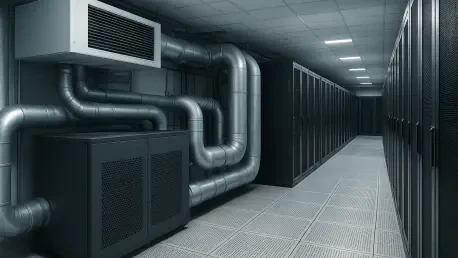
The core of the MHI methodology involves moving beyond the optimization of individual components and toward a comprehensive, system-level architecture. In traditional setups, a centrifugal chiller or a specific cooling tower might be tuned for peak performance in isolation, yet the overall system remains inefficient due to losses in distribution. MHI addressed this by focusing on the ‘header’ piping systems and buffer tanks that serve as the circulatory system of the facility. By managing the flow and pressure within these main pipes, the technology ensures that chilled water is distributed exactly where it is needed without the turbulence or fluctuations that typically lead to wasted pump energy. This holistic control philosophy encompasses the primary machinery responsible for heat rejection as well as the air handling units that manage the server room climate. The result is a stabilized thermal loop that functions as a single, responsive organism rather than a collection of parts.
Precision within the server room environment was achieved through the use of advanced digital simulations that identified chronic bottlenecks in temperature distribution. Before the implementation of the new control protocols, uneven airflow often created micro-climates where some server racks were significantly warmer than others, forcing the entire cooling system to work harder to protect the warmest units. By rebalancing the airflow and fine-tuning the air handling units based on real-time simulation data, engineers improved the temperature distribution across the room by approximately 2°C. While this might appear to be a modest adjustment, it provided the necessary operational headroom to lower the overall cooling output without endangering the hardware. This granular approach to airflow management allowed the broader infrastructure to operate at more efficient set points, proving that minor adjustments at the rack level can lead to significant energy savings across the entire cooling ecosystem.
Measuring the Impact of Intelligent Control Protocols
During the initial phase of the demonstration at the Fujitsu site, the results were both immediate and quantifiable, offering a clear validation of the software-driven approach. The facility recorded a 2.3% reduction in energy consumption across the entire cooling system during the trial period, an achievement that was realized without any modifications to the physical hardware. Furthermore, the efficiency of the centrifugal chillers, represented by the Coefficient of Performance, saw an increase of more than 1.2 points. This improvement indicates that the chillers were able to produce significantly more cooling capacity for every kilowatt-hour of electricity consumed. These metrics are crucial because they directly influence the Power Usage Effectiveness of the facility, allowing it to support more intensive computing tasks without a corresponding increase in utility costs or carbon emissions. The success of this pilot phase provides a robust data set for other operators looking to justify efficiency upgrades.
While the pilot program focused on a specific server room to ensure operational safety, the data gathered allowed for highly accurate projections of facility-wide benefits. When the optimization protocols are scaled across the entire complex, MHI estimates that the total cooling system energy savings will reach 7.6%. This degree of improvement is transformative for a large-scale data center, potentially saving millions of kilowatt-hours annually and significantly extending the lifespan of existing equipment by reducing the mechanical strain of over-cycling. This scalability proves that the technology is not just a niche solution for new builds but a vital tool for the revitalization of the global data center fleet. As facilities from 2026 to 2028 continue to integrate more power-dense AI hardware, the ability to shave nearly 8% off the cooling load provides the thermal flexibility necessary to maintain growth while adhering to strict environmental regulations.
Strategic Evolution: Advancing the Blueprint for Sustainable Digital Infrastructure
Looking ahead, the strategy for data center management involves the integration of this cooling optimization with a broader suite of industrial and energy solutions. MHI envisions a unified ecosystem where high-efficiency cooling works in tandem with decarbonized energy sources and advanced power resiliency systems. This approach includes the use of large-capacity uninterruptible power supplies and the integration of renewable energy grids to ensure that the facility remains operational 24/7 with a minimal carbon footprint. By leveraging digital twins and AI-driven predictive analytics, operators will be able to anticipate thermal surges before they occur, allowing the cooling system to pre-cool specific zones in response to upcoming computational workloads. This proactive stance represents the next evolution of data center design, where energy management is treated as a dynamic, predictive process rather than a reactive necessity to maintain equipment safety and uptime.
The demonstration at the Fujitsu AKASHI Data Center established a clear blueprint for achieving sustainability in high-demand environments. Engineers successfully proved that software-driven optimization could overcome the limitations of heterogeneous hardware configurations, providing a scalable solution for the global infrastructure crisis. By focusing on holistic system control rather than component-level upgrades, the project delivered measurable energy reductions while safeguarding critical daily operations. The decision to prioritize vendor-agnostic technology allowed the facility to retain its existing assets, maximizing the return on previous capital investments. This initiative demonstrated that the path to a greener digital future did not require a complete abandonment of legacy systems, but rather a more intelligent way to manage them. Industry leaders were encouraged to view these findings as a call to move toward integrated thermal management, ensuring that high computational demands remained compatible with environmental commitments.