
The global demand for computational power and vast storage repositories has reached an unprecedented peak as generative artificial intelligence models require massive datasets to function effectively. While solid-state drives often capture headlines for their impressive speeds and low latency, the traditional hard disk drive has reclaimed its position as a cornerstone of the data center ecosystem due to its unrivaled cost-efficiency and massive capacity. This resurgence is not merely a survival of legacy technology but rather a strategic alignment with the needs of hyper-scalers who must manage exabytes of training data without breaking their operational budgets. As these organizations scale their infrastructure to support next-generation machine learning workloads, the reliance on high-capacity mechanical drives has intensified, leading to a significant market revitalization that few analysts predicted during the initial rush toward all-flash arrays in the recent past. This shift underscores a fundamental truth in modern infrastructure design where the balance between performance and affordability dictates the long-term viability of storage solutions.
The Economic Imperative: Why Mechanical Storage Persists
The Economic Advantage: Cost-Effective Capacity at Scale
The fiscal reality of maintaining massive artificial intelligence clusters has forced chief technology officers to re-evaluate their storage acquisition strategies in favor of high-density mechanical drives. While flash storage remains the preferred choice for transactional databases and real-time inference workloads, the sheer volume of raw data required for large language model training makes an all-flash environment prohibitively expensive for most enterprises. High-capacity hard drives currently offer a price-per-terabyte ratio that is significantly lower than their solid-state counterparts, providing a buffer against the spiraling costs of data center expansion. This price disparity is particularly evident when projects transition from the pilot phase to full-scale production, where storage requirements can jump from petabytes to exabytes within a single fiscal year. Consequently, the procurement of 30TB and 40TB units has become a standard practice for maintaining economic sustainability in the cloud, as these drives allow for massive scaling without the exponential cost increases associated with premium flash.
Engineering Innovation: HAMR and the Path to 50TB
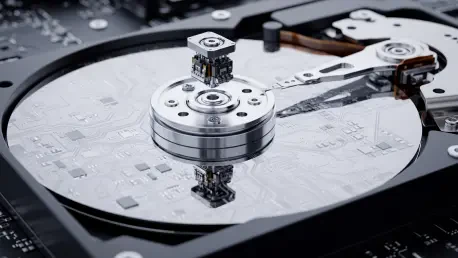
Technological advancements such as Heat-Assisted Magnetic Recording have fundamentally shifted the density roadmap, allowing manufacturers to pack more information onto a single platter than ever before. This innovation uses a small laser diode to momentarily heat a tiny spot on the disk, making it easier to flip the magnetic bits and allowing for much tighter data packing without compromising stability. As we move through the current year, these drives have successfully bridged the gap to the 50TB threshold, offering a viable path for data centers that are physically limited by rack space and power delivery systems. By increasing the areal density, manufacturers have managed to reduce the total cost of ownership by allowing more data to be stored within the same physical footprint and power envelope. This leap in engineering is a direct response to the pressure from hyperscale cloud providers who demand constant improvements in storage density to keep up with the soaring data generation rates, ensuring that mechanical storage remains competitive in a rapidly evolving technological landscape.
Infrastructure Integration: The Hybrid Storage Model
Tiered Storage Systems: Balancing Speed and Volume
Modern infrastructure design has moved away from the binary choice of disk versus flash, favoring instead a sophisticated tiered architecture that utilizes each technology for its specific strengths. In an AI-centric environment, the hot data used for active training and real-time inference is typically housed on high-speed NVMe solid-state drives to minimize latency and maximize throughput. However, the warm and cold data, consisting of massive archives, training logs, and historical datasets, is relegated to high-capacity hard drives where performance is less critical than total volume. This hybrid approach allows organizations to achieve high-performance results while maintaining a manageable cost structure, ensuring that data is always stored on the most appropriate medium. Software-defined storage solutions now manage this movement automatically, identifying which data segments are frequently accessed and promoting them to faster tiers while aging out less active data to high-capacity mechanical arrays that provide reliable and persistent storage.
Operational Sustainability: Long-Term Growth in Modern Arrays
The revitalization of the high-capacity disk market demonstrated that technical evolution was rarely a linear path toward a single dominant medium. Strategic planners who integrated a diverse array of storage technologies found that they were better positioned to handle the massive influx of data required by advanced artificial intelligence models. It became clear that the successful deployment of large-scale infrastructure depended on the ability to balance raw performance with sustainable economic growth and environmental responsibility. Leaders in the field moved toward a more nuanced understanding of data lifecycles, ensuring that their storage investments matched the specific access patterns of their workloads. By prioritizing flexibility and cost-efficiency, these organizations avoided the pitfalls of over-provisioning expensive flash storage where it was not strictly necessary. The industry ultimately moved toward a collaborative model where mechanical and solid-state technologies complemented one another, creating a robust foundation for the continued expansion of the global digital economy.