
Robert Saini sits down with Maryanne Baines, a cloud technology authority who has evaluated stacks and providers across industries. She speaks candidly about a 25MW floating data center in Singapore. The discussion spans site selection, seawater cooling, PUE 1.25, 50% green power, and resilience. It also weighs CAPEX/OPEX trade-offs, cable integration, and lessons from global pilots.
What problem are you solving with a 25MW floating data center in a dense city, and how did you weigh trade-offs versus building on land? Walk us through the decision criteria, key constraints, and one example where the floating approach clearly outperformed a conventional site.
We’re solving land scarcity and heat rejection limits in a dense grid. Near-shore siting frees up 9,870m2 on land by moving 19.2MW afloat. We weighed PUE 1.25, 50% green power, and cable access. In Loyang, seawater cooling beat air-side limits, without potable draw.
You plan to start construction mid-2026 and go live in 2028—what are the critical path milestones? Describe permitting, engineering validation, and supply-chain checkpoints, and share contingency plans if a phase slips by three to six months.
Key gates are permits, hull/fabrication, and grid tie. We lock marine works before onshore fit-out to avoid clashes. Long-lead heat exchangers gate M&E. If we slip 3–6 months, we resequence shoreside works and stage IT ramp.
How will you meet a PUE of 1.25 at full IT load and secure at least 50% green power? Detail the cooling topology, power sourcing strategy, and the step-by-step commissioning tests you’ll run to prove compliance.
We use seawater plate exchangers and high-efficiency pumps. Topology is warm-water loops with minimal lift. Power blends grid and contracted green to hit 50%+. We prove PUE 1.25 with step-load tests to full IT and M&V logs.
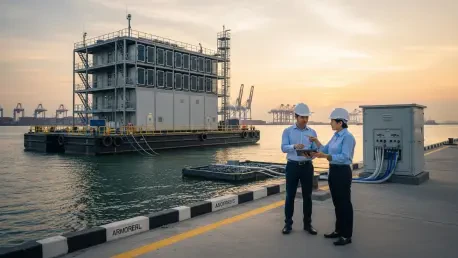
A four-story, roughly 19MW waterborne module will sit alongside shoreside infrastructure—what drove that split? Explain capacity allocation, redundancy tiers, and how you balance latency, cable runs, and maintenance access between floating and landside elements.
The 19.2MW module maximizes sea surface use at 7,580m2. Shoreside holds switchgear, fiber, and support. Short cable runs keep latency tight and serviceable. Redundancy spans both, so maintenance stays safe and quick.
Seawater cooling reduces potable water use—but what are the environmental guardrails? Describe intake/outfall design, anti-fouling measures, thermal plume modeling, and the monitoring metrics you’ll publish, including acceptable temperature deltas and biodiversity safeguards.
Intakes use screens and low velocities to protect fauna. Outfalls diffuse and limit temperature deltas to modeled bounds. Non-toxic anti-fouling and cleaning are standard. We’ll publish intake/outfall temps and biodiversity checks.
How did you select a near-shore location like Loyang for deployment? Walk through bathymetry, mooring, wave and wind profiles, seabed rights, and the marine traffic study, and share one surprising site constraint that reshaped your design.
Bathymetry supports stable drafts near 25 Loyang Crescent. Mooring fits within seabed rights and traffic lanes. Wave and wind profiles suit year-round ops. A tight fairway forced shorter cable paths and compact hull beams.
Modular floating units can be redeployed—how practical is that in real timelines and cost? Outline the decommission, tow, recommission process, required permits, downtime expectations, and lessons from prior relocations or maritime moves of large industrial assets.
It’s practical, but sequenced. You decommission, secure plant, and tow on weather windows. Permits and surveys gate each leg. Downtime compresses by pre-building the new shore tie-in.
Meeting stringent data center sustainability certifications demands rigorous proof—what documentation trail and audits will you prepare? Describe M&V plans, sensor coverage, third-party verification steps, and how you’ll reconcile annualized metrics with seasonal cooling variability.
We map sensors across IT, pumps, and exchangers. M&V ties to PUE 1.25 at full load and 50% green. Third parties verify data trails and tests. Seasonal shifts are normalized with hourly logs and models.
How are you integrating subsea cable connectivity into the campus design? Discuss shore-end landings, diversity routes, latency budgeting, and how you’ll manage marine works scheduling alongside construction to avoid costly rework.
Shore-end landings feed the campus and the float. We design route diversity to split risk zones. Latency budgeting favors short, direct trunks. Marine windows lock in before civil works pour.
What are the dominant corrosion, vibration, and biofouling risks for a floating facility, and how will you mitigate them? Share material choices, coatings, cathodic protection strategies, vibration isolation, inspection intervals, and the failure modes you’re engineering against.
We specify marine-grade steels and robust coatings. Cathodic protection shields wetted areas. Vibration isolation decouples pumps and racks. We inspect on fixed intervals to catch pitting and fatigue.
How does the business case compare with a conventional facility—both CAPEX and five-year OPEX? Break down hull/platform costs, cooling energy savings, grid interconnection expenses, insurance, and maritime fees, and indicate the breakeven IT load where floating becomes favorable.
CAPEX adds hull and mooring but trims land works. OPEX drops with seawater cooling and fewer towers. Grid tie is shared with shoreside gear. Breakeven improves as we near 25MW fully loaded.
What unique physical and cyber security measures does a waterborne data center require? Describe perimeter control, boarding detection, waterside patrols, SOC integration, and how you harden OT networks for pumps and heat exchangers against maritime-adjacent threats.
We build layered waterside perimeters and patrols. Boarding detection ties to lights, cams, and alarms. The SOC fuses marine and land events. OT is segmented and hardened for pump and exchanger control.
Extreme weather, ship strikes, and power disruptions are real risks—how resilient is the design? Detail mooring redundancy, freeboard margins, emergency power, black start procedures, and the tabletop drills you’ll conduct with port authorities and utilities.
Moorings are redundant and load-shared. Freeboard margins address storm surges and waves. Emergency power and black start are rehearsed. We drill with port and utility teams on clear runbooks.
Talent and operations on a floating site can be tricky—how will you staff, train, and certify teams? Outline marine safety credentials, confined-space protocols, maintenance windows, and the shift patterns that balance uptime with crew well-being.
Staff carry marine safety credentials and refreshers. Confined-space and hot-work rules are tight. Maintenance windows align with marine tides and load. Shifts rotate to protect uptime and health.
A 6.5MW barge project in California changed hands after launch, and Japan is piloting offshore solar-plus-battery concepts—what lessons do you draw from these efforts? Compare platform economics, regulatory friction points, and what you would emulate or avoid.
Stockton’s 6.5MW showed cooling works but ownership can shift. Economics hinge on anchors like customers and power. Regulation and permits shape pace and risk. I’d emulate modularity and avoid overcomplex hybrids early.
As you scale to 25MW, how will you phase incremental capacity, manage thermal transients, and keep PUE within target? Describe staged IT load ramp-up, chiller/plate exchanger sequencing, control loop tuning, and the telemetry you’ll watch daily.
We stage IT load in measured steps to full 25MW. Plate exchangers sequence to right-size flow and lift. Controls tune loops for stable temps and PUE 1.25. We watch pump kW, temps, and alarms daily.
What is your forecast for floating data centers?
Readers should expect measured but real growth. Pilots today lead to anchored near-shore fleets. In places like Singapore, 25MW class will set patterns. The winners will show proof on PUE 1.25, 50% green, and uptime.