
Maryanne Baines is a leading authority in the cloud technology sector, possessing a deep understanding of the infrastructure and financial scaffolding that underpins the modern artificial intelligence revolution. With an extensive background in evaluating tech stacks and product applications across various industrial landscapes, she provides a critical lens on the massive capital shifts and engineering challenges facing the tech giants of today. In this discussion, we explore the unprecedented $500 billion data center initiative in Ohio, examining the strategic pivot of hardware providers into financial guarantors and the immense energy requirements of the next generation of AI clusters. We also delve into the strategic significance of long-term infrastructure leases for companies like OpenAI and the complex public-private partnerships required to transform former industrial sites into state-of-the-art technology campuses.
The scale of the proposed 10GW data center on the former uranium-enrichment site in Ohio is staggering. What does a project of this magnitude, costing over $500 billion, tell us about the current trajectory of AI infrastructure?
A $500 billion price tag is almost difficult to visualize, but it represents the sheer industrial gravity required to keep pace with generative AI. This isn’t just about building a larger version of what we already have; it is about creating a massive Portsmouth Technology Campus that can eventually support 10GW of data center capacity. When you consider that the first phase alone is expected to deliver around 800MW by 2028, you realize the aggressive timeline these companies are operating on. Repurposing a former uranium-enrichment site at the Portsmouth Gaseous Diffusion Plant adds a layer of symbolic transformation, turning a Cold War relic into the beating heart of the digital future. The sheer density of computing hardware planned for this site is what drives the cost upward, as these facilities must be equipped with the most advanced, power-hungry systems available today.
Nvidia is reportedly discussing a $250 billion financing guarantee for this project, marking a significant evolution in its business model. How does this shift from being a hardware supplier to a financial backstop change the dynamics of the industry?
This is a tectonic shift in the corporate relationship between hardware vendors and their primary customers. By offering a $250 billion financial guarantee, Nvidia is effectively providing the credit scaffolding that OpenAI currently lacks, given that the company remains unprofitable and does not yet hold an investment-grade credit rating. This guarantee serves as a vital reassurance to lenders, providing a safety net for the massive debt financing required to build out such a sprawling campus. Furthermore, when you layer in the separate $350 billion financing discussions for actual hardware purchases, you see Nvidia deeply embedding itself into the very survival of the project. It is a bold move that certainly carries credit risk, but it ensures that Nvidia’s GPUs remain the foundational standard for the largest AI cluster ever conceived.
Managing the energy requirements for a 10GW campus is an immense logistical hurdle. Given the plan for 9.2GW of natural gas generation and billions in transmission upgrades, what are the implications for the regional grid and the project’s sustainability?
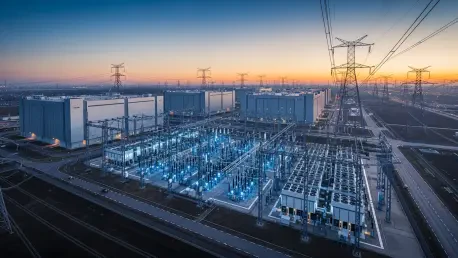
Power is the ultimate constraint in the AI race, and the Portsmouth site requires an energy plan as massive as the data centers themselves. We are looking at at least 9.2GW of new natural gas generation, supported by a significant $33.3 billion investment from Japanese funding sources under a specialized trade agreement. Beyond just generating the power, the infrastructure to move it is incredibly expensive, with SB Energy and AEP Ohio planning to invest $4.2 billion into upgraded high-voltage transmission, including 765kV lines and four new substations. Crucially, the Department of Energy has noted that these costs will not be passed on to local ratepayers, which is a vital move for maintaining public support. The use of natural gas indicates that for projects of this scale, reliability and sheer volume currently take precedence over purely renewable solutions, reflecting the urgent need for a “base load” that can keep the servers humming 24/7.
OpenAI has historically relied on partnerships with Microsoft, Amazon, and Oracle, but this Ohio project suggests a move toward more direct control. What is the strategic logic behind seeking a 20-year lease for dedicated facilities?
This move signals that OpenAI is ready to step out from the shadow of being just a “cloud tenant” and wants to become a “master of its own infrastructure.” By pursuing a potential 20-year lease where they control the equipment deployed at the site, they are securing their operational future far beyond the typical refresh cycles of the cloud industry. While they have strong existing ties—such as the 2GW of AWS Trainium capacity and their commitments through the Stargate program—the Ohio project provides a dedicated, long-term home that they can tailor to their specific architectural needs. This doesn’t necessarily replace their cloud agreements with Microsoft or Oracle, but it adds a layer of sovereign capacity that protects them against the fluctuating availability of the general cloud market. It allows them to manage the lifecycle of their hardware directly, which is essential when you are spending hundreds of billions of dollars on specialized computing clusters.
The involvement of the Department of Energy and high-ranking officials like the U.S. Commerce Secretary highlights the national importance of this project. How do these public-private complexities and the environmental cleanup of the site factor into the project’s success?
The intersection of government policy and private capital is what makes the Portsmouth project truly unique. You have U.S. Commerce Secretary Howard Lutnick involved in high-level discussions about power access, while the Department of Energy is facilitating the lease of federal land to an SB Energy affiliate. This isn’t just about tech; it’s about national competitiveness, which is why you see other giants like Anthropic, Google, and Microsoft also eyeing the site’s potential. There is also a major environmental benefit here, as SB Energy has committed funding toward the accelerated cleanup and redevelopment of the former uranium-enrichment site. By tying the future of AI to the rehabilitation of an industrial wasteland, the project gains a degree of political and social capital that would be much harder to achieve on pristine land.
What is your forecast for the future of AI mega-campuses like the Portsmouth site?
I believe we are entering an era of “sovereign-scale” computing where we will see the emergence of a few massive, multi-gigawatt hubs that act as the central nervous systems for global intelligence. We will likely see more projects exceeding the $700 billion spending mark for AI infrastructure annually as companies realize that localized, smaller data centers cannot provide the low-latency, massive-scale training environments required for the next generation of models. These mega-campuses will increasingly be built on repurposed industrial or federal land because the power and transmission requirements are simply too great for traditional commercial zones to handle. As hardware providers like Nvidia continue to provide the financial guarantees to bridge the gap for unprofitable but high-growth AI firms, the boundary between being a “tech company” and a “global utility provider” will almost completely disappear.