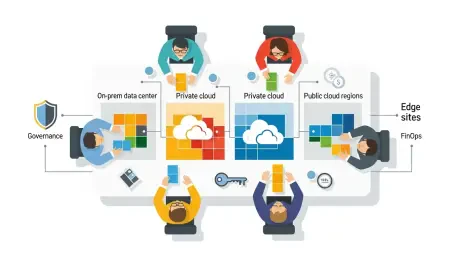

Boards demanded AI everywhere, regulators tightened oversight on data movement, and architects struggled to keep latency and sovereignty in check without spiking costs or fracturing operations across silos that never quite aligned with business risk or developer speed. Against that backdrop, Kyndryl expanded its distributed cloud services with Google Cloud to help enterprises place AI and cloud‑native workloads exactly where data lives—on‑premises, in private data centers, across public clouds, and out at the edge—while preserving a single operating motion. The approach hinges on Google Distributed Cloud (GDC) to extend Google infrastructure and services into customer‑controlled locations, paired with Kubernetes‑based modernization on Google Kubernetes Engine (GKE) and Kyndryl’s consulting, implementation, and managed services that bind strategy, platform, and day‑two operations into one program.
Why Sovereign Distributed Cloud Now
Enterprises face regulatory sprawl that no monolithic public‑cloud stance can fully satisfy, from data residency rules governing citizen records to latency thresholds in trading, manufacturing, and connected healthcare. GDC addresses this by bringing managed Google capabilities into sovereign or sensitive domains under customer control, so inference, caching, and event processing occur near data sources while datasets remain within jurisdictional boundaries. That reduces backhaul, shields PII from cross‑border transfers, and supports deterministic performance for AI services that cannot tolerate round‑trip delays. For workloads that still benefit from hyperscale elasticity, the same services can burst to regional Google Cloud zones, with identity, policy, and observability preserved across the span.
Building on this foundation, Kyndryl provides a unified operating model that standardizes governance, security, and lifecycle management across GDC footprints, private clouds, and public regions. Policy‑as‑code enforces location controls and key management; SRE playbooks and automation keep clusters compliant; and FinOps disciplines temper runaway spend by tying resource use to business KPIs. In practice, a computer‑vision model can ingest frames at an edge site on GDC, run low‑latency inference in‑place, then hand off curated samples to a GKE cluster for retraining without rewriting pipelines. The portability extends to regulated data marts, where residency‑bound analytics can remain local while federating queries to permitted zones under a single catalog and audit trail.
Modernization and Operations for AI at Scale
Kubernetes and containerization anchor the modernization path, turning heterogeneous estates into a schedulable fabric for AI and data services. GKE supplies consistent cluster operations, admission controls, and workload identity, while service mesh and gateways standardize east‑west and north‑south traffic. CI/CD templates promote immutable images; artifact registries track provenance; and MLOps patterns—feature stores, model registries, canary rollouts—translate cleanly from on‑prem GDC clusters to public regions. To reduce complexity, teams can lean on Gemini Enterprise to draft YAML baselines, surface misconfigurations, and suggest policy guardrails, accelerating day‑zero setup and day‑two tuning. Kyndryl stitches these elements together, mapping target architectures, landing zones, and runbooks to each client’s risk profile and industry mandates.
The partnership also reflected market momentum, with Kyndryl reporting increased adoption of its Google Cloud services and recognition with five 2026 Google Cloud Partner of the Year awards. For technology leaders, the next moves should have been concrete: classify datasets and models by residency and sensitivity; map those classes to GDC and regional placements; stand up a reference landing zone with GKE, centralized policy, and secrets management; codify portability SLAs for moving containers and data products between sites; predefine edge blueprints for retail, factory, and branch use cases; and implement FinOps guardrails early to bound AI experimentation. Taken together, these steps had turned a fragmented multicloud into a governed, sovereign, and AI‑ready platform that balanced control with velocity.