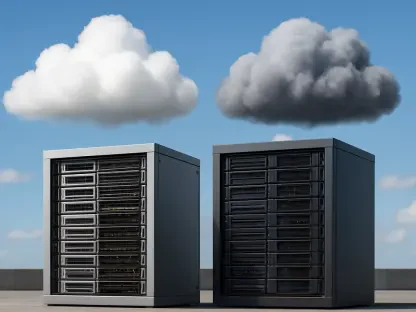

The once-clear promise of a single, all-encompassing cloud is fracturing, giving way to a far more complex and potent reality where enterprise infrastructure is no longer a destination but a pervasive, intelligent fabric. This fundamental paradigm shift away from centralized data centers toward a geographically dispersed and fragmented architecture is a direct and necessary response to the immense pressures of modern digital business. The proliferation of connected devices, the computational intensity of artificial intelligence, and a tightening web of global data regulations have exposed the inherent limitations of the monolithic cloud model. Consequently, enterprises are now navigating a transition toward distributed cloud networking, a transformative evolution that reshapes infrastructure into a more agile, high-performing, and compliant foundation for the next generation of digital operations. This movement is not a regression into complexity but an irreversible advancement, moving from a location-centric model—a “place” where data is sent—to a logic-centric one that brings computational resources directly to the data, wherever it may reside. This approach is designed to conquer the challenges of latency, cost, and compliance that have become the primary roadblocks to innovation.
The Driving Forces of Distribution
The Demands of Modern Workloads
The exponential growth of artificial intelligence stands as a primary catalyst compelling organizations to rethink their infrastructure strategies and embrace distributed architectures. Modern AI presents a bifurcated challenge that centralized clouds struggle to address efficiently. On one hand, the training of large language models and complex algorithms requires massive, concentrated clusters of computational power, typically found only in specialized hyperscale data centers. This phase is resource-intensive and can take weeks or months. On the other hand, AI inference—the real-time application of these trained models to make decisions—demands deployment at the network edge, close to users and devices, to deliver the ultra-low latency required for applications like autonomous vehicles, industrial robotics, and personalized in-store retail experiences. A round-trip journey to a distant central cloud for every inference request would render these applications functionally useless. This dual requirement for both massive centralization and extreme decentralization creates a significant architectural dilemma.
A distributed cloud framework provides the ideal solution to this complex problem by creating a cohesive fabric that spans from the core to the edge. It allows organizations to seamlessly manage and coordinate between massive, centralized training hubs and a myriad of distributed inference locations. This architecture effectively solves the “data gravity” problem, a phenomenon where the sheer volume of data generated by AI and IoT devices makes it prohibitively slow and expensive to move across a network for processing. By bringing compute resources directly to the data source, a distributed model drastically reduces network congestion, slashes data egress costs, and improves application responsiveness. This ability to intelligently place workloads based on their unique performance and data requirements is not merely an optimization; it is a fundamental enabler for the next wave of AI-powered services that will define competitive advantage in the coming years.
Regulatory and Geographical Imperatives
Beyond the technical demands of new technologies, a powerful non-technical force is actively reshaping cloud geography: the global proliferation of data sovereignty regulations. A growing number of nations, citing concerns over privacy and national security, have enacted laws that mandate specific types of data remain within their national borders. Legislation like the European Union’s General Data Protection Regulation (GDPR), China’s Cybersecurity Law, and similar statutes in other countries has made complete reliance on a handful of centralized hyperscale cloud regions an untenable strategy for any global organization. This regulatory landscape forces businesses to architect their infrastructure not just for performance and cost, but for legal and political compliance, turning data residency into a critical design consideration. The monolithic cloud, with its limited geographic footprint, simply cannot meet these granular, country-specific requirements.
The market has responded to this regulatory pressure with the emergence of “sovereign clouds”—cloud services operated entirely within a specific country’s jurisdiction, often by local providers, to ensure compliance with local laws. Distributed cloud networking serves as the critical connective tissue in this new landscape. It provides the technological framework that enables enterprises to integrate these sovereign instances with their existing public cloud environments and private data center resources. This creates a single, governable architecture that can enforce granular data residency policies automatically. For example, a multinational financial institution can use this model to ensure that European customer data is processed and stored exclusively within EU-based sovereign cloud regions, while placing other, less sensitive workloads in public cloud regions that offer the best performance or cost efficiency. This approach transforms the challenge of regulatory compliance from a complex operational burden into a manageable, policy-driven architectural feature.
The Rise of the Network Edge
Edge computing, the practice of pushing processing capabilities to the physical periphery of the network where data is generated and consumed, represents the logical culmination of the distributed cloud vision. Fueled by the maturation of enabling technologies such as high-speed 5G connectivity, advanced edge hardware, and sophisticated software orchestration platforms, the edge is no longer a theoretical concept but a practical, operational reality. Enterprises are deploying compute resources in thousands or even millions of locations, from retail stores and factory floors to telecommunications towers and smart city infrastructure. This massive decentralization creates an entirely new set of management challenges. Attempting to manage this vast and heterogeneous collection of edge nodes as a separate, siloed system with specialized tools and expertise is operationally unsustainable and creates significant complexity for IT teams.
Distributed cloud networking provides the essential architectural framework that makes managing these sprawling edge deployments operationally viable. It allows organizations to treat this vast collection of edge infrastructure as a cohesive and natural extension of their central cloud environment. The key is the ability to extend a consistent operational model, management plane, and set of services from the core data center out to the furthest reaches of the network. This means that developers and IT operators can use the same tools, APIs, and processes to deploy and manage applications whether they are running in a public cloud region, a private data center, or on a small server in a remote branch office. This operational consistency dramatically reduces complexity, accelerates deployment times, and lowers the barrier to entry for organizations looking to leverage the power of the edge to deliver new services and improve customer experiences.
Architecture and Market Impact
The Technical and Operational Blueprint
The core architectural principle that defines distributed cloud networking is the separation of the management plane from the execution plane, enabling centralized control over a physically distributed infrastructure. This concept is fundamentally different from simpler multi-cloud strategies, which often involve using services from multiple providers in a siloed fashion. While multi-cloud can lead to a fragmented operational experience, distributed cloud aims to create a unified, software-defined fabric that spans geographically dispersed locations, regardless of the underlying provider or whether the infrastructure is public, private, or at the edge. The key differentiator is the delivery of a consistent operational model that allows IT teams to manage a highly complex and heterogeneous portfolio of resources as a single, logical system. This abstraction layer simplifies everything from application deployment and policy enforcement to security monitoring and lifecycle management.
The technical implementation of this vision relies heavily on a Software-Defined Networking (SDN) layer that abstracts the underlying physical hardware and network connections. This layer creates virtual networks that overlay the entire distributed topology, effectively stitching together disparate environments into a seamless whole. These virtual networks employ advanced routing protocols and intelligent traffic management systems that enable dynamic path selection for application traffic. Based on real-time conditions such as network latency, available bandwidth, and data transit costs, the system can automatically route traffic along the most optimal path. This ensures that applications always receive the performance they require, whether that means routing a user request to the nearest edge node for the lowest latency or sending a large data analytics job to a public cloud region with the most cost-effective compute resources. This intelligent, automated orchestration is the technical heart of the distributed cloud model.
Economic and Security Considerations
Adopting a distributed cloud architecture carries significant economic and security implications that demand careful strategic planning and analysis. The economic case is not universal and depends heavily on the specific workloads and business objectives. For applications with stringent low-latency requirements or those that generate massive volumes of data, such as real-time video analytics or industrial IoT, the economic advantages are often clear. The substantial savings on bandwidth and data egress costs, combined with the performance gains from processing data locally, can create a compelling return on investment. However, the added infrastructure and management complexity can increase operational expenses. A comprehensive Total Cost of Ownership (TCO) analysis must therefore look beyond direct infrastructure costs and account for the business value unlocked by newly viable applications—such as a retailer using edge AI for in-store personalization to increase sales—which frequently justifies the investment.
Distributing infrastructure, however, dramatically expands the organization’s attack surface, introducing a new and complex set of security challenges. The traditional, perimeter-based security model, which relies on protecting a well-defined network boundary, becomes inadequate and obsolete in an environment where applications and data are spread across countless locations. This reality has championed the adoption of Zero Trust security models. A Zero Trust architecture operates on the principle of “never trust, always verify,” assuming no implicit trust for any user or device, regardless of their location. It requires continuous verification, enforces strict least-privilege access to resources, and encrypts all data both in transit and at rest. This approach is intrinsically suited to distributed environments where a clear perimeter does not exist. While this shift poses initial challenges, a distributed architecture also offers unique security benefits, such as enhanced resilience against attacks and the ability to isolate breaches to a specific geographic location, thereby limiting their potential impact on the broader organization.
Market Evolution and New Opportunities
The architectural shift toward distributed infrastructure is actively reshaping the cloud market, creating significant opportunities for a new class of “neocloud” vendors who are challenging the long-held dominance of the hyperscale giants. This emerging ecosystem includes specialized regional cloud providers, dedicated edge computing specialists, and major telecommunications companies leveraging their vast network infrastructure. The competitive advantage of these new players lies in their focus and specialization. For example, a regional provider can offer superior network latency for local users and deeper expertise in local data sovereignty regulations, making them an ideal choice for specific workloads. Similarly, a telecommunications company can leverage its existing cell towers and central offices to provide ultra-low-latency edge services that are perfectly suited for 5G-enabled applications.
This fragmentation of the market provides enterprises with more choice, fosters innovation, and promotes competitive pricing. However, it also introduces a new layer of operational complexity, as organizations must now manage relationships and integrations with a wider array of vendors. Consequently, distributed cloud networking platforms that can abstract these underlying differences and provide a single management interface across multiple providers are becoming increasingly essential. These platforms act as a universal control plane, allowing businesses to seamlessly provision, manage, and secure workloads across a diverse landscape of neocloud providers, public hyperscalers, and their own private infrastructure. This capability is critical for harnessing the benefits of a fragmented market without becoming overwhelmed by its inherent complexity, enabling a truly agile and provider-agnostic infrastructure strategy.
The Strategic Path Forward
The evolution toward distributed cloud networking was an irreversible and necessary maturation of cloud computing. It transitioned from an emerging concept to an operational reality for forward-thinking enterprises. As organizations navigated this transition, they faced strategic choices regarding the timing and approach of their adoption. The technology industry responded with a growing ecosystem of tools from major cloud providers, established networking vendors, and innovative open-source projects, all designed to simplify adoption and ensure interoperability between different environments. The organizations that successfully developed and executed a strategy to manage this new distributed infrastructure were best positioned to harness the transformative power of artificial intelligence, meet complex global compliance obligations, and deliver the superior, low-latency digital experiences that modern users and applications demanded. The fragmentation of the cloud, therefore, had not represented a failure of its original promise, but rather its powerful adaptation into a more flexible, resilient, and sophisticated form capable of meeting the complex demands of the modern enterprise.