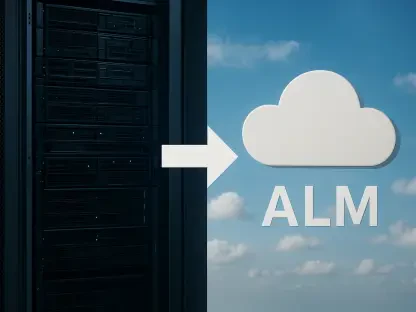

The traditional concept of a secure corporate perimeter has effectively dissolved into a mosaic of ephemeral cloud instances and decentralized microservices, rendering the legacy hardware-centric security model obsolete for most modern organizations. As digital assets migrate toward highly distributed environments, the reliance on a single gateway has been replaced by a need for granular, pervasive visibility that travels alongside the workload itself. Today, the challenge is no longer just about building a taller wall, but rather about weaving a protective fabric into the very networking layers that connect disparate cloud providers, on-premises data centers, and remote access points. Hackers have capitalized on the visibility gaps created during this rapid transition, often lurking within internal traffic flows that old-school firewalls were never designed to inspect or manage. Consequently, the modern cloud firewall has evolved into a sophisticated, multi-layered intelligence hub that orchestrates security across entire ecosystems, ensuring that every data packet is scrutinized regardless of its origin or destination. This shift requires a fundamental rethink of how security intersects with infrastructure, turning the firewall from a standalone appliance into a programmable, scalable service that adapts to the fluid nature of today’s business operations.
Key Market Trends and Operational Shifts
Managed Services: The Transition to Security as a Service
One of the most significant transformations observed throughout 2026 is the widespread abandonment of self-managed virtual firewall appliances in favor of fully managed “Security as a Service” models. Organizations have realized that the operational overhead of maintaining the underlying operating systems, patching vulnerabilities, and manually scaling instances across multiple availability zones is an inefficient use of specialized cybersecurity talent. Instead, the preference has shifted toward cloud-native managed offerings where the provider assumes responsibility for the infrastructure’s health and scalability. This allows internal security teams to redirect their focus toward high-level policy orchestration and threat modeling rather than the mundane tasks of hardware emulation or capacity planning. By consuming firewall capabilities as a service, enterprises can achieve a level of resilience that was previously unattainable, as these platforms are designed to auto-scale instantaneously in response to traffic surges, ensuring that security never becomes a bottleneck for performance or a single point of failure during a massive DDoS event.
Furthermore, the integration of security into the development pipeline has become a prerequisite for any viable cloud firewall solution in the current landscape. Modern security operations demand that every rule, policy, and configuration be manageable through Infrastructure as Code (IaC) tools such as Terraform, Pulumi, or provider-specific frameworks like CloudFormation. This programmatic approach ensures that security is not an afterthought but is baked into the deployment process of every new application or microservice from the very first line of code. If a firewall solution cannot be deployed, updated, and audited through a version-controlled repository, it is increasingly viewed as a legacy liability that hinders the speed of innovation. By treating security configurations as code, businesses can maintain a clear audit trail, perform automated testing on new rules before they reach production, and ensure that every environment—from development to staging to production—maintains a consistent and rigorous security posture that leaves no room for human error during manual console configurations.
Networking and Traffic Control: Securing the Internal Fabric
The industry has reached a critical inflection point where the focus on “North-South” traffic—data moving in and out of the corporate network—is being balanced with an intense scrutiny of “East-West” traffic moving between internal services. In a world dominated by microservices and containerized applications, an attacker who gains a foothold in one low-priority service can easily move laterally to more sensitive areas if internal traffic is left unmonitored. Modern cloud firewalls distinguish themselves by their ability to provide deep packet inspection between virtual private clouds and individual subnets, creating a zero-trust environment where every internal connection is verified and logged. This micro-segmentation strategy ensures that even if a single component is compromised, the potential blast radius is strictly contained, preventing the kind of catastrophic data breaches that characterized the early days of cloud adoption. The ability to visualize and control these internal flows has become the new baseline for organizational defense-in-depth strategies.
In tandem with this internal scrutiny, there is a visible move toward “fabric-embedded” security, where the firewall functionality is integrated directly into the cloud’s networking layer rather than existing as a separate destination for traffic. Historically, rerouting data to a firewall appliance introduced latency and complexity, often requiring complicated route table adjustments and “hairpinning” of traffic. Advanced solutions now utilize technologies like eBPF and gateway load balancer integrations to inspect traffic in-line, providing high-speed protection without the performance penalties associated with traditional architectures. This evolution means that the network itself becomes the security tool, providing a seamless experience for users and applications while maintaining a high level of rigorous oversight. By embedding security into the network fabric, organizations can eliminate the friction between the networking and security teams, fostering a more collaborative environment where performance and protection are viewed as complementary goals rather than competing interests.
Top Solution Providers
Establishing Uniformity: Deep Inspection and Hybrid Consistency
Palo Alto Networks has maintained its position as a dominant force by offering a seamless transition for organizations moving from traditional data centers to complex, multi-cloud architectures. Their managed cloud firewall services leverage the same industry-leading threat intelligence and application-aware inspection capabilities that made their hardware appliances a staple of enterprise security. For companies operating in hybrid environments, the ability to apply the same sophisticated security policies across on-premises servers, AWS, and Azure is an invaluable asset that reduces complexity and the risk of misconfiguration. Their platform provides a unified management console that offers a single pane of glass for visibility, allowing security analysts to track a single user’s activity across disparate environments. This consistency ensures that the transition to the cloud does not result in a fragmented security posture where different rules apply to different platforms, thereby closing the gaps that attackers often exploit during the migration process.
Contrasting with the high-end complexity of some competitors, Fortinet has carved out a massive market share by focusing on the synergy between cost-effectiveness and performance across diverse digital platforms. Their approach centers on the FortiOS operating system, which provides a consistent user interface and functionality regardless of whether it is running on a high-performance physical appliance in a branch office or as a virtual service within a cloud provider’s ecosystem. This uniformity is particularly appealing to enterprises that require a broad deployment of security nodes but want to avoid the steep learning curve associated with managing multiple different vendor products. Furthermore, their flexible licensing models allow organizations to shift their security spend dynamically as their workloads move between different clouds or back to the edge. By prioritizing a “security-driven networking” philosophy, they ensure that the firewall remains an enabler of business agility, providing robust protection that scales economically alongside the enterprise’s growing digital footprint.
Innovation and Architecture: Native Integration and Zero Trust Models
For organizations that have standardized their operations on a single major cloud provider, the simplicity and deep integration of native firewall services like AWS Network Firewall or Azure Firewall provide a compelling path forward. These tools are designed to be “invisible” from a management perspective, as they are fully integrated into the cloud provider’s billing, logging, and identity management systems. AWS Network Firewall is often the choice for developer-centric teams because it utilizes familiar open-source rule engines, allowing for a high degree of customization without the need to learn proprietary vendor languages. Meanwhile, Azure Firewall offers a highly refined experience for organizations already deep within the Microsoft ecosystem, providing specialized protections for virtual desktops and SQL databases that are unique to that platform. These native solutions eliminate the “vendor-in-the-middle” problem, offering a streamlined architectural approach that simplifies procurement and ensures immediate compatibility with new cloud features as they are released.
While native tools offer simplicity, specialized providers like Aviatrix and Zscaler are pushing the boundaries of what a firewall can be by moving away from the traditional concept of an “appliance” altogether. Aviatrix has gained significant traction by embedding security directly into the multi-cloud transit layer, effectively turning the entire network into a distributed firewall that can enforce policies at the routing level. This approach is particularly effective for large-scale enterprises that struggle with the complexity of connecting multiple different cloud regions and providers. On the other hand, Zscaler has popularized a “Zero Trust Exchange” that treats the internet as the new corporate network, providing security by connecting users directly to applications rather than placing them on a network segment. This model removes the cloud infrastructure from the line of fire entirely, hiding internal resources from the public internet and providing a more resilient defense against targeted attacks. These architectural innovations represent the cutting edge of security, prioritizing agility and user experience without compromising on the rigor of data protection.
Strategic Implementation and Economic Viability
Determining Ownership: Strategic Questions and Operational Efficiency
When evaluating a firewall solution in the current technological climate, the most critical question is often not about the technical specifications, but about who within the organization will be responsible for its day-to-day operation. In many modern enterprises, the line between the security team and the DevOps team has blurred, leading to a shift in how tools are selected. If the goal is to empower developers to move quickly, a firewall that integrates deeply with CI/CD pipelines and supports declarative configuration is essential. Conversely, if security is managed by a centralized, traditional IT department, a solution with a robust, visual management dashboard and detailed compliance reporting may be more appropriate. Determining whether the system is “owned” by the people building the applications or the people protecting them will fundamentally dictate which vendor provides the best workflow fit, as a tool that creates friction for the development team will inevitably be bypassed or misconfigured, leading to significant security risks.
Beyond ownership, decision-makers must evaluate the depth of inspection required for their specific use cases versus the potential impact on application performance. While every organization wants the best protection possible, not every workload requires the extreme resource overhead of full SSL/TLS decryption and sandboxing for every single packet. For some internal services with predictable traffic patterns, basic protocol filtering and identity-based access control may be sufficient and far more cost-effective. However, for public-facing applications or those handling highly sensitive financial or medical data, the investment in advanced threat prevention features is a non-negotiable necessity. Balancing these requirements involves a careful analysis of the data being protected and the threat actors likely to target it. By categorizing workloads based on risk and applying the appropriate level of security inspection, organizations can build a tiered defense strategy that provides maximum protection where it is needed most without overspending on unnecessary features for lower-risk environments.
Financial Oversight: Optimizing Expenditure in Consumption Models
As we move through the middle of this decade, the financial aspect of cloud security has become just as complex as the technical implementation, primarily due to the shift toward consumption-based pricing models. In 2026, many cloud firewall providers charge not only for the software license but also for the volume of data processed through the inspection engine. This can lead to “bill shock” for companies with architectures characterized by “chatty” services—applications that frequently exchange large volumes of data across different subnets or availability zones. To avoid these unforeseen costs, it is imperative for architectural teams to perform a rigorous analysis of their internal traffic patterns before committing to a specific vendor. Implementing traffic-shaping policies or optimizing how services communicate can significantly reduce the amount of data that needs to pass through the firewall, directly impacting the monthly security budget.
Moreover, the hidden costs of data egress and cross-region traffic must be factored into the overall total cost of ownership for any firewall solution. Some third-party firewalls require traffic to be routed through a centralized inspection hub, which can trigger significant data transfer fees from the cloud provider that are entirely separate from the firewall vendor’s bill. Organizations should prioritize solutions that support distributed inspection or those that offer “vantage point” flexibility, allowing the security engine to reside as close to the workload as possible. By modeling these costs over a two-to-three-year period, companies can move beyond the initial sticker price and understand the long-term economic viability of their security choices. Ultimately, the most effective cloud firewall is one that provides a high level of protection without becoming a financial burden that drains the resources needed for other vital business innovations and growth initiatives.
Future-Proofing the Security Architecture
Selecting a cloud firewall in the current year required a departure from traditional procurement mindsets, as the focus transitioned from static hardware specifications to dynamic, service-oriented capabilities. Organizations that successfully navigated this transition prioritized integration with automated workflows and sought out solutions that could bridge the gap between disparate cloud environments without sacrificing visibility. The most effective implementations were those that recognized the firewall as a foundational element of the networking fabric rather than an isolated security gate. By asking deep questions about operational ownership and the true cost of data processing, businesses avoided the common pitfalls of performance degradation and budgetary overruns. Moving forward, the emphasis should remain on maintaining a flexible architecture that can adapt to new threat vectors and emerging cloud technologies as they continue to evolve. Security teams that adopted a programmatic, code-centric approach to their firewall management found themselves better prepared for the rapid shifts in the digital landscape. Ultimately, the right choice was defined by a balance of rigorous threat prevention, operational simplicity, and long-term economic scalability, ensuring that the business remained resilient in an increasingly complex and interconnected world.