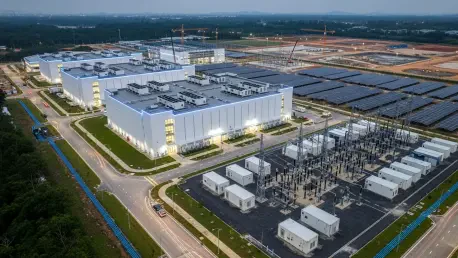

Seismic shifts in cloud infrastructure rarely announce themselves with clarity, yet a $2 billion commitment has a way of concentrating attention across corporate boardrooms, national planning units, and the vendor ecosystem racing to serve Southeast Asia’s digital appetite. Google’s decision to anchor new data centers and expand cloud regions in Malaysia reached beyond capex headlines, threading into GDP targets, carbon pledges, and the knotty question of how to grow a skills base fast enough to sustain a modern digital economy. The plan aligned with Malaysia’s push to lift the digital economy’s share of GDP from 22.6% to 25.5% by 2025, turning a policy goal into a build schedule. It also answered a long-simmering regional debate: where to place resiliency, latency, and regulatory flexibility as Singapore tightens land and power allocation. By placing a major bet on Malaysia, Google signaled a multiyear intent to shape compute gravity across the Strait of Malacca.
The Bet: Why Malaysia, Why Now
The contours of the strategy were visible in the architecture of the rollout: phased data center construction over three to five years, a first site targeted to go live by late 2025, and integration with Google Cloud services tuned to regional use cases in financial services, manufacturing, and the public sector. Executives cited geography, policy stability, and demand density as core levers. Proximity to major submarine cable routes reduced network hops for customers in Indonesia, Thailand, and Vietnam, while Malaysia’s tax incentives and streamlined permitting accelerated time to readiness. The intention went beyond raw compute. Leaders framed the facilities as a regional node that could sharpen disaster recovery footprints and satisfy data residence mandates emerging in regulated industries, drawing enterprises that had balanced workloads across Singapore and Hong Kong but sought a more diversified topology.
Energy shaped the second pillar of the playbook. Google tied the sites to renewable power, aligning with its 24/7 carbon-free energy aspiration and Malaysia’s sustainability goals as utility-scale solar and corporate power purchase agreements matured. That alignment mattered for hyperscale workloads where embodied and operational carbon are under growing scrutiny from boards and regulators. The investment also stitched infrastructure to human capital. Through university and vocational partnerships, more than 100,000 Malaysians were set to receive training in cloud architecture, data engineering, and applied AI by 2026, closing a capacity gap that often stalls cloud migrations after pilot phases. Economic modeling pointed to up to $3.2 billion in activity and around 8,000 direct and indirect jobs, with spillovers into construction, electrical engineering, fiber deployment, and specialized maintenance. In effect, compute capacity, clean power, and talent were treated as one interdependent stack.
Market Dynamics: Competition, Capacity, and the Stakes
The regional context clarified the stakes. Southeast Asia’s cloud market was forecast to expand at roughly 20% CAGR from 2026 to 2028, approaching $40 billion as digital commerce, fintech rails, and Industry 4.0 programs scaled. AWS and Microsoft Azure held incumbency via earlier region-wide expansions, sovereign cloud offerings, and aggressive partner networks. Google’s move read as an effort to rebalance share by targeting high-growth verticals with differentiated data analytics, Vertex AI tooling, and open, multi-cloud postures prized by banks and telecoms. Latency-sensitive workloads—fraud detection at issuers, inventory planning for cross-border logistics, compliance analytics for insurers—stood to benefit from a Malaysian region that reduced path variability while preserving regulatory optionality. For CIOs, the calculus leaned toward multi-region architectures that mixed Singapore, Johor or Klang Valley, and a secondary site in Thailand or the Philippines to spread risk.
Building on this foundation, Malaysia positioned itself to capture adjacency effects that often decide whether a site becomes a transient node or a durable hub. Semiconductor supply chains supporting data center components, fiber backhaul upgrades along the North–South Expressway, and a deepening bench of local managed service providers shaped the ecosystem. Policy continuity remained decisive. Clarity on cross-border data flows, standardized green tariff mechanisms, and transparent land allocation for hyperscale campuses reduced friction that can delay commissioning by quarters. Meanwhile, enterprise buyers looked for concrete migration accelerators: discounted commit contracts tied to training vouchers, reference architectures for regulated workloads, and fast paths for on-prem systems using Anthos or Kubernetes to land in the cloud with minimal refactoring. In this race, capacity alone was table stakes; programmability, compliance, and credible sustainability claims differentiated the field.
What Comes Next: Playbook for Policymakers and Enterprises
For policymakers, the near-term agenda favored execution over new slogans. Grid operators needed bankable road maps for interconnection and firming capacity as renewables increased, while permitting offices benefited from single-window processes that synced utility, environmental, and construction approvals. Universities could link curricula to industry certifications—CompTIA, Google Cloud Professional, and CNCF—in capstone projects that fed directly into apprenticeships. Sovereign frameworks mattered as well. Clear, risk-based guidance on data classification and residency enabled banks and ministries to adopt regional architectures without waiting for bespoke exceptions. Finally, anchoring more submarine cable landings and diverse terrestrial routes through Malaysia reduced single points of failure and improved bargaining power with carriers and consortia.
For enterprises, the practical steps were equally concrete and had been stated plainly. Start with a landing zone in the Malaysian region that enforced identity, logging, and policy-as-code, then stage migrations using containerized workloads and event-driven interfaces to avoid brittle point-to-point links. Contract for green capacity where available and publish sustainability disclosures that track compute intensity against business outcomes. Build incident playbooks that fail over between Malaysia and Singapore to meet recovery time and point objectives, then add a tertiary node for regulatory audits. Invest in people: pair cloud engineers with business owners in two-pizza teams, and tie skill badges to promotion criteria so training converted into capability. Taken together, these moves turned a headline investment into operational leverage and had underscored why Malaysia’s bid to be a Southeast Asian cloud hub looked less like a gamble and more like a plan executed in deliberate stages.