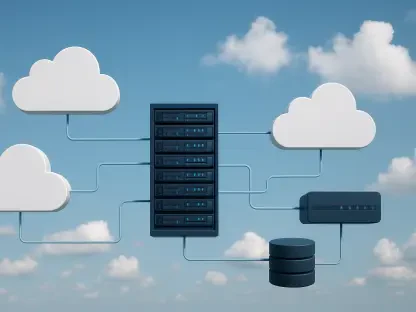

The launch of a software-defined interconnect service marks a shift from physical circuit management to an on-demand experience built on standardized Open API specifications. For years, architects struggled with the latency and administrative overhead of backhauling traffic through traditional data centers or third-party colocation facilities. This new collaboration between Microsoft Azure and Amazon Web Services addresses these bottlenecks by establishing direct, high-speed links that bypass the public internet entirely. By integrating these services directly into management consoles, the providers are effectively shrinking the digital distance between competing environments. This initiative represents a rare moment of alignment between the two largest cloud providers, driven by enterprise demand for seamless mobility. Instead of dealing with weeks of provisioning, engineers can spin up massive bandwidth capacities in minutes. The focus has moved from maintaining hardware to orchestrating intelligent data flows across a unified fabric.
Technical Foundations: API Standardization and Global Fabric Integration
Central to this evolution is the utilization of standardized APIs that allow for programmatic control over cross-cloud traffic. Previously, connecting an Azure VNET to an AWS VPC required complex manual configurations and often involved proprietary middle-mile providers. Now, the implementation of a universal control plane enables automated routing updates and real-time bandwidth scaling. This software-defined approach relies on a global backbone of fiber-optic networks that both companies have been expanding over the period from 2026 to 2028. By using these assets, the service ensures that packets travel via the most efficient path, minimizing jitter and maximizing throughput for sensitive workloads. The shift to a code-driven interconnect model also simplifies security posture management. Encryption is handled at the transport layer, and identity-aware networking ensures only authorized workloads can traverse the bridge. This level of integration removes the need for fragmented third-party appliances.
Furthermore, this unified interconnect service significantly enhances an organization’s ability to maintain data residency requirements. In a landscape where regulatory bodies demand precise control over where information is stored and how it moves, having a direct link provides a transparent audit trail. Administrators can define specific geo-fencing rules that prevent data from leaving certain jurisdictions while it is in transit between Azure and AWS regions. This level of granularity was previously difficult to achieve when relying on generic internet exchange points. The automated nature of the service also reduces the risk of human error during the configuration of BGP routes or firewall rules. By removing the complexity of manual peering, the system ensures that compliance policies are consistently applied across both platforms. This evolution suggests the cloud is no longer a set of isolated islands but a contiguous ecosystem. Consequently, enterprises find it easier to distribute their databases where they perform best.
Strategic Implementation: Practical Pathways for Enterprise Adoption
Transitioning to this new interconnect model requires a strategic reassessment of how microservices are deployed across geographically dispersed clusters. Organizations must move away from monolithic architecture and embrace a distributed design that takes advantage of low-latency cross-cloud communication. For instance, a financial services company might run its high-performance compute tasks on AWS while utilizing Azure’s advanced AI and machine learning tools for post-processing. This specific implementation is made possible by the direct interconnect, which facilitates near-instantaneous synchronization of large datasets. The primary challenge now lies in refactoring legacy applications to handle the ephemeral nature of cloud-native networking. To succeed, IT teams should prioritize the automation of their infrastructure-as-code pipelines to include these new connectivity parameters. By treating the interconnect as a programmable resource, developers optimize cost by adjusting bandwidth based on real-time demand.
The implementation of this collaborative interconnect service redefined how global enterprises approached multi-cloud resilience. Decision-makers who previously hesitated to spread critical workloads across multiple providers found that the technical barriers had finally vanished. To capitalize on these advancements, technical leads moved to audit their current egress costs and identified specific latency-sensitive applications that benefited from direct peering. They also established new governance frameworks to oversee the automated scaling of cross-cloud bandwidth, ensuring that costs remained within projected budgets. Looking forward, the industry pivoted toward a holistic view of the cloud where vendor lock-in was mitigated by the ease of movement. Infrastructure teams focused on upskilling in cross-platform orchestration, recognizing that the ability to manage a unified network fabric became a competitive necessity. Those who acted early secured a more agile posture, allowing them to leverage the best-of-breed features.