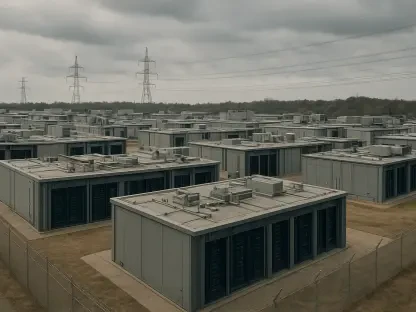

Targeting the Yandex facilities in Sasovo, Kaluga, and Vladimir has directly impacted the market value of Russia’s leading tech giant on the Moscow exchange. This tactical shift signifies a departure from the purely digital skirmishes that once defined the Russo-Ukrainian conflict. For several years, the struggle primarily occupied the intangible realms of malware and disinformation, but the current landscape reveals a much more visceral strategy. The “iron hearts” of modern civilization—vast data centers housing the servers that power everything from banking to state governance—are now prioritized as primary kinetic targets. Russia’s initial campaign to induce a “forced digital detox” across Ukraine by bombarding its connectivity infrastructure has finally met its match in a symmetrical retaliation. As Ukrainian drone technology has reached a point of sophisticated maturity, the war has effectively crossed the threshold from the screen to the physical foundation of the internet, turning these sprawling server farms into high-stakes battlefields.
Digital Sovereignty: The Targeted Destruction of Digital Hubs
The shift toward targeting physical digital infrastructure represents a fundamental change in how modern states view their vulnerabilities. As administrative and financial systems become increasingly centralized in massive, energy-intensive server farms, these locations transform into high-value military objectives. These facilities are the physical manifestation of a nation’s “cloud,” making them far more tangible than a piece of malicious code. Unlike cyberattacks, which can often be mitigated through software patches or network isolation, a kinetic strike on a data center results in the permanent loss of hardware and immediate local disruption. The focus on these hubs demonstrates that controlling the physical flow of information is now as critical as controlling physical territory. By aiming for the hardware that stores and processes national data, combatants are able to paralyze economic functions and government services without firing a single shot in a traditional urban center or on a distant battlefield.
Strategic Strikes: The Balakovo Infrastructure Impact
On October 14, Ukrainian forces executed a precision drone strike on a massive Sberbank data center in Balakovo, located in the Saratov region. This facility was far more than a regional hub; valued at over $1 billion, it was designed to be the largest data center in Europe, capable of housing 120,000 servers at its peak capacity. Beyond its obvious role in the financial sector, the site was intended to host GosTech—the Kremlin’s unified state digital platform—and house the most powerful supercomputers slated for development starting from 2026 to 2028. By striking this cornerstone of the Russian digital marketplace, Ukraine demonstrated that even the most ambitious and expensive technological projects are within its reach. The message was unmistakable: the digital modernization of the Russian state is no longer a safe venture. These facilities represent the central nervous system of the nation’s economy, and their vulnerability creates a cascading effect of uncertainty across the entire tech sector.
Information Warfare: Discrepancies Between Official Claims and Reality
Following the explosions, Russian officials and Sberbank leadership were quick to issue denials, claiming that all systems remained operational and unaffected by the recent kinetic activity. Despite these public assurances of normalcy, outage-monitoring services and countless user reports painted a starkly different picture of the situation on the ground. Immediate disruptions were felt across the Sberbank mobile app, the GigaChat AI platform, and various digital delivery services, indicating a massive failure in backend operations. These technical failures, occurring in tandem with the physical strikes, highlighted the inherent vulnerability of centralized digital hubs to fires and power instabilities caused by kinetic attacks. Even if the hardware itself survived the initial blast, the resulting thermal surges and emergency shutdowns often prove just as destructive. The discrepancy between official narratives and the digital reality underscores the difficulty of masking physical damage in a highly connected world.
Kinetic Retaliation: A Symmetrical Response to Infrastructure Aggression
The doctrine of symmetry in this conflict has extended from the trenches of the eastern front to the server rooms of major metropolitan areas. When one side attempts to dismantle the digital life of its opponent, it must now expect an immediate and equal response against its own critical nodes. This creates a cycle of infrastructure attrition that moves beyond traditional military logistics. The goal is no longer just to disrupt communications but to fundamentally degrade the enemy’s technological capabilities for the foreseeable future. This strategy targets the economic prosperity and the daily convenience of the civilian population, aiming to create internal pressure on the ruling government. As these attacks continue, both nations are forced to reconsider the wisdom of extreme centralization. The era of building massive, singular digital hubs is being challenged by the reality of long-range precision weapons that can identify and reach any large-scale industrial site from hundreds of miles away.
Economic Attrition: Targeting Tech Giants and Financial Nodes
The strike on Sberbank was part of a broader Ukrainian strategy to answer Russian aggression with equivalent force and strategic depth. After Russia damaged or destroyed the data centers of at least eight Ukrainian companies in late September, Kyiv responded by targeting Russia’s tech titans, including Yandex. Prior to the Balakovo incident, Ukrainian drones successfully hit Yandex facilities in Sasovo, Kaluga, and Vladimir, causing significant operational delays. The Sasovo hub was particularly vital, as it contained the supercomputers used to train advanced AI models, and its disruption contributed to a notable decline in the company’s share prices on the Moscow exchange. This pattern of behavior suggests that Ukraine is no longer content with defensive maneuvers but is actively seeking to dismantle the infrastructure that supports Russia’s digital sovereignty. By focusing on these high-value assets, Kyiv is forcing Moscow to divert resources from the front lines to protect internal nodes.
Supply Chain Fragility: The Long-Term Impact of Hardware Losses
The most devastating aspect of these strikes for Russia lies in the fragility of its technological supply chain, which is already under immense pressure. Due to Western sanctions and the country’s exclusion from global banking systems, high-end hardware like specialized servers and GPUs is increasingly difficult to source from legitimate markets. Unlike conventional military equipment, destroyed server racks cannot be easily replaced from domestic stockpiles or redirected from existing manufacturing lines. Every burnt component represents a significant loss that must be smuggled into the country at a high premium, making the recovery process both slow and prohibitively expensive for private and state entities alike. This hardware attrition creates a long-term deficit that hinders the nation’s ability to compete in global tech sectors like artificial intelligence and big data. Without a reliable pipeline of components, the destruction of a single data center can set a company’s technological development back by several years.
Future Resilience: Strategic Lessons for Global Infrastructure
The transition from digital hacking to the physical demolition of hardware marked a significant escalation in the scope of the war. Russia’s initial attempt to forcibly “detox” Ukraine from its technological capabilities invited a symmetric response that targeted the very heart of the Russian economy. As the conflict progressed, the systematic degradation of these technological hubs threatened Russia’s digital sovereignty and its long-term economic outlook. Stakeholders in global infrastructure recognized that physical security and decentralization became essential for survival in modern warfare. The “digital detox” indeed became a two-way street, leaving Moscow to face the reality of a regressing technological landscape that was harder to maintain or rebuild under the weight of global isolation. Future strategies emphasized the need for redundant systems and a movement away from the massive, vulnerable hubs that defined the early digital era. This period proved that in a total war, the servers were just as vital as the soldiers.