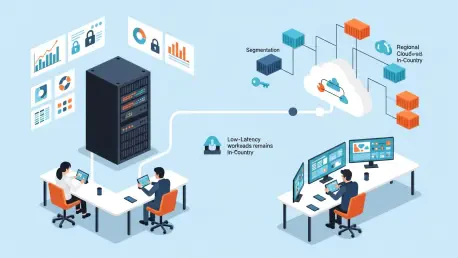

A small market can brew exceptional digital “coffee” yet remain stuck at the kitchen counter, and that tension—craft without reach—framed a national conversation that turned pragmatic once local leaders switched from metaphors to engineering and policy. Brunei’s go-live of AWS Outposts at Synapse 2026 Hybrid Cloud Day repositioned that constraint as an opportunity to align data sovereignty with access to cloud-scale services, effectively giving agencies and enterprises a low-latency, regulator-friendly onramp to modern architectures. The launch established the country as the 24th AWS Edge Network Location in Asia Pacific, which mattered less as a milestone and more as a capability set: native AWS services on local hardware, consistent APIs, and a control plane that bridges Bruneian data centers to the nearest AWS Region for lifecycle management. With partnerships formalized and a playbook emerging, the promise centered on moving from reliability to agility, then compounding gains with AI.
Infrastructure and Readiness
Edge Capability Meets Hybrid Reality
AWS Outposts introduced a direct path to run EC2, EBS, and containerized workloads via EKS Anywhere or ECS on AWS-designed racks embedded in Bruneian facilities, with S3 on Outposts available for object storage that must remain in-country. This stack supported consistent tooling—CloudFormation, CloudWatch, and AWS Systems Manager—while linking to the nearest Region through resilient connectivity, often via AWS Direct Connect with redundant paths. In practice, that meant a payments gateway could process card data locally for compliance, store tokens in KMS-backed keys, and burst analytics to a regional data lake when allowed. Latency-sensitive services, from CCTV analytics to hospital PACS archives, could stay within national borders without reverting to brittle on-prem stacks. Hybrid stopped being a hedge and became the core operating model.
Building on this foundation, agencies gained an option to standardize network segmentation and identity controls with AWS IAM and, where necessary, PrivateLink for private service access. The architecture aligned neatly with zero trust principles by placing inspection points at the VPC level and enforcing granular service-to-service authentication through short-lived credentials. That shift mattered for operational posture as much as for policy. Disaster recovery plans could adopt pilot-light or warm-standby designs with Outposts as the primary site and a regional fallback for stateless services, tested using runbooks in AWS Systems Manager Automation. The result was not a theoretical blueprint but a concrete platform on which procurement offices, health operators, and education bodies could rationalize legacy estates without compromising statutory duties around custody of sensitive records.
Data Residency and Compliance Unlocked
For ministries and regulated firms that faced a binary choice between aging on-prem and fully public cloud, Outposts allowed a third way anchored in verifiable residency. Sensitive datasets—personally identifiable information, patient records, tax ledgers—could be pinned to local storage tiers while applications still consumed managed services like RDS on Outposts for PostgreSQL or MySQL. Encryption remained consistent through AWS KMS with customer-managed keys, and hardware security module needs could be met by integrating with dedicated HSMs where policy required. This meant audit trails became simpler: access logs stayed local, IAM policies were consistent across environments, and compliance teams could rely on CloudTrail Lake to query events without exporting raw evidence out of country. The migration path, once impeded by legal ambiguity, now had a tested control stack.
Panelists coalesced around the prerequisite of codified rules before code moves. A cloud-first policy clarified workloads eligible for Outposts versus those fine on shared regional services, while a three-tier data classification scheme—Public, Internal, Restricted—made the approval process repeatable. Agencies were urged to publish reference guardrails using AWS Control Tower landing zones: mandatory tagging for data classes, pre-approved AMIs, centralized logging accounts, and SCPs that blocked writes to buckets outside Brunei for Restricted data. With that scaffolding, program teams could run migration factories that lifted .NET and Java apps onto EC2 with minimal changes, then refactor high-value services into containers. Crucially, security operations gained fidelity through GuardDuty and Security Hub feeds tuned to local threat models, reducing alert noise and accelerating incident triage.
Partnerships and Playbook
Alliances That Compress the Learning Curve
Execution hinged on collaboration rather than solo runs. Comquest and Dynamik Technologies signed a memorandum that set a shared delivery cadence—assessment, landing zone setup, pilot migrations, and scaled rollout—while Imagine, the Bruneian telecom provider, committed to a service agreement focused on compliance and data residency outcomes. Comquest’s partnership with Xtremax added hard-won lessons from Singapore’s Government Commercial Cloud, including patterns for onboarding agencies through a catalog of pre-hardened environments and CI/CD pipelines with baked-in security tests. These alliances translated into artifacts: Terraform modules vetted against CIS benchmarks, golden images aligned to ASVS guidelines, and a service registry that cataloged who owned what, down to data classification and RTO/RPO targets.
The combined playbook favored measurable outcomes over broad declarations. For example, a pilot with a citizen-services portal could target a 40% reduction in change lead time by moving from manual releases to Git-based workflows using CodePipeline and CodeBuild, with quality gates enforced by static analysis and container image scanning. Meanwhile, a health records modernization might prioritize read latency under 20 milliseconds within Outposts subnets, validated by synthetic monitoring in CloudWatch Synthetics. Knowledge transfer was embedded, not appended: engineers rotated through build squads, documentation lived alongside code, and platform backlogs were governed by a steering group that included risk officers to prevent architecture drift. The message was clear—partner to start fast, but design so local teams finish stronger.
Pacing With Room to Leapfrog
Leaders framed progress as a marathon with targeted sprints where Brunei could skip intermediary steps. Reliability came first: standardized observability with metrics, logs, and traces; controlled blast radius through cell-based architectures; and practiced incident response using runbooks and game days. Once stable, agility followed through platform self-service—developers requested namespaces, databases, and secrets through a portal backed by Service Catalog and scoped IAM roles. This approach naturally led to AI and analytics, but only when data pipelines were clean and discoverable. With lineage tools and a governed lakehouse pattern, teams could layer Amazon Bedrock or SageMaker endpoints to pilot generative AI for case intake, document summarization, or developer assistance, keeping sensitive prompts and outputs within Outposts where needed.
Leapfrogging did not imply recklessness. Borrowing patterns from Singapore shortened learning curves, yet adaptation to Brunei’s regulatory cadence remained essential. A phased approach divided domains by complexity and risk: customer-facing portals and static content moved first; transaction systems with mixed sensitivity came next after tokenization; critical registries shifted only once key management and business continuity tooling were proven in drills. To maintain velocity, leaders encouraged a financial lens—showback models that priced environments by consumption, rightsizing recommendations via Compute Optimizer, and reserved capacity planning for predictable workloads. The ambition extended to cross-border reach: once services stabilized locally, APIs could be exposed through API Gateway with regional endpoints, backed by CDN distribution for read-heavy workloads, enabling Bruneian products to engage global users without surrendering core data.
Execution and Outcomes
Operating Model and Practical Steps
Consensus settled on “policy first, pipelines second.” Agencies were advised to start with a crisp service inventory: classify data, map dependencies, and score applications on cloud readiness using well-defined questionnaires. Next came a baseline landing zone with multi-account guardrails, followed by a migration wave plan that grouped workloads by affinity—databases refactored with DMS where possible, application servers containerized for EKS, and stateful edge cases anchored to RDS on Outposts. Security exemplars were non-negotiable: centralized key policies, VPC endpoints for all management traffic, and network ACLs that defaulted to deny. Teams then instrumented SLOs—uptime, latency, error budgets—and reported them weekly to a joint governance board so trade-offs were explicit rather than inferred.
Practical tools tethered the strategy to daily execution. Change management shifted from PDFs to tickets enriched by pipeline metadata, enabling approvers to see diffs, test coverage, and vulnerability posture before promotion. Cost controls moved upstream through guardrails that blocked oversized instances and enforced lifecycle policies for EBS and snapshots. Data protection policies turned tangible with automated classification on landing, record-level encryption, and periodic restore tests to verify that backups were not only present but usable. Importantly, the operating model documented exit criterian application left the migration program only after meeting security controls, hitting agreed SLOs for a full quarter, and passing a resilience test that validated failover between Outposts cells and the regional fallback for stateless tiers. Progress shifted from narrative to evidence.
Talent and the Innovation Flywheel
Bringing Outposts onshore reshaped career paths by elevating local roles from system caretaking to platform engineering, security architecture, and data product management. Rotational programs placed Bruneian engineers inside build squads run with partners, pairing on IaC, policy-as-code, and observability patterns that persist beyond the initial wave. Universities and training centers had a clearer target: courses emphasizing cloud-native patterns, container orchestration, and applied AI on governed data. Certification mattered, but portfolio work mattered more; capstones deploying EKS with service meshes, tracing, and autoscaling mirrored real enterprise needs. With a steady cadence of brown-bag sessions and internal guilds, knowledge spread laterally instead of collecting in single teams.
As capabilities matured, the innovation loop tightened. Product teams experimented with domain-specific AI—in legal search, land registration, and customs clearance—without exposing restricted data to external endpoints. Vector stores ran on Outposts for sensitive embeddings; less critical use cases leveraged regional services for scale. A center-of-excellence model prevented reinvention by curating blueprints: reference pipelines for OCR and summarization, reusable Terraform modules for GPU-enabled nodes, and guidelines for human-in-the-loop review. Market reach grew as services met global expectations for latency and reliability while signaling a robust compliance stance. The next steps were actionable and had been framed in past-tense commitments: finalize and publish a national data taxonomy, expand the migration factory to a second wave with measurable SLOs, institutionalize quarterly resilience game days, and align education funding to hands-on labs that mirrored production stacks. By doing so, Brunei anchored momentum in practice, not promise.