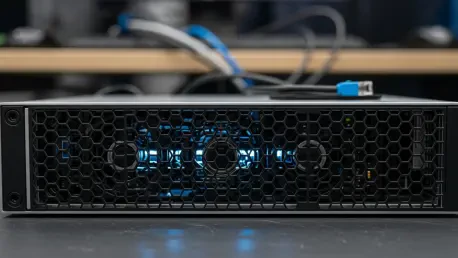

The modern corporate landscape is undergoing a radical transformation as the demand for immediate, secure data processing pushes organizations away from massive, centralized cloud infrastructures toward highly efficient edge computing solutions. This shift is not merely a temporary trend but a necessary response to the growing complexities of real-time machine learning and the stringent data privacy regulations that define the current digital era. Within this context, the introduction of the Dell Pro Max with GB10 marks a significant milestone, effectively shrinking the capabilities of a room-sized supercomputer into a form factor that fits comfortably on a standard office desk. By utilizing the cutting-edge Nvidia DGX Spark architecture, this workstation offers an unprecedented level of computational density for data scientists who require the autonomy of a localized environment. It addresses the inherent latencies of remote processing while providing a fortified sandbox where proprietary intellectual property remains protected from external exposure throughout the development lifecycle.
Engineering Excellence and Physical Design
The physical engineering of the Dell Pro Max achieves a remarkable balance between compact dimensions and heavy-duty industrial performance, adhering to the specialized DGX Spark footprint of 150 by 150 by 51 millimeters. This design philosophy ensures that the device occupies no more desk space than a traditional thin client or a standard external hard drive array, making it ideal for crowded laboratory environments or executive offices. Weighing only 1.3 kilograms, the unit remains portable enough for secure transport between facilities, yet its internal density suggests a level of power usually reserved for rack-mounted servers. Dell has purposely moved away from the flashy, neon-soaked aesthetics often found in high-end hardware, choosing instead a “corporate maturity” look characterized by an understated gray finish. This professional exterior allows the workstation to blend seamlessly into modern enterprise settings without drawing unnecessary attention, emphasizing its role as a serious tool for research.
Functional design elements are integrated directly into the chassis to ensure that the internal components can operate at peak efficiency under the most demanding computational loads. A prominent hexagonal honeycomb lattice grill dominates the front and sides of the unit, serving as both a stylistic signature and a critical component of the thermal management system. This lattice facilitates a high volume of airflow, which is necessary to dissipate the heat generated by the dense Superchip architecture during multi-hour training sessions. By prioritizing a functional airflow path, the engineering team has managed to keep the device remarkably stable, preventing the thermal throttling that often plagues small-form-factor PCs. This commitment to physical reliability ensures that the Pro Max can handle sustained high-intensity workloads, such as deep learning optimizations or complex physics simulations, without any degradation in speed or structural integrity over years of continuous operation.
Connectivity and Advanced Networking
Connectivity on the Dell Pro Max is explicitly designed to meet the demands of the future, though it necessitates a complete embrace of modern peripheral standards and high-speed data transfer protocols. The workstation is equipped with several USB-C 3.2 Gen 2×2 ports that support DisplayPort 2.1 compatibility, allowing for ultra-high-definition visual output and rapid data exchange with external storage arrays. An HDMI 2.1 port is also included for standard display setups, alongside a high-performance Ethernet jack for traditional wired networking. Notably, the machine features Nvidia’s ConnectX-7 SmartNIC port, a sophisticated inclusion that represents a major leap forward for localized scaling. This specific port allows users to physically link two workstations together, creating a unified processing entity that doubles the available memory and compute capacity. This modular approach provides a clear path for expansion as project requirements grow beyond the scope of a single device.
The decision to exclude traditional USB-A ports entirely signals a definitive shift toward a unified USB-C ecosystem, reflecting the industry’s broader move away from legacy hardware connections in professional spheres. While this may require some organizations to utilize dongles or updated cables for older input devices, the benefit is a significantly higher ceiling for bandwidth and power delivery across all available ports. By streamlining the I/O panel, Dell has maximized the space available for internal cooling and specialized networking hardware like the SmartNIC. This specialized networking interface is particularly valuable for data scientists who need to move massive datasets between local nodes without the bottlenecks associated with standard office networks. The inclusion of such advanced hardware ensures that the Pro Max functions not just as a standalone PC, but as a flexible component within a larger, high-performance computing fabric that can adapt to the evolving needs of an enterprise.
The Architecture of Localized Intelligence
At the technical core of the Dell Pro Max resides the Nvidia GB10 Superchip, which represents a sophisticated fusion of the Grace CPU and the Blackwell GPU onto a single, high-efficiency substrate. The Grace CPU utilizes a 20-core Arm-based architecture that is meticulously optimized to balance general-purpose processing with the specific demands of data pre-processing and system management. This allows the workstation to remain highly responsive during traditional multitasking while simultaneously feeding data to the Blackwell GPU at incredible speeds. The 5nm Blackwell GPU serves as the primary engine for AI-specific tasks, capable of reaching an astonishing 1,000 teraflops of performance when utilizing efficient 4-bit floating point precision. This level of raw power allows for the rapid iteration of neural networks and the execution of complex generative models that would otherwise require a dedicated server farm, all within the physical confines of a desktop workstation.
Memory architecture is perhaps the most significant differentiator of the GB10 platform, as the system incorporates 128GB of LPDDR5x unified memory to eliminate traditional hardware bottlenecks. This unified approach allows both the CPU and the GPU to access the same high-speed data pool simultaneously, removing the need for time-consuming data transfers between discrete memory banks. Such a high capacity enables the workstation to natively support sophisticated AI models with up to 200 billion parameters, a feat that was previously impossible for a device of this size. When two units are scaled together through the integrated SmartNIC, the total parameter capacity jumps to 405 billion, effectively providing the power of a small-scale data center on a single desktop. This architectural breakthrough empowers researchers to experiment with massive language models and complex visual generators locally, ensuring that the entire development cycle remains fast, fluid, and highly secure.
Operational Performance and Thermal Reliability
In various performance benchmarks, the Dell Pro Max demonstrates a clear and consistent superiority over general-purpose professional PCs, particularly in multi-threaded and AI-centric testing environments. However, the true value of the hardware becomes apparent during real-world applications where sustained performance is more critical than peak burst speeds. During intensive tasks like high-fidelity image generation or long-form video synthesis, the system maintains its performance metrics with remarkable consistency. This reliability is a direct result of the highly optimized internal cooling system, which works in tandem with a robust 280W power brick to provide the necessary energy for the Superchip to operate at its limit. Unlike many competing mini-PCs that suffer from significant performance drops after several minutes of heavy load, the Pro Max is designed to run at full capacity for the duration of a standard workday without any measurable loss in efficiency.
The thermal efficiency of the Pro Max is particularly impressive given the density of the Blackwell GPU, as the workstation remains surprisingly quiet even under maximum computational stress. This silent operation is crucial for professional environments where loud fan noise can be a major distraction during collaborative meetings or deep research sessions. The inclusion of a higher-wattage power standard provides the system with the necessary headroom to handle sudden spikes in demand without triggering safety-related power throttling. For the professionals who require a machine capable of running complex simulations or training cycles for hours on end, this stability offers a level of confidence that is essential for mission-critical research and development. The ability to maintain these sustained peak-load operations gives the Dell Pro Max a significant edge over more consumer-oriented hardware, positioning it as a specialized tool for the highest tier of AI development.
Strategic Implementation and Deployment Path
A hardware platform of this complexity requires a equally sophisticated software environment, and the Dell Pro Max ships with the Nvidia DGX OS built on a specialized version of Ubuntu. A central feature of this software ecosystem is the inclusion of “Playbooks,” which are comprehensive, web-based tutorials designed to simplify the initial setup and ongoing management of AI workloads. These guides offer intuitive, step-by-step instructions for essential tasks such as resource allocation, container management, and the construction of custom model generators. By lowering the technical barrier to entry, these tools made the technology accessible to a broader range of professionals who may not have possessed the background of a traditional data scientist. This software-first approach ensured that organizations could begin seeing a return on their investment almost immediately after the hardware arrived, reducing the time spent on troubleshooting and initial configuration.
The strategic decision to integrate the Dell Pro Max into an enterprise workflow offered a clear path for organizations to reclaim control over their sensitive data and computational costs. By transitioning from a cloud-only model to a localized AI infrastructure, companies managed to mitigate the rising expenses associated with remote processing while significantly enhancing their internal security posture. This workstation represented a specialized tool for power users who prioritized a mature software environment and a sophisticated, reliable physical design over cheaper, less integrated alternatives. For the AI practitioner demanding the highest levels of local inference and training capability, the Pro Max stood as the premier choice in the expanding field of localized supercomputing. The successful deployment of these units across various industries demonstrated that the future of high-performance computing lay in the ability to deliver massive power in a secure, compact, and highly manageable local package.