
Oracle is meeting the demand for agentic AI by ensuring that its database services are available within every major public cloud ecosystem. This strategic pivot addresses the growing reality where corporate intelligence is no longer confined to a single digital silo but dispersed across a complex landscape of specialized services. As enterprises transition from basic generative models to autonomous agents capable of executing business logic, the necessity for a unified data fabric becomes undeniable. These agents require more than just a training set; they demand instantaneous access to the most recent transactional records and operational metrics to make informed decisions in a live environment. By embedding its core database technologies into platforms like Amazon Web Services and Microsoft Azure, Oracle has effectively removed the physical and logistical barriers that previously hindered real-time data processing, allowing for a seamless integration of information into AI pipelines.
Architecture: The Logic of Physical Adjacency
Hardware Consistency: The Role of Exadata Hardware
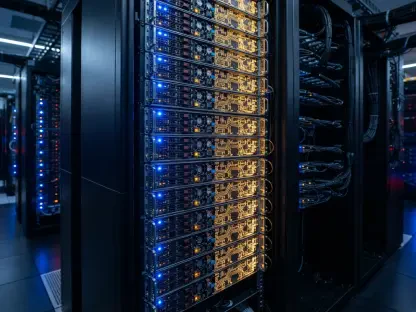
The foundation of this multicloud transition rests upon the deployment of identical Exadata hardware across all supported cloud platforms and on-premises environments. This hardware parity ensures that the exact same performance characteristics and security protocols are maintained regardless of where the database resides. By utilizing a consistent architectural footprint, businesses can bypass the traditional difficulties associated with cloud migration, such as the need to refactor complex code or redesign underlying data structures. This “like-for-like” approach allows for a fluid movement of workloads between Oracle Cloud Infrastructure and other major providers like Google Cloud. Instead of managing a patchwork of disparate technologies, IT teams can leverage a singular operational model that simplifies maintenance and scaling. Such uniformity is essential for organizations that cannot afford the downtime or performance variability typically found in hybrid setups.
Performance Metrics: Why Data Proximity Matters
The effectiveness of modern AI systems is increasingly measured by data freshness, which refers to how quickly an AI agent can access the most recent information. In the current 2026 landscape, a delay of even a few seconds can render an AI’s output irrelevant, especially in high-stakes industries like finance or healthcare. By placing the database logically and physically adjacent to the AI applications, Oracle minimizes the latency that often plagues cross-cloud communication. When an AI agent needs to verify a customer’s credit limit or check real-time inventory levels, it can query the Oracle database through a direct, low-latency link. This proximity ensures that the AI is not working with a stale cache or a snapshot from several hours ago. Maintaining a live connection to the primary source of truth is what separates successful production AI from experimental prototypes that fail to deliver meaningful business value during critical moments.
Ecosystem: Strategic Integration Across Providers
Cloud Interoperability: Breaking Down Traditional Silos
Modern digital ecosystems are inherently diverse, and the recent expansion into partnerships with major providers like Amazon Web Services and Google Cloud reflects a departure from old isolationist policies. Organizations today do not want to be forced into consolidating all their operations onto a single proprietary cloud platform just to use a specific database technology. Oracle’s multicloud strategy acknowledges that a company might run its consumer-facing applications on one cloud while maintaining its core business logic on another. By offering services like Oracle Database@Azure, the company allows users to maintain their existing business relationships and technical stacks. This flexibility is crucial for large-scale enterprises that have spent years building specialized environments. They can now integrate database capabilities into their existing cloud footprint without the friction of a full-scale platform migration.
Future Readiness: Moving Toward Autonomous Operations
In conclusion, the evolution of database placement became a defining factor in the success of corporate AI initiatives throughout 2026. Oracle successfully demonstrated that the most effective way to power real-time intelligence was to remove the distance between data and compute. Enterprises that prioritized hardware consistency and low-latency connectivity were able to deploy autonomous agents with far greater reliability than those struggling with fragmented infrastructures. Moving forward, the focus should shift toward auditing existing data pipelines to identify latency bottlenecks that could hinder AI performance. Decision-makers were encouraged to embrace multicloud architectures that offer the flexibility to run workloads in the most logical environment without sacrificing technical standards. By adopting a strategy that emphasized data proximity and infrastructure parity, companies secured a competitive edge in an increasingly automated world.