
The push for enterprise platform consolidation has created a massive single point of failure risk, as evidenced by the simultaneous loss of email, chat, and AI services. This vulnerability was laid bare during a recent 24-hour period in mid-November, when a systemic collapse paralyzed Microsoft’s most vital services, including Exchange Online and the Copilot AI environment. The investigation into the incident revealed that the crisis stemmed from a dormant scalability flaw within the Windows architecture, a defect that had remained hidden since July. While this bug persisted unnoticed for several months, it transformed into a catastrophic liability during routine maintenance of network gateways. As traffic shifted between regions, the software defect triggered a cascading failure that traditional recovery mechanisms were unable to contain. This event serves as a stark reminder that in a hyperconnected cloud ecosystem, even a minor engineering oversight can escalate into a global crisis. The scale of the disruption has forced a total reevaluation of how global infrastructure is maintained and defended against the inherent fragility of shared network components, pushing the company to prioritize system reliability above the rollout of any new consumer-facing features or experimental AI capabilities.
Internal Crisis Management
Challenges in the Fog of War
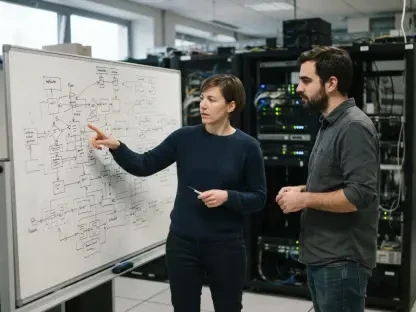
Internal communications from high-level leadership, including memos from Jason Henderson and Amanda Silver, painted a picture of an engineering environment struggling under the weight of its own complexity. Silver described the effort to stabilize the systems as operating within a “fog of war,” where the very tools meant to facilitate communication were themselves part of the outage. Despite the mobilization of the company’s premier engineering talent, the response was severely hampered by a fragmented internal infrastructure. Diagnostic data was scattered across disparate platforms, and the teams responsible for restoration found themselves operating without a unified “source of truth.” This lack of centralized visibility led to a chaotic atmosphere where emergency responders exchanged over 11,000 messages across 11 different internal chat threads, often duplicating efforts or pursuing conflicting diagnostic hypotheses. The breakdown in communication highlighted a critical flaw: when the primary collaboration platform fails, engineering teams lose the ability to coordinate at the speed required for modern cloud operations. This operational paralysis delayed the identification of the root cause, allowing the regional collapse to spread unchecked for hours while engineers manually pieced together a coherent picture of the network’s health.
Operational Deficiencies and Metrics
The severity of the mid-November outage was further quantified by Charles Lamanna, who observed that the frequency and intensity of component failures during that single 24-hour window were equivalent to a full decade’s worth of allowable failure rates. This staggering statistic served as a wake-up call for the organization, revealing that existing safety margins were wholly inadequate for the current scale of global traffic. The internal post-mortem pointed toward a significant gap between the rapid growth of the company’s cloud footprint and the evolution of its diagnostic and tracking systems. Because internal monitoring tools were often disconnected from one another, recovery teams could not immediately see how a gateway failure in one region was directly poisoning the health of gateways in distant geographic locations. The “Code Red” mandate was born out of this failure, signaling that the company can no longer afford to treat infrastructure as a background concern. By establishing a protocol that treats reliability as the highest possible priority, the organization is attempting to close the gap between its ambitious service expansion and the foundational engineering required to support it. The crisis exposed that previous protocols were designed for a less integrated world, necessitating a complete overhaul of how the firm manages large-scale infrastructure emergencies.
The Code Red Strategic Mandate
Isolation and Workload Prioritization
The first major pillar of the new initiative focuses on preventing the “domino effect” that characterized the November outage by implementing stricter regional traffic isolation. In the past, automated network gateways were designed to reroute traffic seamlessly to ensure uptime, but this mechanism inadvertently became a vector for spreading software defects across the globe. By building digital barriers between regional clusters, engineers aim to ensure that a failure in the United States or Australia remains contained within its original boundary, rather than migrating to healthy systems in Japan or Europe. Alongside this isolation strategy, the company is developing sophisticated workload prioritization mechanisms. These tools will allow the cloud infrastructure to automatically recognize and throttle low-priority tasks during periods of extreme system stress. For example, during a network surge, the system could temporarily suspend background data indexing or non-essential AI processing to preserve the bandwidth required for critical voice calls and email delivery. This approach acknowledges that not all cloud traffic is equal, and maintaining core communication channels must take precedence over secondary features when resources are limited. This strategic pivot marks a move toward a more resilient, tiered service model that prioritizes the continuity of essential business functions over the “always-on” availability of the entire suite.
AI Diagnostics and Rapid Patching
To achieve the ambitious goal of resolving future global outages within a single hour, the “Code Red” protocol is integrating advanced AI agents into the diagnostic pipeline. These agents are being trained to ingest and analyze massive streams of real-time performance data, identifying the subtle signatures of a cascading failure long before human engineers could parse the logs. By utilizing AI to find the root cause of a defect in minutes rather than hours, the company hopes to cut the initial response time down to a fraction of its current state. However, identification is only half the battle; the speed of remediation must also increase significantly. Historically, deploying a critical patch across the entire global Microsoft 365 environment could take as long as five or six days to ensure stability and avoid further regressions. The new mandate demands that the entire lifecycle—from the moment a fix is coded to its global deployment—must be compressed into a 60-minute window. This requires a fundamental redesign of the deployment architecture, moving away from slow, staged rollouts in favor of high-speed, validated distributions. Achieving this “one-hour benchmark” is now the primary metric of success for engineering leadership, serving as the ultimate test of whether the infrastructure has been sufficiently hardened to meet the demands of the modern enterprise.
Market Implications and Competitive Landscape
The Risks of Platform Consolidation
The recent outage has reignited a critical debate regarding the risks of platform consolidation, particularly for high-stakes industries like government administration and financial services. For years, the prevailing trend has been to consolidate email, collaboration, and AI workflows onto a single, integrated platform to simplify management and reduce costs. However, the mid-November failure proved that this strategy creates a massive single point of failure where a single gateway flaw can paralyze every digital tool an organization relies on. For a major bank or a federal agency, the loss of email is manageable if chat systems remain functional, but the simultaneous loss of both, combined with the failure of AI assistants, creates a total operational vacuum. Consequently, the decision to renew or expand large-scale cloud contracts now hinges on whether service providers can prove their ability to localize failures and prevent widespread paralysis. Enterprise customers are increasingly demanding guarantees that their critical workflows will not be collateral damage in a regional network crisis. This shift in customer sentiment has placed immense pressure on cloud providers to demonstrate that their “integrated” suites are not “interdependent” to a fault, forcing a move toward architectures that offer the benefits of a unified user experience without the risks of a monolithic failure.
Recovery Speed as a Competitive Metric
In the current competitive landscape, recovery speed has emerged as a primary differentiator between cloud service providers. While the market initially reacted to the “Code Red” announcement with cautious optimism, the broader tech industry is now evaluating companies based on their “time to restore” rather than just their “uptime” percentages. The reality of 2026 is that outages are viewed as inevitable, but a 24-hour disruption is no longer acceptable in a world where business moves at the speed of light. This has led to a surge in interest for “hardened” engineering practices, where the ability to guarantee a rapid return to service is becoming as valuable as the software features themselves. As Microsoft’s stock showed only marginal gains following the activation of its emergency protocols, it became clear that investors are waiting for tangible proof of resilience before rewarding the company’s strategic pivot. The broader industry focus has moved away from the “feature wars” of the early 2020s and toward an era of infrastructure accountability. Competitors are now being measured by the robustness of their underlying systems, and the ability to maintain service during routine maintenance has become a key performance indicator for potential enterprise clients. This evolution suggests that the future of the cloud market will be dominated by those who can master the art of rapid crisis resolution and system transparency.
Cybersecurity in the Age of AI
Rising Threats and Third-Party Solutions
While the specific outage that triggered the “Code Red” protocol was not the result of a cyberattack, it occurred against a backdrop of increasingly sophisticated AI-driven security threats. In regions like Australia and Japan, authorities have recently documented instances where AI agents were utilized to gain unauthorized access to non-public government data or to orchestrate complex intrusions. These incidents highlight a dangerous paradox: the same AI tools that Microsoft intends to use for system recovery are also being weaponized by malicious actors to exploit cloud vulnerabilities. These AI-driven attacks often combine multiple low-risk vulnerabilities to create high-impact breaches that traditional security tools might miss. This has created an urgent need for “zero-trust” verification for every action taken by an autonomous agent within a network. Organizations are realizing that as they integrate more AI into their core operations, they are simultaneously expanding their attack surface. The complexity of these threats means that internal security measures are often insufficient, leading to a significant increase in the adoption of third-party security layers that can monitor AI behavior in real time. This growing threat landscape has transformed cybersecurity from a secondary concern into a fundamental requirement for the successful deployment of any AI-integrated cloud platform.
The Future of Digital Infrastructure Resilience
The surge in AI-related vulnerabilities has directly fueled the rapid growth of specialized cybersecurity vendors such as Palo Alto Networks and CrowdStrike. As enterprises rushed to protect their digital ecosystems following the November outage, Palo Alto Networks reported a ninefold increase in traffic through its SASE platform, while CrowdStrike’s AI-focused security tools reached unprecedented revenue milestones. These third-party providers stepped in to fill the gap between the vulnerabilities exposed by the outage and the protective measures required for a “zero-trust” environment. Organizations increasingly sought out solutions that could verify the identity and permissions of autonomous agents, ensuring that no tool could invoke a command without rigorous authorization. The industry recognized that the infrastructure supporting the AI revolution had to be fundamentally more resilient than the legacy systems it replaced. By the end of this transformative period, the enterprise sector moved away from a reliance on single-vendor security, opting instead for a layered approach that prioritized visibility and rapid response. These strategic adjustments established a new standard for digital defense, where the focus shifted from preventing every possible failure to ensuring that any intrusion or technical glitch could be neutralized before it evolved into a global crisis. The lessons learned during the activation of the “Code Red” initiative ultimately provided a blueprint for a more secure and reliable digital future.