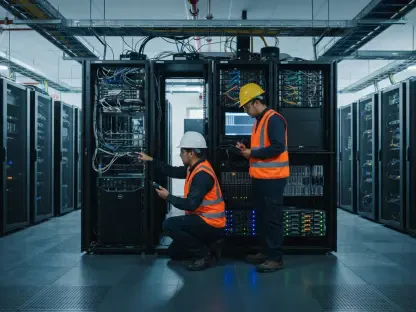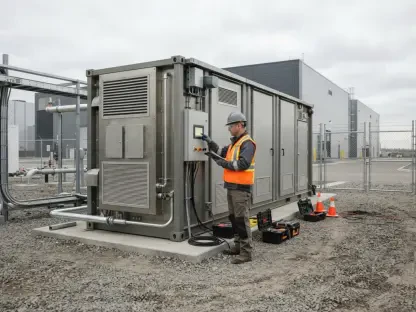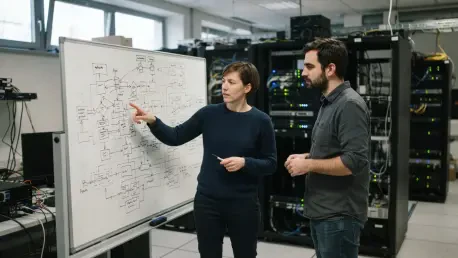

Instruction sets such as AVX-512 are providing the necessary computational foundation for running sophisticated deep learning tasks directly on standard server hardware without specialized accelerators. This technological shift represents a fundamental realignment in how global enterprises perceive cloud infrastructure in 2026. Rather than relying solely on scarce and expensive discrete accelerators, the industry is seeing a major resurgence in the utility of general-purpose silicon for high-stakes AI operations. Major cloud providers are now collaborating more deeply with Intel to ensure that the underlying architecture is not just a passive host but an active participant in performance optimization. These hardware-level enhancements allow for more fluid scaling of microservices and containerized environments without the bottlenecks typically associated with specialized hardware dependencies. By integrating these advanced capabilities into standard instance types, organizations can achieve a level of computational density that was previously reserved for niche, high-cost clusters. This evolution is lowering the barrier to entry for complex data science, enabling a broader range of companies to deploy intelligent applications at a global scale.
Modern Silicon Optimization
CPU-Driven AI Inference
The current landscape is witnessing a strategic pivot where high-performance general-purpose compute is effectively challenging the dominance of specialized graphics processors for AI workloads. Intel Xeon processors, particularly within the M7i and R7i instance families, are now at the forefront of this transition, utilizing Advanced Matrix Extensions (AMX) to handle deep learning inference with remarkable efficiency. This capability allows businesses to reclaim idle CPU cycles for significant background data processing, effectively reducing the reliance on external hardware accelerators that are often plagued by supply chain constraints. For many engineering teams, the priority has shifted toward maximizing the throughput of these CPU-based instances to support real-time decision-making engines and local AI pipelines. By leveraging the built-in acceleration of modern silicon, enterprises are finding they can maintain lower operational costs while still delivering the low-latency performance required for modern user experiences. This approach effectively bridges the gap between traditional compute and the high demands of predictive modeling in a cost-effective manner.
High-Performance Enterprise Workloads
Scaling massive application landscapes like SAP HANA now requires a more nuanced understanding of the intersection between memory footprints and storage throughput. In the context of programs like SAP RISE, the success of cloud migration often hinges on the ability to fine-tune instances specifically for data-intensive operations. In 2026, the focus has moved toward utilizing Intel-optimized instances that offer a balanced ratio of compute power to memory bandwidth, ensuring that large-scale databases remain responsive under heavy loads. Technical teams are finding that unoptimized cloud transitions frequently lead to prohibitive costs, making the precise calibration of hardware resources a mandatory step in the deployment lifecycle. By tailoring the underlying infrastructure to the specific demands of the software, organizations can avoid the over-provisioning trap that often erodes the financial benefits of the cloud. This trend underscores a broader movement toward architectural maturity, where the goal is not just to be in the cloud, but to operate within it with surgical precision. This methodology ensures that even the most demanding enterprise systems can scale without incurring unnecessary capital expenditure.
Developer and Workforce Ecosystems
Local Cloud Emulation
The increasing complexity of serverless pipelines and microservices has made efficient local testing environments an essential component of the DevOps lifecycle. For a long time, LocalStack served as the primary method for emulating cloud APIs, but its shift toward a more restrictive commercial licensing model has catalyzed a demand for truly open-source alternatives. Emerging tools like Floci have gained traction by providing a lightweight, MIT-licensed emulator that avoids the friction of authentication tokens and proprietary accounts. This development allows developers to maintain their autonomy while simulating complex Identity and Access Management policies and S3 environments directly on their local machines. By offering a drop-in replacement that listens on the standard port 4566, these open-source projects are simplifying the localhost experience and reducing the latency associated with testing against live cloud environments. This shift highlights a growing consensus within the engineering community that the speed of development should not be hindered by the commercial interests of infrastructure emulators. Maintaining a friction-free local environment remains vital for the rapid iteration required in modern software engineering.
Scalable Virtual Desktops
Amazon WorkSpaces has transitioned from a niche remote access tool into a cornerstone of enterprise agility, capable of supporting rapid, large-scale workforce deployments. The benchmark for this evolution was set by massive organizations that successfully migrated tens of thousands of desktops to the cloud in less than three days, demonstrating the power of a fully managed virtual desktop infrastructure. These environments are increasingly reliant on Intel-based instances to provide the consistent, high-performance experience required by developers and administrative professionals alike. By utilizing specialized instances, companies can provide their global workforces with standardized, secure desktops that are accessible from any location without compromising on performance. This ability to scale rapidly is becoming a competitive advantage for firms operating in volatile markets, allowing them to onboard talent or shift operational focuses with minimal IT friction. The resulting flexibility ensures that the digital workspace is no longer a bottleneck but a facilitator of organizational growth. These cloud-based desktops provide the necessary security and performance to support specialized developer environments on a global scale.
Future of Autonomous Operations
Agentic AI Integration
The integration of Agentic AI within cloud-based desktops is fundamentally changing the way IT departments manage complex infrastructure and troubleshoot systemic issues. These intelligent agents are designed to navigate both modern cloud-native applications and legacy mainframe systems, automating multi-step workflows that once required significant manual intervention. By deploying AI-driven advisors for administration, organizations can now automate the provisioning and governance of virtual desktop environments, ensuring that security policies are consistently applied across the entire fleet. This level of automation significantly reduces the operational overhead for IT teams, allowing them to focus on high-value strategic initiatives rather than routine maintenance tasks. Furthermore, these agents can proactively identify performance bottlenecks and suggest optimizations before they impact the end user, creating a more resilient and responsive ecosystem. The emergence of these autonomous capabilities signals a shift toward a self-healing infrastructure where the line between human administration and machine intelligence continues to blur. This evolution ensures that even the most complex global environments remain stable and efficient.
The Hallway Track
The informal exchange of ideas among system architects and developers proved to be one of the most effective ways to validate the performance of new silicon-level integrations. These informal interactions offered an unfiltered look at how Intel-optimized instances performed under the stress of real-world production environments, leading to the consensus that specialized tuning was no longer optional. Engineers who shared practical insights regarding the fine-tuning of vector operations and the management of memory-intensive databases provided a level of technical depth that went beyond official documentation. This collaborative spirit encouraged organizations to prioritize a hardware-aware approach, ensuring that their infrastructure strategies remained resilient against evolving data demands. By cross-referencing these real-world experiences, teams successfully implemented more efficient local emulation workflows and agent-driven management layers. These historical interactions served as a vital reminder that technical mastery required both formal training and the collective wisdom found in professional communities. Practitioners who embraced this multifaceted approach to learning were better positioned to navigate the complexities of modern cloud architecture.