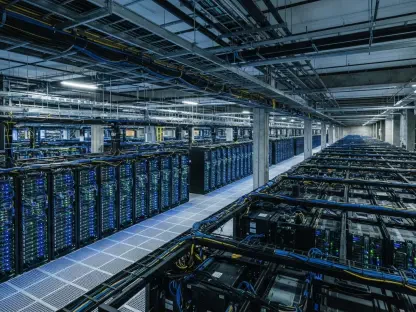

The Dutch expansion marks a pivotal moment for Chinese technology firms as they intensify competition within the global cloud and artificial intelligence landscape. As European enterprises pivot toward more sophisticated digital architectures, the arrival of two new data centers in Amsterdam provides a critical bridge for businesses seeking a balance between high-performance computing and stringent regulatory compliance. By establishing a sovereign presence in the Netherlands, Alibaba Cloud addresses the localized demand for low-latency connectivity and robust disaster recovery capabilities. This strategic move ensures that regional organizations can process massive datasets without moving information beyond the borders of the European Union, which remains a non-negotiable requirement for many financial and healthcare institutions. The facilities serve as a foundation for a new era of innovation where artificial intelligence is not just a peripheral tool but a central component of operational efficiency and customer engagement across the continent.
Technical Sovereignty: Security Architectures and Autonomous Intelligence
The current shift toward autonomous technology requires more than just raw processing power; it demands a specialized environment where security is deeply integrated into the hardware itself. To address this, the launch introduces “agentic AI” services specifically designed to secure the next generation of autonomous digital assistants and workflows. Tools like the ACS Agent Sandbox provide hardware-level isolation to prevent unauthorized access or data leakage during complex computations, while the Agent Security Center offers an integrated defense layer against evolving cyber threats. Furthermore, the deployment of AI Security Guardrails 2.0 allows companies to implement real-time risk detection, ensuring that generative models operate within safe parameters. These advancements are particularly relevant for industries like logistics and retail, where intelligent agents are increasingly tasked with making high-stakes decisions. By automating threat detection through platforms like Agentic SOC and STAROps, businesses can manage their operations with greater precision.
Building on this technical foundation, the expansion emphasizes a commitment to hybrid cloud solutions through the latest iteration of Apsara Stack, which provides over 80 products tailored for public sector and complex enterprise workloads. This flexibility is vital for firms that maintain legacy systems while transitioning to the cloud, allowing for a seamless integration of on-premises resources with public cloud scalability. A notable implementation involves JetBrains, the software development firm, which has begun exploring the integration of Qwen models into its AI-driven coding assistant, Junie. This partnership highlights the growing appetite among developers for high-performance, open-source-aligned models that offer greater control over AI environments compared to rigid, proprietary alternatives. By providing the infrastructure to support such sophisticated integrations, the new Dutch facilities empower local developers to build and deploy applications that leverage the latest breakthroughs in large language models while maintaining strict data residency.
The digital expansion in the Netherlands effectively repositioned the regional tech landscape by providing the low-latency infrastructure necessary for advanced AI workloads. As companies successfully integrated these new cloud resources, it became clear that the focus shifted from simple storage to high-level agentic automation. For organizations looking to capitalize on this progress, the first step involved auditing existing data workflows to identify where local processing could most improve security and speed. It was also vital to explore how open-source models, such as the Qwen series, could be fine-tuned within a sovereign cloud environment to maintain proprietary advantages. Looking ahead, the projected growth toward a total global capacity exceeding 20GW by 2032 indicates that this is only the beginning of a massive infrastructure cycle. Decision-makers should now prioritize training their development teams in hybrid cloud management and AI safety protocols to ensure they are prepared for a future where autonomous agents handle the bulk of routine operations.