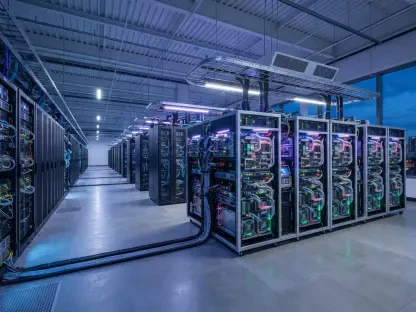

The global banking landscape is currently undergoing a seismic shift as legacy institutions transition from experimental pilot programs to full-scale industrialization of artificial intelligence across their core operations. HSBC has recently solidified its position at the forefront of this movement by expanding its long-term partnership with Google Cloud to deploy over two hundred unique generative artificial intelligence use cases. This massive undertaking is not merely a technical upgrade but a fundamental reimagining of how a Tier 1 global bank interacts with its vast data stores and diverse customer base. By integrating these advanced capabilities, the institution aims to solve complex financial puzzles that were previously too resource-intensive for traditional computing methods. This strategic move signals a departure from tentative exploration, moving toward a robust, cloud-first framework that prioritizes real-time intelligence for all of its various international clients.
Cloud Tech
Vertex AI
The backbone of this massive deployment rests on Google Cloud’s Vertex AI platform, which provides the necessary tooling to build, deploy, and scale machine learning models with unprecedented speed and precision. HSBC is utilizing this infrastructure to create a unified environment where data scientists and engineers can collaborate on sophisticated large language models tailored specifically for financial services. By leveraging BigQuery as a centralized data warehouse, the bank ensures that its AI models have access to high-quality, structured information across various international markets. This integration allows for a seamless flow of data from raw input to actionable insight, reducing the latency typically associated with cross-border financial analysis. Furthermore, the use of Google’s specialized AI chips offers the computational power required to process billions of transactions while maintaining a commitment to carbon-efficient digital transformation throughout the entire global firm.
Trade AI
Beyond customer-facing applications, the partnership focuses heavily on streamlining internal processes that have traditionally been bogged down by manual documentation and legacy silos. One of the most impactful applications involves the automation of trade finance reviews, where generative AI can analyze thousands of pages of shipping manifests and legal contracts in seconds to identify discrepancies. This capability significantly reduces the operational risk associated with human error and speeds up the movement of goods across the global supply chain. Additionally, the bank is deploying AI-driven assistants to help corporate relationship managers synthesize market trends and client histories into coherent investment strategies. These tools do not replace human judgment but rather augment it by surfacing relevant data points that might otherwise remain buried in unstructured text formats. This shift allows the workforce to focus on high-value advisory roles now.
Security
Defense
In an era where cyber threats and financial crimes are becoming increasingly sophisticated, the deployment of AI use cases includes a heavy emphasis on defensive and protective measures. HSBC is utilizing Google Cloud’s security-centric AI capabilities to enhance its anti-money laundering protocols and real-time fraud detection systems. These models are trained to recognize subtle patterns of illicit activity that deviate from standard behavioral baselines, allowing the bank to flag suspicious transactions with a higher degree of accuracy. By reducing false positives, the institution can allocate its investigative resources more effectively, targeting genuine threats rather than benign anomalies. Moreover, the partnership incorporates rigorous data privacy standards, ensuring that sensitive customer information remains protected while still being accessible for legitimate analytical purposes. This balance is crucial for maintaining trust in a digital-first financial environment where information is the most valuable asset.
Ethics
The strategic alliance between HSBC and Google Cloud provided a clear blueprint for how massive financial institutions successfully navigated the complexities of large-scale AI adoption. Organizations that moved beyond isolated experiments and toward integrated, cloud-native platforms found themselves better positioned to handle the volatility of the global market. To replicate this success, leaders should have focused on breaking down internal data silos and investing heavily in the upskilling of their existing workforce to work alongside automated systems. Decision-makers were encouraged to prioritize use cases that offered immediate operational relief while building a foundation for long-term strategic growth. The transition required a shift in mindset from seeing technology as a utility to viewing it as a core engine of business transformation. Ultimately, the lessons learned from this deployment offered a path forward for any enterprise aiming to balance rapid innovation with the highest security.