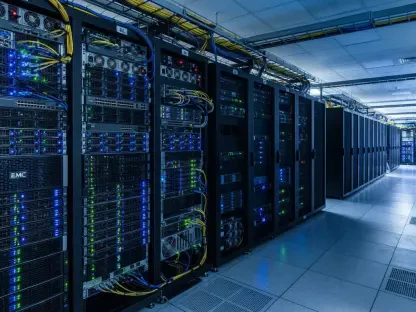

Management has authorized a tenfold increase in capital expenditure over the next year to purchase the hardware required to fulfill massive new storage contracts for AI infrastructure. This aggressive expansion marks a definitive departure from the organization’s long-standing reputation as a reliable provider of consumer-level computer backups. In the current landscape of 2026, the demand for massive data repositories to feed hungry machine learning models has transformed the business environment entirely. While the legacy backup division remains a stable component of the brand, the cloud storage sector has emerged as the primary engine for financial performance. Recent fiscal reports indicate that this high-performance division now dictates the strategic direction of the entire firm. By focusing on enterprise-scale needs, the company is effectively repositioning itself as a utility for the next generation of digital development, moving beyond simple data preservation toward becoming an active participant in the artificial intelligence revolution that is currently sweeping through every major global industry.
The Role of AI in Revenue Growth
Driving Demand Through Strategic Partnerships
The emergence of Neoclouds—specialized cloud providers tailored specifically for heavy-duty GPU workloads—has created a massive niche for secondary storage providers that can offer both scale and cost-efficiency. By serving as the capacity tier for entities like CoreWeave, the company ensures that the vast datasets required for training large language models are always accessible and securely housed. This strategy has proven immensely successful, as demonstrated by the record-breaking growth seen in the B2 cloud storage segment throughout the middle of the current decade. The ability to provide an alternative to the rigid structures of legacy giants has allowed these partnerships to flourish in a competitive market.
Building on this foundation of specialized infrastructure, the firm has observed a trend in customer behavior that suggests a long-term commitment. The net revenue retention rate for the enterprise segment currently stands at a robust 115 percent, a figure that highlights the tendency of existing clients to expand their data footprints rapidly over time. As projects move from initial testing into full-scale production, the underlying data requirements grow exponentially, which creates a very sticky environment for enterprise customers who value seamless scalability. This organic growth within the existing customer base provides a stable foundation for revenue projections as models continue to scale.
Strategic Customer Acquisition and Lead Generation
The shift toward a more sophisticated clientele is evident in the recent uptick of high-value customer acquisitions, particularly among those contributing more than $50,000 in annual recurring revenue. In the third quarter alone, the organization saw a 57 percent increase in this specific category, underscoring a definitive move toward the enterprise tier. These builders often begin with modest projects before doubling their storage commitments within months as their models gain complexity. This land and expand model is highly effective in a market where the speed of deployment is just as critical as the price point, allowing the company to capture a larger share of the emerging infrastructure market.
An unexpected but powerful driver of this growth has been the company’s commitment to transparency through its detailed disk drive reliability reports. Visibility from search engines grew by 230 percent year-over-year, as automated research tools increasingly cite these data sets as authoritative sources for hardware performance. This technical credibility translates into high-quality sales leads, with visitors from these sources converting into active customers at more than twice the rate of traditional search traffic. By leveraging its data-centric heritage, the firm has built a reputation for expertise that resonates deeply with the technical requirements of the AI community, providing a bridge to modern needs.
Operational Expansion and Future Outlook
Scaling Infrastructure to Meet Market Needs
The decision to increase capital expenditure is a calculated move to stay ahead of a market that is consistently outperforming forecasts. By allocating significant funds toward new storage hardware, the company is preparing for a future where petabyte-scale contracts are the standard rather than the exception. Management noted that hardware allocations are tracking ahead of schedule, with major clients beginning to load data significantly earlier than originally projected. This acceleration proves that the demand for capacity is immediate and that waiting to build out infrastructure would result in lost market share in a fast-moving economy where physical readiness is a major competitive advantage.
While the increase in hardware spending is significant, the strategy is grounded in a model of committed contracts with minimum ramps. Unlike speculative builds, these investments are directly tied to long-term agreements that guarantee a return on the deployed assets before they even go online. This approach reduces the risk of stranded capacity, as customers are already signed and waiting for the storage to be provisioned. The transition to a capital-intensive model reflects a maturing market where physical storage is vital, and the organization is now firmly established as a leader in providing the raw capacity needed for modern computing tasks that require massive data throughput.
Long-Term Vision and Market Positioning
The organization has identified the Neocloud capacity storage market as an opportunity that could reach a valuation of $14 billion by 2031. To capture this segment, the company is positioning itself as a high-performance, cost-effective alternative to the legacy cloud providers that currently dominate the field. Traditional giants often carry high egress fees and complex pricing structures that can become prohibitive for researchers working on massive projects. In contrast, a streamlined storage-first approach provides the predictability and speed that modern developers crave in their data stack, allowing the firm to ride the high-velocity wave of enterprise growth while maintaining healthy margins.
The successful shift from a backup service to a cornerstone of the AI stack was achieved through disciplined investment and a sharp focus on high-growth sectors. By prioritizing the needs of high-value builders, the organization transitioned into a cash-flow-positive leader with a clear trajectory for the coming years. Industry analysts suggested that companies should have evaluated their storage architecture to ensure it remained capable of supporting AI-driven workloads. Moving forward, the organization prepared for even greater data density by exploring advanced hardware configurations. These actions ensured that the company stayed ahead as the demand for storage skyrocketed, solidifying its role as a digital utility.