
Maryanne Baines stands at the intersection of orbital mechanics and next-generation cloud infrastructure, bringing years of expertise in evaluating the hardware stacks that power our digital world. As an authority in cloud technology, she has spent her career dissecting how different industries leverage high-performance computing to solve complex problems. Today, she provides her specialized perspective on the emerging frontier of orbital data centers, a concept that aims to relocate the heavy lifting of artificial intelligence from Earth’s surface to the stars.
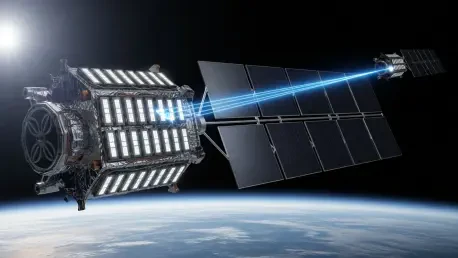
Project Suncatcher involves equipping solar-powered satellites with Tensor Processing Units and utilizing optical links for data movement. How do these components change the way we approach AI training, and what specific advantages does free-space optical communication offer over traditional radio frequency signals in this high-speed environment?
Integrating Google’s Tensor Processing Units into a satellite framework shifts AI training from a land-locked resource to a highly mobile, distributed network. By moving data between satellites using free-space optical links, we bypass the bandwidth bottlenecks and interference issues that often plague traditional radio frequency signals. These optical links allow for the transmission of massive datasets at speeds essential for training complex models, effectively turning a constellation of satellites into a single, unified supercomputer. It is a bold departure from traditional terrestrial infrastructure, offering a low-latency environment that operates far above the physical and regulatory constraints of ground-based fiber networks.
Satellites in specific orbits can bypass the day-night cycle and atmospheric weather that limit Earth-based solar systems. What are the operational benefits of having constant solar access for high-performance computing, and how does this reliability affect the long-term sustainability and scaling of global data center infrastructure?
The primary operational benefit is the elimination of the intermittency that haunts terrestrial solar power, as satellites in the right orbits can harvest sunlight nearly 100% of the time. This constant energy flow provides a stable, high-density power source for energy-hungry TPUs, removing the need for the massive battery storage systems or backup generators required on Earth. From a sustainability perspective, this allows us to scale global data infrastructure without further straining local power grids or consuming vast tracts of land for solar farms. We are essentially looking at a future where the most power-intensive compute tasks are offshored to a place where energy is truly infinite and clean.
Terrestrial data centers currently face power costs between $570 and $3,000 per kW annually, while orbital models require launch costs to drop to roughly $200 per kilogram. What logistical shifts must occur in the launch industry to hit this price point, and how do you calculate the ROI?
To hit that critical $200 per kilogram target, we need to see the full maturation of ultra-heavy, fully reusable launch systems that can fly with the frequency of commercial aircraft. Currently, the industry is banking on the economies of scale provided by partners like SpaceX to drive these costs down from their historical highs to a level that competes with terrestrial energy bills. Calculating the ROI involves spreading those initial launch costs over the five-to-ten-year operating life of the spacecraft and comparing that to the $3,000 per kW top-end costs of ground-based power. If the launch cost per kilogram meets that threshold, the orbital model becomes commercially viable, even before you factor in the savings from reduced land taxes and cooling infrastructure.
Operating hardware in a vacuum presents unique hurdles, specifically regarding radiation durability and thermal management. What engineering strategies can protect sensitive processors from cosmic radiation, and how do you effectively dissipate the immense heat generated by intensive AI workloads without an atmosphere to assist in cooling?
Protecting sensitive TPUs in the harsh environment of space requires a “defense-in-depth” strategy, combining physical shielding with radiation-hardened circuitry and sophisticated error-correcting software. Because there is no air to carry heat away via convection, we have to rely entirely on large-scale thermal radiation systems, using specialized heat pipes to move warmth from the processors to massive external radiators. This requires a complete reimagining of hardware architecture, where the physical layout of the satellite is dictated by the need to shed heat into the cold void. It is a delicate balancing act, ensuring the hardware stays warm enough to function while preventing the intense heat of AI workloads from melting the internal components.
The first prototype mission for orbital computing is slated for early 2027 using two test satellites. What are the primary benchmarks for success during this initial learning phase, and how will the partnership between satellite imaging specialists and cloud providers evolve as these constellations expand?
The 2027 mission with Planet Labs will focus on validating whether the TPU hardware can survive the launch and maintain operational stability under constant radiation exposure. Success will be measured by the reliability of the optical links between the two prototypes and the efficiency of the thermal management system under actual compute loads. As these partnerships evolve, we will likely see a fusion of “edge” processing and “cloud” storage, where imaging satellites process data in real-time before it even hits the ground. This turns the satellite from a simple camera into an intelligent node capable of delivering immediate insights, fundamentally changing the value proposition for satellite imaging specialists.
There is growing interest in integrating massive ground-based facilities with gigawatt-scale orbital infrastructure to support advanced AI models. How will this hybrid model change the geography of global data processing, and what are the primary technical hurdles to synchronizing space-based nodes with existing terrestrial networks?
A hybrid model will de-center data processing from traditional hubs like Virginia or Northern Europe, allowing us to place massive compute power in any orbit regardless of local geography or political stability. The technical hurdle lies in synchronizing these space-based nodes with terrestrial networks, which requires ultra-precise timing and high-bandwidth ground-to-space links that can pierce the atmosphere without significant data loss. We are essentially building a “planetary-scale” computer, where the challenge is maintaining a seamless data flow between a gigawatt-scale orbital array and a ground facility like the Colossus 1 site. It requires a level of network orchestration that we are only just beginning to develop in the cloud sector.
What is your forecast for the future of orbital AI data centers?
I forecast that by the mid-2030s, orbital data centers will transition from experimental research to a fundamental pillar of the global AI economy. We will see the emergence of “compute constellations” that act as a backbone for the world’s most demanding AI models, operating entirely on sovereign, space-based energy. While the initial costs are high, the convergence of falling launch prices and the insatiable demand for power-efficient AI will make the vacuum of space the most sought-after real estate in the tech industry. Eventually, the very definition of a “data center” will move away from concrete buildings on the ground toward shimmering arrays of silicon and solar panels orbiting the Earth.