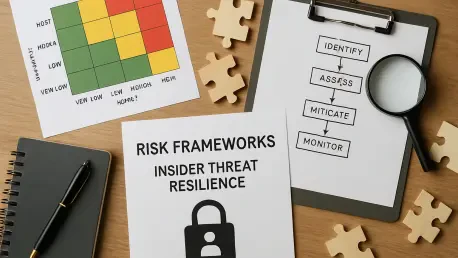

The silent migration of sensitive intellectual property through the hands of a trusted employee often remains undetected until the damage to a company’s competitive advantage becomes irreversible. In 2026, the complexity of the digital enterprise has outpaced the effectiveness of traditional perimeter-based security, forcing a fundamental shift toward an “inside-out” defensive strategy. This transition recognizes that individuals granted legitimate access—ranging from full-time staff to temporary contractors and third-party vendors—now represent the most significant potential for operational disruption. Risk management frameworks provide the indispensable structure required to identify, assess, and mitigate these internal vulnerabilities before they evolve into full-scale crises. By moving away from reactive, ad hoc responses and adopting standardized methodologies, organizations establish a resilient posture that treats insider risk as a business priority rather than a mere IT problem. These frameworks serve as the organizational scaffolding for institutionalized governance, ensuring that security decisions are consistent, defensible, and aligned with broader strategic objectives. This foundational approach is essential for transforming a fragmented defense into a cohesive program capable of weathering the unique challenges posed by internal actors who understand the system’s inner workings.
Institutionalizing Insider Risk Governance
Strategic Posturing: Financial Accountability and Timing
The economic impact of delayed detection remains a primary driver for the adoption of formal risk frameworks in the modern corporate environment. Recent industry data indicates that the average annual cost of insider incidents has risen to over $16 million, with remediation expenses increasing exponentially when threats remain undetected for more than 90 days. This financial reality highlights the importance of frameworks like ISO 27001 or the NIST Risk Management Framework, which prioritize early detection and rapid response. By implementing these structured methodologies, organizations can establish clear monitoring protocols and automated alerts that significantly shorten the window of vulnerability. When the time to detect an internal anomaly is reduced, the resulting financial hit is often contained, preventing the cascading losses associated with long-term intellectual property theft or system sabotage. Furthermore, these frameworks mandate a cost-benefit analysis of security controls, ensuring that investments are directed toward the most critical internal assets. This level of financial accountability transforms cybersecurity from a cost center into a strategic function that preserves the long-term value of the organization while providing a clear return on investment through loss prevention and operational continuity.
Cross-Functional Alignment: Bridging Departmental Silos
Effective risk management requires a governance structure that unites diverse departments, moving beyond the traditional silos of IT and security. Frameworks such as NIST SP 800-53 help resolve the ambiguity of ownership by documenting clear escalation paths for behavioral changes or security violations that may originate in non-technical areas. A successful insider threat program relies on a coalition between Human Resources, Legal, IT, and executive leadership to ensure that all aspects of an employee’s lifecycle are monitored appropriately. For instance, when a manager or an HR representative identifies a concerning behavioral shift in a high-access employee, the framework provides a verified roadmap for investigation and resolution that respects legal boundaries and privacy rights. This coordinated approach ensures that no single department is responsible for the heavy lifting of security, distributing the burden of vigilance across the entire enterprise. By formalizing these communication channels, organizations can identify the “precursors” of an insider threat—such as disgruntled behavior or financial distress—long before any technical data exfiltration occurs. This multidisciplinary collaboration is the cornerstone of a resilient defense, turning disparate organizational insights into a unified front against internal risks that might otherwise fall through the cracks of a fragmented reporting system.
Strengthening Identity and Access Controls
Managing the Currency: The Power of Access
Access is the primary currency of the insider threat, making Identity and Access Management a cornerstone of any resilience program implemented in 2026. Risk frameworks emphasize the principle of “least privilege,” which restricts user permissions to the absolute minimum required for their specific job functions and nothing more. This strategy is designed to minimize the potential “blast radius” if a user decides to act maliciously or inadvertently falls victim to a credential compromise. By strictly controlling who can see, modify, or delete sensitive data, an organization limits the damage a single individual can inflict on the broader network. Frameworks guide the implementation of granular access controls that are dynamically adjusted based on the user’s role and current projects. This ensures that a software developer, for example, does not have access to the company’s financial records or the HR department’s personnel files unless there is a specific, documented business need. Maintaining this tight control over digital keys requires a constant state of vigilance, but the payoff is a significantly reduced attack surface. When access is treated as a high-value asset that must be earned and continuously justified, the likelihood of a massive internal data breach is substantially lowered, as the framework creates natural barriers to unauthorized lateral movement within the enterprise.
Mitigating Privilege: Preventing Access Creep
To further secure high-risk assets, organizations utilize Privileged Access Management to oversee users with administrative authority who hold the highest level of trust and potential for harm. Frameworks mandate regular, scheduled access reviews and automated de-provisioning workflows to combat the phenomenon of “access creep,” which occurs when employees accumulate permissions over time as they move between different departments or projects. Without a structured framework to govern this process, an employee who has been with a company for several years might retain administrative rights to legacy systems they no longer need to use. Ensuring that access is revoked immediately upon an employee’s departure or change in role is a critical control measure frequently highlighted in these methodologies to prevent “zombie accounts” from being exploited. These frameworks also advocate for “just-in-time” access, where administrative rights are granted temporarily for a specific task and then automatically rescinded once the task is complete. This reduces the time a privileged account is “live” and vulnerable, providing an additional layer of security against both intentional abuse and external hijacking. By institutionalizing these rigorous access management practices, organizations ensure that their most sensitive systems are protected by a constantly evolving barrier that adapts to the changing roles and responsibilities of the workforce.
Leveraging Behavioral Intelligence
Analytical Shifts: Moving From Signatures to Behavior
Traditional security tools that rely on malware signatures or static rules are often ineffective against insiders who use legitimate credentials to perform unauthorized or harmful actions. In 2026, there is a broad consensus that organizations must move toward User Behavior Analytics to detect the subtle nuances of internal threats. By establishing a baseline of “normal” digital activity for every employee, frameworks allow systems to identify anomalies that suggest a user has gone rogue or that their account has been compromised by an outside party. This shift from identifying “bad files” to identifying “bad behavior” is a fundamental component of modern risk frameworks. For example, if a data scientist who typically uploads large files to a specific cloud repository suddenly starts downloading massive amounts of data from a different, unrelated server, the UBA system flags this as a deviation from the norm. These behavioral baselines are not static; they evolve as the employee’s work habits change, ensuring that the system remains accurate and reduces the number of false positives. This proactive monitoring allows security teams to intervene at the earliest possible moment, often before any sensitive data has left the company’s control. By focusing on the human element of security through behavioral intelligence, frameworks provide a more nuanced and effective defense than traditional technical barriers alone.
Holistic Monitoring: Integrating Diverse Data Signals
Real-time monitoring provides a holistic view of the threat landscape by integrating data from various streams, including email metadata, physical access logs, and application usage patterns. When a user who typically handles low-level administrative data suddenly attempts to download sensitive intellectual property at unusual hours, the risk framework ensures this alert is filtered through pre-defined thresholds. This prevents security teams from being overwhelmed by “noise” or a flood of irrelevant alerts, while ensuring that truly critical threats are addressed with the necessary urgency. The integration of physical and digital security data is particularly important in 2026, as the line between the two has continued to blur. A framework might correlate a badge swipe into a restricted server room at midnight with an unusual login to a high-security database, creating a high-priority alert that would not have been triggered by either event in isolation. This layered approach to data collection ensures that the organization has a 360-degree view of its internal environment, making it much harder for a malicious insider to hide their activities. By synthesizing these diverse signals into a single, actionable intelligence stream, risk frameworks empower security professionals to make informed decisions quickly, significantly enhancing the organization’s overall resilience and ability to respond to complex, multi-stage internal threats.
Coordinating Prevention and Incident Response
Defense-in-Depth: Architecture of Multi-Layered Protection
A resilient organization balances prevention with rapid response through a defense-in-depth architecture that assumes technical controls will eventually be tested by a determined insider. Prevention is bolstered by tools such as Data Loss Prevention and network segmentation, which prevent unauthorized transfers and stop insiders from moving laterally through sensitive systems. These technical layers ensure that even if one barrier is bypassed, other controls remain in place to protect the most critical assets, much like the watertight compartments of a ship. Network segmentation, in particular, limits an insider’s ability to explore parts of the network that are outside their immediate job scope, containing potential damage to a small, isolated area. Furthermore, DLP policies can be configured to block the transfer of specific data types, such as customer credit card numbers or proprietary source code, to external devices or unauthorized cloud storage. These automated “guardrails” provide a safety net for the organization, catching mistakes or malicious acts before they result in a data breach. When these technical controls are integrated into a broader risk framework, they become part of a cohesive strategy that prioritizes the protection of the most valuable information. This multi-layered approach ensures that the organization’s security posture is not dependent on any single tool, but rather on a robust system of overlapping defenses that work together to mitigate risk.
Incident Execution: Speed and Integrity in Response
Response strategies focused on speed and integrity are equally important within a risk framework, as the initial moments following the discovery of an insider threat are critical. These methodologies provide a pre-defined “playbook” for incident response, ensuring that containment occurs without alerting the insider, which could otherwise lead to panic-driven sabotage or the deletion of evidence. A well-structured playbook outlines exactly who needs to be involved, from forensic investigators to legal counsel, and what steps should be taken to preserve the chain of custody for any digital evidence. This level of preparation is essential for maintaining the integrity of an investigation and ensuring that any subsequent legal or disciplinary actions are based on solid, defensible facts. Post-incident reviews are then used to feed lessons back into the management cycle, creating a continuous loop of improvement and hardening the organization against future threats. By analyzing how a threat was able to bypass existing controls, security teams can refine their detection algorithms and strengthen their preventative measures. This iterative process ensures that the organization’s defenses are always evolving and adapting to new tactics used by internal actors. In 2026, the ability to learn from past incidents and quickly implement changes is a hallmark of a truly resilient enterprise, turning every security challenge into an opportunity for growth and reinforcement.
Cultivating Resilience Through Culture and Compliance
Human Factors: The Psychology of a Security Culture
Technology alone cannot solve the insider threat problem; a truly resilient organization must also cultivate a healthy security culture that addresses the human factors at play. This involves creating an environment of psychological safety where employees feel empowered to report suspicious activity or even their own mistakes without fear of immediate retaliation or a “blame culture.” Education and role-specific training ensure that high-risk groups understand their unique vulnerabilities and the importance of following established protocols, such as using multi-factor authentication and avoiding unauthorized software. When employees understand the “why” behind security policies, they are much more likely to comply with them and to act as a distributed network of sensors for the organization. Furthermore, a strong security culture reduces the likelihood of “accidental” insider threats, where well-meaning employees inadvertently compromise security by trying to find more efficient ways to do their jobs. By fostering a sense of shared responsibility for the organization’s safety, leadership can turn the workforce into a powerful asset in the fight against internal risks. This human-centric approach complements technical controls, creating a more comprehensive and durable defense that accounts for the complexities of human behavior and the social dynamics of the modern workplace.
Operational Integrity: Future Proofing Through Strategic Governance
The journey toward a resilient posture necessitated a fundamental shift in how organizations viewed their internal workforce. Rather than viewing employees as inherent liabilities, forward-thinking entities treated them as the first line of defense in an increasingly complex threat environment. The most successful organizations adopted a posture of continuous improvement rather than static compliance, ensuring that their risk frameworks were living documents that evolved alongside new technological advancements. This proactive stance allowed businesses to demonstrate due diligence to regulators under frameworks like GDPR and NIS2, while simultaneously protecting their operational integrity. Leaders prioritized the integration of behavioral analytics with traditional security measures, creating a balanced approach that respected employee privacy while maintaining strict oversight of sensitive data. In the final analysis, the implementation of these frameworks provided the necessary roadmap for navigating the volatile landscape of the mid-2020s. Companies that invested in these structured methodologies found themselves better equipped to handle the nuances of internal risk, ultimately securing their reputations and financial stability. Moving forward, the focus remained on the refinement of these strategies, ensuring that resilience was not just a goal, but a permanent feature of the organizational culture. This strategic governance ensured that the enterprise remained robust, adaptable, and prepared for whatever challenges the future held.