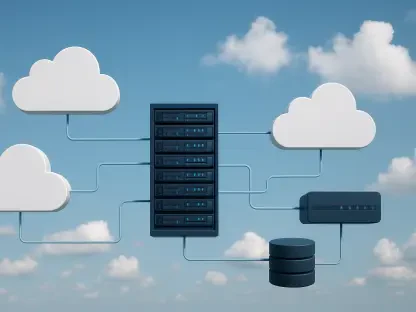

The sudden appreciation in the valuation of Meta Platforms has sent a clear message to the global financial community that the social media giant is no longer content with being just a platform for digital interaction. By announcing plans to sell its specialized artificial intelligence computing capacity to external enterprise customers, the company has effectively declared its intention to become a primary infrastructure player. This strategic pivot marks a significant moment in corporate history, as it seeks to monetize a massive data center network that was initially built to support internal AI development and the ambitious metaverse project. Offering high-performance compute power to third parties allows the firm to enter a market dominated by titans, potentially disrupting the existing hierarchy of cloud services. This transition suggests that the massive capital expenditures of previous years were not merely costs but the building blocks of a new revenue stream that could redefine the company’s long-term identity and financial stability.
A Strategic Evolution in Corporate Spending
Transforming Cost Centers into Revenue Streams
For a significant period, institutional investors expressed deep-seated concerns regarding the aggressive capital expenditure strategies adopted by Meta, with projections suggesting spending levels could reach an unprecedented $145 billion through the end of 2026. These outlays were previously viewed as high-risk investments into speculative technologies like the metaverse, which often lacked immediate or transparent returns on investment. However, by transitioning its internal infrastructure into a public-facing cloud offering, the organization has successfully reclassified these staggering expenses as potential profit centers. This shift addresses the long-standing skepticism from Wall Street by providing a tangible roadmap for how expensive hardware can generate recurring revenue. Instead of merely serving as a support system for internal social media features, the data centers now represent a versatile asset that can be leased to a global market hungry for processing power. This move effectively hedges against the volatility of the advertising market while maximizing the utility of every server rack installed.
Monetizing Massive Infrastructure Investments
Mark Zuckerberg has officially transitioned the concept of commoditizing excess capacity from a theoretical possibility to a central operational mandate within the corporate strategy. At the heart of this initiative is a massive inventory of high-end Nvidia GPUs, which are currently recognized as the gold standard for training and deploying large-scale generative AI models across various industries. By providing third-party access to these specific hardware clusters, Meta is meeting an urgent and growing global demand for specialized compute resources that traditional cloud providers are often struggling to fulfill. Many enterprises currently find themselves in a queue, waiting months for the hardware necessary to launch their own AI initiatives, creating a perfect entry point for a well-equipped new player. This operational shift not only provides immediate financial relief but also deepens the company’s influence over the broader technological ecosystem. By becoming the provider of choice for AI startups and research institutions, the firm secures a central position in the supply chain of future innovation.
Market Disruption and Competitive Impact
Carving a Niche in the AI Economy
Industry analysts are increasingly looking at this market entry as a highly logical solution to the ongoing challenges of massive hardware depreciation and rapid technological cycles. The global cloud infrastructure market represents a multi-hundred-billion-dollar opportunity that continues to expand as businesses of all sizes integrate machine learning into their core operations. Unlike established cloud giants that offer a broad and sometimes fragmented array of general-purpose services, Meta’s infrastructure is specifically engineered for the high-intensity workloads required by modern neural networks. This specialized, performance-first approach provides a distinct competitive advantage, particularly for clients who require massive parallel processing capabilities rather than standard web hosting or database management. By focusing on this specific niche, the company avoids a head-to-head battle on every front with established providers and instead captures the high-margin segment of the AI sector. This focus allows for more efficient resource allocation and a more streamlined service offering.
Challenging the Dominance of Established Providers
The arrival of such a well-capitalized competitor has already created significant ripples throughout the tech industry, particularly impacting the burgeoning sector of neocloud companies that specialize in GPU rentals. These smaller firms, which once thrived by filling the gaps left by major providers, now face a competitor with immense economies of scale and a vertically integrated stack that is difficult to replicate. Meta’s ability to leverage its existing power agreements, cooling technologies, and custom-designed server architectures allows it to offer pricing and performance levels that smaller competitors simply cannot sustain. As the company aggressively courts high-end AI research labs and large-scale enterprise clients, the resulting market pressure is likely to lead to a consolidation phase among niche providers. This shift in the competitive landscape forces every player to reconsider their value proposition, as the barrier to entry for large-scale AI compute continues to rise. The presence of a social media giant in this space fundamentally changes the cost structure of AI development for the industry.
Navigating Risks and Future Prospects
Resetting the Corporate Narrative
This move into the cloud computing sector serves as a vital narrative reset for the corporation following a period marked by intense legal scrutiny and several high-profile technical challenges. Throughout early 2026, the company navigated a series of complex lawsuits related to platform safety and unexpected glitches that occurred after human moderators were replaced with generative AI systems. By pivoting the public and investor focus toward cloud infrastructure and innovation, the leadership has successfully redirected the conversation toward fiscal responsibility and technological leadership. This strategic redirection provides a clear and tangible justification for the massive hardware investments of the past few years, effectively distancing the stock price from the fallout of previous regulatory setbacks. It creates a vision of the company as a foundational utility for the digital age, rather than just a curator of social content. This shift in perception is crucial for maintaining talent retention and attracting new partnerships in a highly competitive environment.
Actionable Strategies for Enterprise Scalability
The successful expansion into the enterprise cloud sector established a vital precedent for how high-scale technology firms repurposed internal assets to achieve market dominance. Organizations that analyzed their own specialized hardware discovered that niche performance often outweighed the convenience of general-purpose platforms. By maintaining a strict separation between consumer data and enterprise compute, the corporation managed to build the necessary trust for hosting sensitive proprietary models. Actionable steps for industry leaders involved auditing current infrastructure to identify surplus capacity that could be commoditized for external use. Furthermore, the focus on AI-optimized networking and cooling provided a roadmap for sustainable scaling in an era of increasing energy demands. Ultimately, the pivot proved that capital-intensive investments could be transformed into resilient revenue streams when aligned with global technological shortages. This transition effectively moved the industry away from a one-size-fits-all cloud model toward a more fragmented, performance-driven ecosystem.