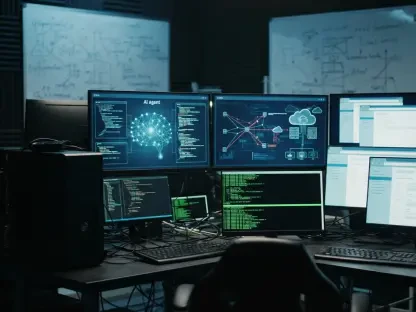

The emergence of Claude Sonnet 5 signifies a departure from traditional generative models by integrating a dynamic execution layer that permits independent decision-making across complex software environments. Unlike previous iterations that require constant human prompting to navigate multi-step tasks, this model utilizes advanced recursive reasoning to anticipate obstacles before they manifest. Large-scale enterprises are moving away from simple chatbots toward fully autonomous systems that manage entire procurement chains or software development cycles. This transition relies heavily on the model’s ability to interpret visual data from user interfaces while processing thousands of lines of documentation. The resulting autonomy reduces the operational burden on human supervisors, who previously spent hours refining prompts to achieve specific outcomes. By internalizing intent, Sonnet 5 bridges the gap between static response and active resolution, setting a new benchmark for utility.
Dynamic Navigation and Interface Mastery
The core of the revolution lies in how the model handles environmental uncertainty during long-running tasks. In the current 2026 landscape, agents are no longer confined to sandbox environments; they actively manipulate web browsers, terminal interfaces, and proprietary software with precision. This capability stems from a refined attention mechanism that prioritizes actionable elements within a visual field, allowing the agent to distinguish between a functional button and decorative graphics. When a developer assigns a bug fix to the agent, the system does not just suggest code. It initializes the local development environment, runs tests to reproduce the error, and iterates on the solution until the tests pass. Such high-fidelity interaction with external tools is supported by a massive expansion in the context window, which maintains the state of the entire project. This ensures that the agent never loses sight of its objective during the process.
Beyond mere interaction, the efficiency gains realized through this autonomous framework are reshaping industrial productivity metrics. Companies like Salesforce and Atlassian have begun embedding these capabilities directly into their platforms to automate high-level project management and data synthesis. This is not a superficial automation that follows a rigid script; rather, it is a fluid adaptation to the changing state of a database or a codebase. The model effectively functions as a digital colleague capable of interpreting nuanced feedback and adjusting its strategy without needing a full restart. For instance, in a 2026 marketing campaign rollout, the agent can analyze real-time engagement data across multiple social channels and automatically reallocate budget to the most effective ads while updating creative assets. This level of agency transforms the role of human workers into strategic architects who define the what, leaving the granular execution to the model.
Governance and Reliability in Unsupervised Workflows
As agents gain the power to act independently, the necessity for robust safety frameworks becomes paramount to prevent failures in critical systems. Anthropic has addressed this by embedding advanced Constitutional AI principles that govern the agent’s behavior during unsupervised periods. These guardrails are not external filters but are woven into the decision-making process, ensuring the model remains helpful and harmless even when faced with ambiguous instructions. If an agent identifies a potential security vulnerability while performing a routine update, it is programmed to halt execution and seek human verification rather than proceeding with a risky patch. This built-in caution is essential for the 2026-2028 deployment cycle, where trust in AI systems is the primary barrier to adoption. Furthermore, the model’s transparency has improved, offering detailed logs that explain the reasoning behind every action taken, which allows for thorough audits of every automated decision.
The integration of Claude Sonnet 5 into the corporate infrastructure necessitated a fundamental shift in how organizations approached digital security and task delegation. Leaders discovered that successful implementation required the establishment of clear operational boundaries and the development of specialized roles within teams to oversee autonomous workflows. These specialists focused on designing the high-level logic and ethical constraints that guided the systems through complex cycles. Companies that prioritized the creation of standardized interaction protocols saw a dramatic reduction in integration friction and a significant boost in operational agility. It was also found that investing in clean, well-documented data environments became a prerequisite for maximizing the model’s reasoning capabilities. Organizations that proactively updated their governance models prepared themselves for an era where AI agents operated as the primary engine of digital transformation, ensuring long-term sustainability.