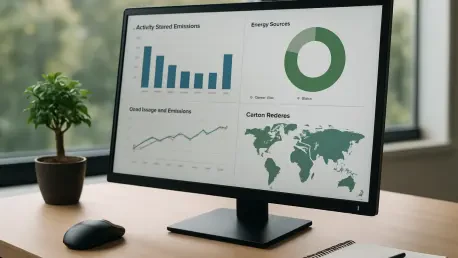

Financial services and healthcare providers increasingly demand primary data to satisfy rigorous Scope 3 emission reporting requirements for their digital supply chains. As regulatory environments tighten from 2026 to 2030, the reliance on vague financial estimates has become a significant liability for global enterprises. SAP is currently addressing this challenge by transitioning from spend-based carbon modeling to a more granular, activity-based methodology. This evolution allows businesses to move beyond broad assumptions and toward a “green ledger” that treats carbon with the same precision as financial capital. By providing product-level insights into energy consumption, SAP enables its customers to identify the actual environmental cost of their cloud operations. This transformation is not merely about compliance; it is about creating a baseline for operational efficiency that supports long-term corporate sustainability goals while maintaining high performance.
Implementing a Bottom-Up Energy Measurement Model
The technical foundation of SAP’s Cloud Product Carbon Footprint (PCF) lies in its sophisticated bottom-up energy model. Unlike older systems that distributed carbon based on contract value, this new framework calculates the actual electrical draw of the physical and virtual servers powering SAP’s vast cloud portfolio. By monitoring daily CPU utilization, memory allocation, and the Power Usage Effectiveness (PUE) of specific data center locations, SAP can generate a high-fidelity map of energy use. This raw data is then ingested into a graph-based dependency model that accurately traces hardware resources to specific customer tenants and software products. Such precision is vital in a world where hardware configurations vary wildly across regions. By leveraging primary data directly from the infrastructure layer, the system eliminates the inaccuracies of spend-based estimations, providing a transparent view of the energy required to run complex enterprise applications in real time.
Credibility within this framework is maintained through strict alignment with the Greenhouse Gas (GHG) Protocol ICT Sector Guidance. SAP has taken the uncommon step of making its full calculation methodology publicly accessible to ensure that auditors and corporate sustainability officers can verify the integrity of the data provided. This transparency is crucial for organizations that must defend their environmental disclosures to shareholders and regulatory bodies. The integration of the Configuration Management Database (CMDB) ensures that every physical asset and virtual environment is accounted for in the carbon inventory. By prioritizing measurement over estimation, the initiative provides the primary data needed for modern supply chains. This approach significantly reduces the margin of error in Scope 3 reporting, allowing financial and healthcare institutions to confidently integrate these metrics into their annual sustainability reports. The shift to activity-based data represents a new gold standard for cloud-based carbon accounting across the industry.
Strategic Optimization for Regulated Global Industries
For organizations operating in highly regulated sectors, the ability to see the specific emissions of a product like SAP S/4HANA Cloud or SAP Datasphere offers immediate strategic value. When a company can pinpoint “emissions hotspots” within its digital infrastructure, it gains the power to enact meaningful change. For instance, a global bank might discover that its workloads in a specific geographic region carry a higher carbon intensity due to the local energy grid’s reliance on fossil fuels. Armed with this activity-based data, the IT department can strategically shift noncritical processes to data centers powered by renewable energy or optimize its application architecture to reduce computational demand. This level of granularity empowers business leaders to integrate environmental impact directly into their operational decision-making processes. Instead of viewing sustainability as a separate compliance task, it becomes a core metric of IT performance, allowing companies to balance speed, cost, and carbon footprints more effectively.
SAP further validates its methodology by serving as its own “Customer Zero,” utilizing these same activity-based metrics to manage its internal cloud operations and corporate net-zero targets. By applying the PCF framework to its own software development and deployment cycles, the company identifies which products require better workload optimization and which infrastructure investments are yielding the best environmental returns. This internal adoption serves as a proving ground for the technology, ensuring that the insights provided to external customers are rooted in practical, tested operational realities. When SAP tracks its own progress from 2026 toward its upcoming environmental milestones, it uses the exact same dashboards and datasets available to its clients. This unified approach demonstrates a deep commitment to data integrity and ensures that the platform evolves based on real-world usage. By testing the methodology against its own massive cloud footprint, SAP ensures that the tool is robust enough to handle the complexities of the world’s largest enterprise environments.
Integrating Sustainability Into Enterprise Resource Planning
Accessing this granular sustainability data is now a streamlined process through the “Finance & Legal” section of the SAP for Me platform. Current coverage includes a strategic selection of core services such as SAP Integrated Business Planning, SAP HANA Cloud, and SAP Analytics Cloud. While the company continues to offer spend-based carbon intensity factors to maintain historical continuity for long-term reporting cycles, the activity-based PCF is clearly positioned as the definitive standard for the future. The product list expands quarterly, ensuring that as new cloud services are launched, they are immediately brought under the same rigorous measurement umbrella. This accessibility allows sustainability teams to pull report-ready data without needing deep technical expertise in cloud infrastructure or server management. By placing this information alongside financial and legal documentation, SAP signals that environmental impact is a fundamental component of the modern business contract, requiring the same level of scrutiny and accessibility as any other critical business metric.
The roadmap for these carbon transparency initiatives highlighted several overarching trends that dominated the tech industry’s approach to the climate crisis. Most significantly, the integration of AI-specific workloads within the PCF framework allowed organizations to account for the energy-intensive nature of modern intelligent systems. By pursuing ISO 14067 alignment and introducing higher time-resolution data, SAP solidified its framework as a reliable standard for global carbon accounting. These updates enabled customers to embed environmental data directly into their enterprise resource planning systems, effectively creating a “green ledger” for the digital age. This progress moved the conversation from simple compliance to a proactive strategy where carbon was managed with the same rigor as financial capital. Ultimately, the transition to activity-based measurement provided a necessary foundation for the next generation of sustainable software operations, ensuring that digital transformation remained compatible with global environmental responsibilities and long-term business resilience in an increasingly carbon-conscious marketplace.