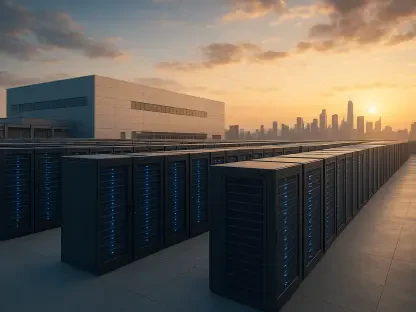

By securing high-level financing discussions with Apollo Global Management and Goldman Sachs, Oracle is positioning itself to bypass traditional organic cash flow constraints. This strategy signifies a total departure from the company’s historical identity as a database software specialist, recasting it as a vital infrastructure landlord for the artificial intelligence era. As of late 2026, the market has rewarded this pivot with a sustained stock rally that pushed valuations toward the $144 per share threshold. The organization has successfully leveraged its extensive enterprise footprint to create a cloud environment that rivals the scale of industry pioneers. By prioritizing the physical components of artificial intelligence, specifically the procurement of advanced silicon and the acquisition of stable power sources, the firm has addressed the primary bottlenecks currently facing global tech development. This comprehensive approach ensures that the platform is not just a secondary option for developers but a primary destination for high-stakes, compute-heavy projects that require both stability and massive scalability.
Strategic Growth: Scaling Financial and Physical Assets
Strategic Partnerships: The Tencent Alliance
One of the most significant indicators of this momentum was the finalization of a $7 billion agreement with the tech giant Tencent to lease approximately 100,000 AI chips across several Southeast Asian data centers. This five-year contract was uniquely structured to include a 30% upfront payment, which provided immediate liquidity to offset the massive capital expenditures required for hardware acquisition. For the industry, this deal represented more than just a revenue stream. It established a blueprint for how infrastructure providers can de-risk their expansion in a volatile market. By securing a major hyperscale client in a high-growth region, the corporation has gained unprecedented visibility into its future cloud earnings while solidifying its presence in the international AI ecosystem. The integration of such a high volume of specialized chips within the Oracle Cloud Infrastructure demonstrates a sophisticated logistical capability that few other companies can match, effectively raising the barrier to entry for potential competitors.
Hardware Procurement: Leveraging Institutional Capital
To sustain this rapid pace of expansion, the corporation has engaged in sophisticated financing maneuvers aimed at securing additional AI hardware before the close of 2026. These discussions with major financial institutions like Goldman Sachs allow the firm to utilize institutional capital to purchase state-of-the-art GPUs, ensuring that supply chain constraints do not hinder its growth trajectory. Although this aggressive deployment has contributed to a total debt profile of approximately $96.33 billion, the investment community has largely categorized these liabilities as productive debt. This perspective stems from the high-margin, recurring nature of the cloud infrastructure business, where the initial hardware cost is rapidly recovered through long-term service contracts. By maintaining a steady flow of new hardware into its data centers, the company keeps itself at the cutting edge of performance metrics, allowing it to attract elite AI developers who demand the most powerful compute environments currently available.
Ecosystem Expansion: Software and Storage Integration
Agentic Systems: The Evolution of Fusion Claw
Oracle has also moved beyond basic infrastructure by integrating sophisticated software capabilities directly into its ecosystem through the introduction of Fusion Claw. This managed runtime for agentic artificial intelligence is embedded within the Fusion Cloud Applications suite, providing a secure environment for autonomous systems to operate. Unlike traditional AI models that function primarily on a prompt-and-response basis, these agentic tools are designed to execute multi-step business processes without constant human intervention. By launching a fleet of 25 new AI-driven applications, the company has created a high level of customer stickiness, making it difficult for enterprises to migrate to other platforms once their workflows are automated. This shift into higher-value software services allows for premium pricing strategies and further differentiates the platform from competitors that focus solely on raw processing power. The integration of these tools shows a commitment to making AI both functional and accessible.
Storage Solutions: Integrating Enterprise Workloads
Data management remains a critical hurdle for large-scale AI projects, leading to a strategic partnership with NetApp to offer specialized, high-performance storage solutions. Through the OCI-native NetApp ONTAP service, enterprise clients can now manage massive datasets with the same level of performance and reliability they previously found in on-premises environments. This fully managed service is designed specifically to handle the heavy read and write requirements of modern machine learning models, ensuring that data bottlenecks do not degrade the performance of expensive AI chips. By providing a seamless migration path for the most complex data workloads, the corporation has removed a significant friction point for legacy enterprises looking to modernize their infrastructure. The synergy between high-speed compute and optimized storage reinforces the platform’s reputation as a holistic solution for data-intensive industries, including financial services and healthcare, where precision and speed are non-negotiable.
Infrastructure Resilience: Energy and Physical Logistics
Nuclear Commitment: Securing Baseload Power
Recognizing that energy availability is the ultimate constraint on data center expansion, the firm committed $300 million to secure carbon-free power from the Point Beach Nuclear Plant in Wisconsin. This subscription provides a stable and predictable baseload of electricity for the Project Lighthouse data center, insulating the company from the price volatility and unreliability often associated with traditional energy grids. As AI workloads continue to consume unprecedented amounts of power, this move into nuclear energy serves as both a strategic defense and a major environmental, social, and governance win. By locking in long-term power agreements, the company ensures that its infrastructure remains operational even as regional grids face increasing strain from the shift toward electrification. This focus on energy security has become a key differentiator for investors who are wary of the long-term sustainability of AI growth. It highlights a proactive approach to civil engineering that treats energy as a core component.
Tactical Execution: Navigating Construction Realities
Finally, the tactical management of physical infrastructure proved to be a decisive factor in the company’s recent operational success. While the Project Jupiter development in New Mexico encountered significant delays due to flooding and pipeline issues, the leadership responded by utilizing unconventional methods such as trucking in natural gas to maintain the construction schedule. This willingness to address logistical hurdles head-on allowed the firm to meet its deployment timelines despite external environmental challenges. In the end, the company established a comprehensive framework that successfully integrated financial agility, software innovation, and physical resilience. Businesses seeking to capitalize on this infrastructure-led economy started prioritizing long-term hardware availability and energy independence over short-term cost savings. Analysts observed that the shift toward stable, landlord-style cloud services became the standard for enterprise AI strategies. This evolution confirmed that the future of technology was as much about securing the physical world.