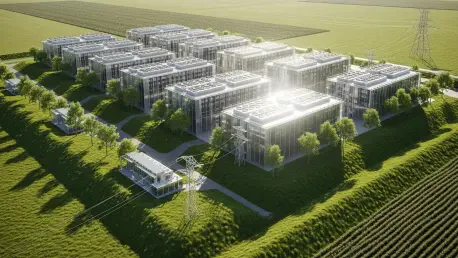

The sprawling green pastures of the British countryside, once defined by centuries-old stone walls and grazing livestock, now face an unprecedented transformation as global tech giants pivot toward massive artificial intelligence infrastructure. This shift is epitomized by a controversial proposal to construct a multi-billion dollar data center complex designed to house the latest generation of NVIDIA Blackwell processors and high-density liquid cooling systems. While the United Kingdom government champions this move as a critical step toward becoming an AI superpower, the local residents of the targeted rural districts view the development as an existential threat to their traditional way of life. The friction highlights a deepening divide between the urgent requirements of the digital economy and the preservation of natural landscapes. As these industrial monoliths demand vast amounts of electricity and land, the debate has evolved from a local planning dispute into a national conversation about the true cost of technological progress in a finite geographic space.
Industrial Impact: Resource Consumption and Economic Potential
The proposed facility is not merely a collection of server racks but a specialized hub capable of processing trillions of data points per second to train large language models and generative AI systems. Proponents of the project argue that securing such a high-capacity site is essential for domestic innovation, ensuring that British startups and research institutions do not fall behind international competitors. By centralizing high-performance computing resources within a single, massive campus, the project aims to optimize data latency and create a localized ecosystem for engineering talent. However, the sheer scale of the construction involves converting hundreds of acres of prime agricultural land into a sterile environment of concrete and steel. This physical footprint is necessary to accommodate the massive power transformers and cooling towers required to prevent the silicon chips from overheating under the intense workloads of neural network training, illustrating the physical reality of the cloud.
Beyond the immediate physical footprint, the data center poses significant challenges to the regional utility infrastructure, necessitating a complete overhaul of the local power grid to handle the projected load. Estimates suggest that at peak operation, the site could consume more electricity than a medium-sized city, raising concerns about potential energy shortages or price hikes for nearby residential areas. Water consumption is another critical point of contention, as traditional evaporative cooling methods require millions of gallons daily to maintain stable operating temperatures for the hardware. Although developers have promised to implement closed-loop systems and explore heat-recycling initiatives to warm local greenhouses, skeptics remain unconvinced that these measures will sufficiently offset the strain on local aquifers. This tension underscores the difficulty of integrating hyper-scale industrial operations into regions that lack the pre-existing industrial capacity to support them without significant disruption.
Strategic Evolution: Navigating Community Opposition and Sustainability
Local opposition groups have mobilized with surprising speed, organizing protests and legal challenges focused on the aesthetic and acoustic impact of the proposed data center structures. Residents argue that the characteristic quietude of the countryside will be shattered by the constant hum of industrial-grade ventilation fans and the persistent glow of security lighting during the night. The psychological toll of living next to a fortress-like facility is a central theme in the community’s grievances, as many moved to these areas specifically to escape the industrial density of urban centers. Furthermore, the promise of job creation is being scrutinized, with critics pointing out that while construction provides temporary employment, the long-term operation of a data center requires a relatively small number of highly specialized technicians. This reality suggests that the local economic benefits may be minimal compared to the permanent loss of biodiversity and the disruption of local ecosystems.
The conflict over the rural AI facility demonstrated that technical feasibility alone was no longer sufficient to secure the future of large-scale infrastructure projects in the modern era. Developers discovered that early and transparent engagement with local communities served as a vital component of the planning process, rather than an afterthought to be managed through legal maneuvering. Moving forward, the industry adopted a philosophy of infrastructure as a neighbor, where facilities provided tangible benefits such as district heating or public park restoration to the surrounding areas. Planning agencies established more rigorous criteria for environmental impact assessments, ensuring that the ecological cost of data storage was fully accounted for before the first shovel hit the ground. Ultimately, the successful integration of artificial intelligence into the national landscape required a shift toward decentralized, high-efficiency designs that minimized the physical and social footprint.