
The deployment of custom Maia 200 chips has enabled Microsoft to deliver nearly twice the tokens per watt for internal applications compared to previous hardware generations, signifying a significant shift in the artificial intelligence investment cycle. This milestone moves away from simple infrastructure accumulation toward a sophisticated focus on operational readiness. For several quarters, the primary concern for the industry was whether cloud providers would commit enough capital to build the foundation for the AI revolution. Today, that question has been settled, and the narrative has evolved to address the “readiness gap.” This term describes the ability of a company to transform massive capital expenditures into revenue-generating assets before high depreciation costs begin to impact the balance sheet. Microsoft’s latest performance serves as a benchmark for how a major firm can navigate supply chain delays while maintaining aggressive growth.
Maximizing Infrastructure Efficiency
Performance Strategy: Innovative Software Solutions Boost Performance
Azure’s 48% growth rate this quarter significantly outperformed expectations, even as the company reported a notable miss in capital expenditure. Microsoft reported $45.2 billion in capex, falling nearly $5.5 billion short of the anticipated consensus. In traditional cloud economics, a drop in spending usually signals an impending slowdown in growth, as capacity often serves as the primary limiter for revenue. However, management characterized this gap as a “timing signal” caused by delays in third-party GPU deliveries rather than a lack of market demand. To compensate, the organization successfully broke the linear relationship between physical construction and revenue generation. By implementing advanced scheduling and model optimization, Microsoft extracted more performance from its existing hardware fleet. This approach allowed the platform to serve a growing number of customer requests without requiring an immediate influx of new chips.
Beyond optimizing high-end accelerators, the organization repurposed underused CPU capacity to handle specific billable AI tasks that do not require extreme parallelism. This tactical shift effectively turned legacy or idle hardware into a high-margin profit center, providing a crucial buffer against global supply chain fluctuations. By offloading less intensive inference tasks to these modified clusters, the company freed up its most expensive GPUs for demanding training scenarios. This architectural flexibility is essential in a market where hardware procurement remains volatile and power consumption is scrutinized. Refined model architectures and sophisticated pricing strategies also played a role, increasing the revenue generated per token across the stack. These software-led efficiencies act as a virtual expansion of the data center footprint, ensuring that Azure remains a destination for developers even when expansion faces temporary supplier bottlenecks.
Global Expansion: Advancements in Physical Logistics and Silicon
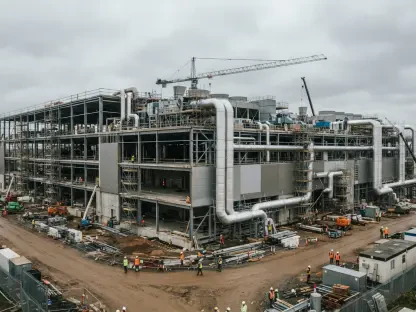
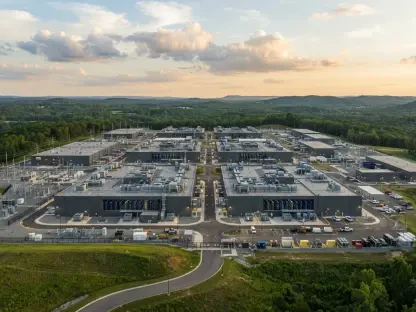
Despite logistical challenges, the physical expansion of the global cloud footprint continued with 24 new data centers added across five continents. To combat supply chain lag, engineering teams prioritized physical logistics, achieving a 20% reduction in “dock-to-live” time for new server systems. This efficiency means that once a rack arrives at a facility, it is integrated into the active network much faster than in previous cycles. The deployment of advanced NVIDIA Vera Rubin GPUs has also commenced, providing a significant boost to the raw compute power available to enterprise customers. These facilities are designed with next-generation high-density cooling systems tailored for peak performance.